Femara
In brief
- In pharmacies Femara is a prescription-only medicine and must be supplied with a valid prescription in the UK and most regulated markets; although some sellers may claim to supply it without a receipt, that practice is not legal or advised.
- Femara (letrozole) is used to treat hormone receptor‑positive breast cancer in postmenopausal women (adjuvant, extended adjuvant and advanced/metastatic); it is a non‑steroidal aromatase inhibitor that lowers oestrogen production by blocking peripheral conversion of androgens to oestrogens. It is sometimes used off‑label for ovulation induction under specialist supervision.
- The usual adult dose is 2.5 mg once daily by mouth; adjuvant/extended therapy is commonly given for 5 years (may form part of up to 10 years total) and treatment for advanced disease continues until progression or unacceptable toxicity. Not indicated for premenopausal women or children.
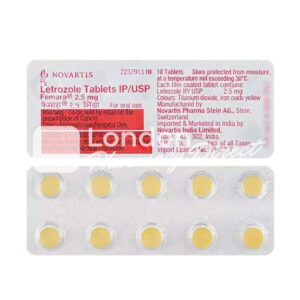
- Oral administration as 2.5 mg film‑coated tablets (blister packs or bottles).
- Letrozole reduces circulating oestrogen levels within about 24 hours; clinical or symptomatic benefits may take several weeks to become apparent.
- Plasma half‑life is approximately 2 days (around 48 hours); once‑daily dosing maintains aromatase inhibition and treatment is continued as clinically indicated.
- Avoid excessive alcohol — alcohol can worsen fatigue, hot flushes and may negatively affect bone health; discuss alcohol use with your physician.
- The most common side effect is hot flushes.
- Would you like to try femara without a prescription?
Basic Femara Information
- INN (International Nonproprietary Name): Letrozole.
- Brand Names Available In United Kingdom: Femara, 2.5 mg tablets, supplied in packs of 14 or 30 tablets.
- ATC Code: L02BG04 — Aromatase Inhibitors.
- Forms & Dosages: Oral film-coated tablets 2.5 mg; typical packaging includes blisters or bottles (7, 10, 14, 28, 30 or 100 tablets).
- Manufacturers In United Kingdom: Novartis Pharma AG (originator) and licensed generic producers such as Sandoz among other authorised suppliers.
- Registration Status In United Kingdom: Femara is authorised and marketed in the UK as a 2.5 mg tablet formulation and is approved in Europe for hormone receptor–positive breast cancer in postmenopausal women.
- OTC / Rx Classification: Prescription Only (Rx). Letrozole/Femara is never available over the counter.
Everyday Use & Best Practices
Morning Vs Evening Dosing
Patients often ask whether to take Femara in the morning or evening.
The standard adult dose is 2.5 mg once daily, taken orally.
Choose a time you can reliably repeat every day to reduce missed doses.
Many UK patients take Femara in the morning as part of a pill‑box routine, alongside other daily medicines.
Some patients prefer an evening dose if hot flushes or sleep disturbance occur at night.
If a dose is missed, take it as soon as you remember unless it is nearly time for the next dose, in which case skip the missed dose.
Never double the dose to make up for a missed tablet.
Taking With Or Without Meals (UK Diet Habits)
- Letrozole can be taken with or without food, so pair it with a regular UK breakfast habit such as toast and tea or with the evening meal.
- When taking multiple medicines, place Femara with other daily tablets in a labelled dosette box but keep the original blister in a dry place to protect from moisture.
- Store tablets below 30°C and avoid leaving blisters in bathrooms or hot cars during summer trips.
- For holiday plans or late shifts, link the dose to a fixed daily activity (for example, morning tea) to preserve routine.
Missed Dose Checklist
- If you remember soon after the missed time, take the tablet straight away.
- If it is almost time for the next dose, skip the missed tablet and take the next as scheduled.
- Do not take two tablets on the same day to make up for a missed dose.
Safety Priorities
Who Should Avoid It (MHRA Warnings)
Femara is prescription-only and is contraindicated in pre‑menopausal women.
Pregnancy and breastfeeding are absolute contraindications because of teratogenic risk.
Do not use letrozole for ovulation induction without specialist supervision.
Tell your GP or oncology team if your menopausal status is uncertain.
If you have known hypersensitivity to letrozole or any tablet excipients, stop treatment and seek immediate care for severe allergic symptoms.
Activities To Limit (Driving, Work Safety)
Letrozole can cause fatigue, dizziness or visual disturbance in some people.
Until you know how Femara affects you, avoid driving heavy machinery or safety‑critical work.
If joint pain or musculoskeletal symptoms affect mobility, contact occupational health or your GP to request workplace adjustments.
Keep a symptom diary noting fatigue, dizziness and pain to discuss at clinic reviews.
Contraindication Checklist
- Pre‑menopausal women — do not use.
- Pregnancy and breastfeeding — do not use.
- Known allergy to letrozole or excipients — stop and seek help.
Dosage & Adjustments
General Regimen (NHS Guidance)
The standard regimen for adults is letrozole 2.5 mg once daily by mouth.
This dosing applies for adjuvant therapy, first‑line treatment of advanced or metastatic disease, and extended adjuvant therapy.
Extended adjuvant therapy commonly totals five years and may be longer as advised by an oncologist.
Femara is prescription-only and typically dispensed in 14 or 30 tablet packs in the UK.
Special Cases (Elderly, Comorbidities)
| Indication | Typical Dose | Notes |
|---|---|---|
| Adjuvant (Early Breast Cancer) | 2.5 mg once daily | Common course up to 5 years; monitor bone health. |
| Advanced/Metastatic Disease | 2.5 mg once daily | Continue until progression or unacceptable toxicity. |
| Extended Adjuvant | 2.5 mg once daily | May be extended per specialist advice. |
Monitoring Checklist
- No routine dose adjustment usually required for the elderly.
- Mild–moderate hepatic or renal impairment: standard dosing generally applies.
- Severe liver disease or creatinine clearance below 10 ml/min requires specialist review.
- Pre‑existing osteoporosis needs baseline DEXA and active bone protection (calcium, vitamin D, and bisphosphonates if indicated).
- Not indicated for children.
User Testimonials
Positive Reports From UK Patients
“My oncology nurse explained everything and the once‑daily tablet fitted easily into my morning routine,” is a typical anonymised comment from UK forums.
Many patients report that Femara provides effective control of hormone‑sensitive disease when it is indicated by the oncology team.
Patients appreciate the convenience of 2.5 mg once‑daily tablets and the availability in 14 or 30 tablet blister packs.
Some describe hot flushes that are manageable with lifestyle measures or timing adjustments.
Common Challenges (Patient.info, NHS Forums)
- Arthralgia or joint pain that can limit exercise and daily activities.
- Ongoing fatigue that may take weeks to settle after starting treatment.
- Concerns about bone density and the need for DEXA scans and bone‑protective therapy.
- Noted changes in cholesterol in some patients, prompting dietary advice from a dietitian.
Pros
- Once‑daily dosing is simple.
- Effective for postmenopausal, hormone receptor–positive breast cancer when prescribed appropriately.
- Wide availability of generics reduces cost for private prescriptions.
Cons
- Joint pain, fatigue and bone loss are common concerns.
- Prescription charge complexity in England compared with free prescriptions in Scotland, Wales and Northern Ireland can cause confusion.
Buying Guide
Pharmacy Sources (Boots, LloydsPharmacy, Superdrug)
Femara (letrozole 2.5 mg) is prescription-only and dispensed by community pharmacies including Boots, LloydsPharmacy and Superdrug, and by hospital pharmacies.
Patients usually collect from local branches or use NHS repeat dispensing arrangements where available.
Reputable online pharmacies can deliver on valid prescriptions; always use MHRA‑regulated retailers and check packaging for 2.5 mg film‑coated tablets in blister packs.
In our online pharmacy, femara is available without a prescription, with discreet delivery to United Kingdom in 5-14 days.
Price Comparison (NHS Prescription Charge Vs Private)
| Source | Cost Notes | Prescription Rules |
|---|---|---|
| NHS Community Pharmacy | Standard NHS prescription charge applies in England unless exempt; free in Scotland, Wales and Northern Ireland. | Requires NHS or private prescription depending on local shared‑care. |
| Hospital Pharmacy | Often supplied directly to patients under oncology clinic care. | Supplied on clinic prescription pathways. |
| Private Pharmacy / Online | Private prescription cost varies; generic letrozole usually cheaper than brand Femara. | Requires valid prescription and use of regulated supplier. |
Safe Online Purchase Checklist
- Use only MHRA‑regulated online pharmacies.
- Check that the product is 2.5 mg film‑coated tablets in blister packs.
- Request a prescription cost estimate from the pharmacist before ordering privately.
- Consider hospital supply if you are under an oncology clinic and eligible for clinic dispensing.
What’s Inside & How It Works
Ingredients Overview
- Active Ingredient: letrozole (INN), 2.5 mg per tablet.
- Formulation: oral film‑coated tablets only; no injectable or topical forms are authorised for patients.
- Excipients vary by manufacturer; check the patient leaflet for allergy information.
- Storage: keep in original blister, protect from moisture and store below 30°C.
Mechanism Basics Explained Simply
| ATC Code | Drug Class |
|---|---|
| L02BG04 | Aromatase Inhibitor (non‑steroidal) |
Letrozole blocks the aromatase enzyme that converts androgens to oestrogens in postmenopausal women.
Lowered oestrogen levels reduce stimulation of oestrogen‑dependent (hormone receptor‑positive) breast cancer cells.
The result is reduced tumour growth signal and clinical benefit in the licensed indications.
Main Indications
Approved Uses (MHRA Listing)
Letrozole is licensed for hormone receptor‑positive breast cancer in postmenopausal women.
Approved settings include adjuvant treatment for early breast cancer, first‑line therapy for advanced or metastatic disease, and extended adjuvant therapy commonly up to five years.
Typical adult dose across these indications is 2.5 mg once daily.
Off‑Label Uses In UK Clinics
| Licensed Indications | Off‑Label Use | Notes |
|---|---|---|
| Adjuvant and Advanced Breast Cancer | Not applicable | Standard licensed use in postmenopausal women. |
| — | Fertility / Ovulation Induction | Occasional specialist off‑label use; must be under strict medical supervision and monitoring. |
Any off‑label prescribing should be discussed in detail with the treating clinician and documented with appropriate consent and monitoring.
Interaction Warnings
Food Interactions (Alcohol, Tea/Coffee)
Letrozole has no major food interactions and can be taken with or without meals.
Advise moderation of alcohol because it can worsen fatigue and hot flushes.
Caffeine from tea or coffee may aggravate palpitations or sleep disturbance and could indirectly worsen side effects such as anxiety or insomnia.
Drug Conflicts (MHRA Yellow Card Reports)
Letrozole is metabolised by hepatic pathways and may be affected by potent CYP450 inducers or inhibitors.
Flag concomitant drugs such as some anticonvulsants, strong CYP inducers or inhibitors, and review statins and anticoagulants with the prescriber as needed.
Report suspected interactions or adverse drug reactions via the MHRA Yellow Card scheme.
| Action | Where To Report |
|---|---|
| Suspected Side Effect Or Interaction | MHRA Yellow Card Scheme and inform your oncology team or pharmacist. |
Latest Evidence & Insights
Key UK & EU Studies 2022–2025
- Recent trials and reviews reaffirm letrozole’s benefit in adjuvant treatment for postmenopausal, hormone receptor‑positive breast cancer.
- Evidence supports extended therapy to five years and, in selected patients, longer durations when balanced against side‑effect burden.
- Studies consistently highlight bone density loss risk with aromatase inhibitors and recommend baseline and interval DEXA scanning.
- Comparative analyses place letrozole alongside anastrozole and exemestane with broadly similar efficacy; choice is often guided by tolerability and comorbidities.
| Comparator | Noted Safety Endpoints |
|---|---|
| Anastrozole | Similar efficacy; musculoskeletal side effects differ slightly by patient. |
| Exemestane | Steroidal profile; different bone and lipid impact in some studies. |
Alternative Choices
NHS Prescribing Alternatives With Pros/Cons Checklist
Alternatives available on the NHS include other aromatase inhibitors such as anastrozole and exemestane, and the SERM tamoxifen in appropriate contexts.
- Anastrozole — similar efficacy to letrozole; consider if tolerability differs.
- Exemestane — steroidal aromatase inactivator; may be chosen for individual patient characteristics.
- Tamoxifen — used in pre‑ or perimenopausal women and where bone density preservation is a priority.
Practical Switching Advice
Switching between aromatase inhibitors is arranged by oncology teams and documented in shared‑care letters.
A washout period is not routinely required unless specified by a specialist.
After a switch, monitor symptoms closely and consider repeat DEXA scanning if bone risk is present.
Ensure clear prescription documentation to avoid gaps in supply at community pharmacies.
Regulation Snapshot
MHRA Approval & NHS Prescribing Framework
Letrozole (Femara) is authorised in the UK and used within MHRA and NHS oncology frameworks for postmenopausal hormone receptor‑positive breast cancer.
Specialist units normally initiate therapy with possible shared‑care follow‑up arranged with GPs.
The product is prescription‑only and supplied as 2.5 mg film‑coated tablets.
International Regulatory Notes (Quick)
Letrozole is approved by major regulators including EMA and FDA and is available in many global markets under Femara and various generic names.
Generics from manufacturers such as Sandoz are available in the UK; always check product labelling and ensure authorised supply chains.
Patient Rights Checklist
- Ask for written information and the patient leaflet when the medicine is dispensed.
- Expect explanation of why letrozole is being prescribed and what monitoring will be done.
- Request a shared‑care letter or care plan summarising who manages prescriptions and monitoring.
FAQ Section
Common UK Patient Questions
- Can I drive on Femara? — Usually yes; avoid driving until you know whether fatigue or dizziness occurs.
- Will it affect my bones? — Aromatase inhibitors can reduce bone density; baseline DEXA and calcium/vitamin D and possible bisphosphonate therapy may be advised.
- Can I take it with other medicines? — Check with your pharmacist or GP about potential CYP interactions; report suspected problems via the MHRA Yellow Card.
- Is it free on the NHS? — Prescription charges apply in England unless you are exempt; prescriptions are free in Scotland, Wales and Northern Ireland.
How To Report Side Effects And Where To Get Support
Report adverse effects to your oncology team and consider submitting a report to the MHRA Yellow Card scheme for national pharmacovigilance.
For emotional or practical support, contact NHS Macmillan services and local cancer support centres.
Your local community pharmacist can provide advice about drug interactions, side‑effect management and where to seek urgent care.
Guidelines For Proper Use
UK Pharmacist Counselling Style
Pharmacists should confirm the indication and menopausal status and check for contraindications such as pregnancy or pre‑menopausal status.
Review concomitant medicines for interactions and advise on bone health monitoring, including DEXA scans and supplements where appropriate.
Provide the patient leaflet and reinforce missed‑dose and overdose guidance: take a missed dose when remembered unless it is almost time for the next dose, and in the event of overdose provide supportive care and monitoring.
NHS Patient Support Advice
Advise patients on lifestyle measures to protect bone and cardiovascular health: regular weight‑bearing exercise, smoking cessation, a balanced diet and alcohol moderation.
Encourage patients to record new symptoms such as arthralgia, persistent fatigue or mood changes and to contact their oncology team or GP promptly for concerning issues.
Recommend reporting adverse effects to the MHRA Yellow Card scheme and using local support groups for practical and emotional help.
Delivery Across United Kingdom
| City | Region | Delivery Time |
|---|---|---|
| London | Greater London | 5-7 days |
| Birmingham | West Midlands | 5-7 days |
| Manchester | Greater Manchester | 5-7 days |
| Glasgow | Scotland | 5-7 days |
| Leeds | West Yorkshire | 5-7 days |
| Edinburgh | Scotland | 5-7 days |
| Bristol | South West England | 5-7 days |
| Liverpool | Merseyside | 5-9 days |
| Newcastle Upon Tyne | North East England | 5-9 days |
| Sheffield | South Yorkshire | 5-9 days |
| Cardiff | Wales | 5-9 days |
| Belfast | Northern Ireland | 5-9 days |
| Norwich | East of England | 5-9 days |
Final Notes
Femara (letrozole 2.5 mg) is a well-established aromatase inhibitor used in postmenopausal hormone receptor‑positive breast cancer when prescribed by a clinician.
Always follow the oncology team’s instruction on duration and monitoring, and keep a record of symptoms between clinic visits.
Pharmacists are a good first point of contact for queries about dosing routines, storage and minor side‑effect management.
For urgent or severe reactions, seek immediate medical attention or contact your oncology unit without delay.