Amantadine
In stock
100mg
from 34,34 £
In brief
- Amantadine treats Parkinson’s disease by increasing dopamine activity and blocking NMDA receptors; its first use, though, was against viruses.
- Sold in a single 100 mg strength, with 30, 60, 90, 120, 180 or 360 per pack.
- Under UK law it is a prescription-only medicine, and the licensed forms are capsules of 100 mg and an oral solution.
Amantadine: an old antiviral with a role in Parkinson’s disease
Amantadine started out as an antiviral; UK indications include Parkinson’s disease and, for some products, herpes zoster. It stimulates dopamine release and blocks NMDA receptors in the brain, and a clinician may use it on its own or beside levodopa to ease stiffness, slowness and tremor. The treatment is for symptoms; the underlying disease carries on regardless.
Listing details and the question of dose form
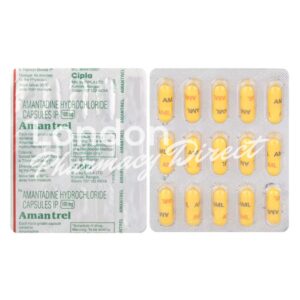
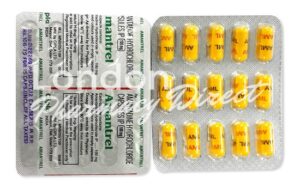
The only strength is 100 mg. Quantities: 30, 60, 90, 120, 180 and 360. UK amantadine comes as capsules and an oral solution, but the formulation of the imported stock must be confirmed from its packaging. Read the strip to confirm how much active ingredient each dose contains. Imported generics can come in packaging with a leaflet written for a different country.
How the SmPC sets the dose
Week one: 100 mg once daily. From then on: 100 mg twice daily as a rule, with any further increase separated from the last by seven days or more. Daily maximum: 400 mg, and the SmPC points out that doses above 200 mg are more likely to be toxic. People in older age groups start low. Because the kidneys remove amantadine, a creatinine clearance of 15 to 35 ml/min limits the dose to 100 mg every two or three days, and under 15 ml/min it should not be taken. When treatment ends, the dose is lowered gradually (halving it each week is one example), since a sudden stop may bring the symptoms back or cause a neuroleptic malignant-like syndrome.
Who is advised against taking it
History of seizures, a past stomach ulcer, severe kidney disease, pregnancy and allergy to any component all rule it out; also on the SmPC’s list are breastfeeding and angle-closure glaucoma that has not been treated. A psychiatric illness, or a heart, liver or kidney problem, calls for added caution. Patients with heart failure may notice swollen ankles from about the fourth week. The SmPC also warns that overdose is dangerous, so someone at risk of suicide should receive only a very small supply.
Interactions and the effects people report
Used with anticholinergic drugs or levodopa, amantadine can increase the adverse effects of each. Taken with antipsychotics, psychotic symptoms might intensify. Alcohol and other medicines acting on the brain add to central nervous system toxicity, and a thiazide diuretic combined with a potassium-sparing diuretic can delay amantadine’s clearance. The effect most characteristic of the drug is livedo reticularis, a lacy purple mottling of the skin. Beyond that come a dry mouth, queasiness, loss of appetite, constipation, light-headedness when standing up, a pounding heart, headaches, poor sleep, anxiety, depressed mood and sweating. The cornea can swell, which blurs sight, and compulsive behaviour such as gambling has been reported. Anyone feeling drowsy or confused should stay off the road.
Prescription status in the UK
Amantadine can be supplied in the UK only on prescription, as 100 mg capsules or as an oral solution containing 50 mg in 5 ml. A neurologist, Parkinson’s nurse or GP is the right person to start, change or stop it.
Practical points to bring to a clinic
As trouble sleeping is a known effect, the time of day for each dose can make a difference, and a dose late in the evening may not suit everybody. New confusion, hallucinations, strange urges, ankle swelling or altered eyesight deserve a prompt mention. Never let supplies run out and then simply stop; ask how to come off gradually. A written record of each dose and time is useful at appointments.