Colchicine
In brief
- Colchicine is a prescription-only medicine (POM) in the UK and should be used under medical supervision.
- Colchicine is used to treat acute gout attacks, help prevent gout flares, and manage familial Mediterranean fever; it also has use in pericarditis in some settings. It works by reducing inflammation, especially by inhibiting neutrophil activity and the inflammatory response to urate crystals.
- The usual dose depends on the condition: for an acute gout flare in adults, 500 micrograms two to four times daily until symptoms are relieved (maximum 6 mg per course); for prevention of gout flares, 500 micrograms once or twice daily; for familial Mediterranean fever, typically 1.2–2.4 mg daily in divided doses.
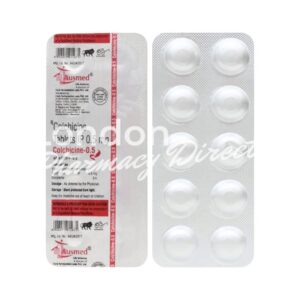
- The form of administration is oral, as 500 microgram (0.5 mg) tablets.
- Colchicine may begin working within about 1 to 2 hours for gout pain relief, although the full anti-inflammatory effect may take longer.
- The duration of action is usually several hours, and for prevention it is taken daily over a long-term course as directed by a doctor.
- Alcohol is best avoided or kept to a minimum, especially during a gout flare, as it can worsen gout and may increase stomach irritation.
- The most common side effects are diarrhoea, nausea, abdominal pain and vomiting.
- Would you like to try colchicine without a prescription?
Basic colchicine information
- INN (international nonproprietary name): Colchicine
- Brand names available in the United Kingdom: generic colchicine 500 microgram tablets
- ATC code: M04AC01
- Forms and dosages: Tablets 500 micrograms (0.5 mg)
- Manufacturers in the United Kingdom: Various generic manufacturers
- Registration status in the United Kingdom: Approved and listed as prescription only under MHRA oversight
- OTC / Rx classification: Prescription-only medicine (POM)
Everyday use and best practices
Worried about when to take colchicine, or whether it should be taken with breakfast, tea, or at night?
For most people using colchicine daily use for prevention, the key rule is simple: take it exactly as prescribed and keep the timing consistent.
That often means a fixed time every day, which makes it easier to remember alongside normal routines such as breakfast, a cuppa, or brushing your teeth.
For an acute gout flare, the usual regimen is 500 micrograms two to four times daily until symptoms are relieved, up to a maximum of 6 mg per course.
It can be taken with or without food, but a light meal may help if nausea appears.
If you are using colchicine for gout, do not repeat the acute flare dose within 3 days unless a prescriber tells you to.
- Keep the dose tied to one routine, such as breakfast or bedtime.
- Take with food if your stomach feels unsettled.
- Use the same pharmacy for repeat supply checks where possible.
- Ask a community pharmacist for reassurance on directions.
Safety priorities
Could colchicine cause serious harm if it is not the right medicine for you?
Yes, it can.
Colchicine is a prescription-only medicine in the UK, approved and listed by the MHRA, and toxicity can become serious quickly if the dose is not adjusted properly.
- Avoid colchicine if you have severe renal impairment.
- Avoid colchicine if you have severe hepatic impairment.
- Do not use it if you have a known hypersensitivity to colchicine or excipients.
- Do not take it with strong CYP3A4 inhibitors or P-gp inhibitors.
That last point matters because these combinations can raise colchicine levels and push a person into colchicine toxicity very quickly.
Common side effects such as diarrhoea, vomiting, fatigue, muscle pain, and rash can affect commuting, office work, caring duties, or shift work.
Extra caution is sensible if your job involves driving, ladders, machinery, or long hours on your feet.
If overdose symptoms appear, seek urgent help at once, because overdose can be fatal.
UK patients often speak to a pharmacist first, so check with a pharmacist if a new medicine is started, especially antibiotics, antifungals, or heart medicines.
Dosage and adjustments
Is the right dose the same for gout, FMF, and pericarditis?
No, the dose depends on the condition, not just the tablet strength.
| Condition | Usual dose | Who needs adjustment |
|---|---|---|
| Acute gout flare | 500 micrograms two to four times daily until relief; max 6 mg per course | Older adults, kidney or liver problems |
| Prevention of gout flare | 500 micrograms once or twice daily | Older adults, renal or hepatic impairment |
| Familial Mediterranean fever | 1.2–2.4 mg/day in divided doses | Children, elderly, renal or hepatic disease |
| Pericarditis | 500 micrograms once or twice daily with NSAIDs | Specialist-led adjustments may be needed |
For children, colchicine is for FMF only, usually from age 4 years, starting at 0.3–0.6 mg/day and titrated carefully.
Older adults generally need a lower starting dose, and severe renal disease or severe liver disease may mean colchicine should be avoided altogether.
Colchicine tablets are 500 micrograms; the dose is based on the condition and the prescriber’s plan, not on convenience alone.
Legal status and availability in the UK
Colchicine is a prescription-only medicine (POM) in the UK.
In our online pharmacy, colchicine is available without a prescription, with discreet delivery to the United Kingdom in 9–21 days.
What is inside and how it works
What does colchicine actually do once you take it?
The INN is colchicine, and the ATC code is M04AC01.
It is an antigout medicine with no effect on uric acid metabolism.
That means it does not lower uric acid in the way allopurinol or febuxostat do.
Instead, it helps reduce the inflammatory response that causes pain, heat, redness, and swelling during a flare.
In the UK, colchicine is supplied as 500 microgram (0.5 mg) tablets.
A simple way to picture it is:
Flare starts → colchicine reduces inflammation → symptoms settle
Main indications
Why has colchicine been prescribed for you?
- Gout — licensed use for acute attacks and prevention.
- Familial Mediterranean fever — specialist-led use.
- Pericarditis — used with NSAIDs, and often specialist-led.
- Other inflammatory uses — sometimes discussed off-label in clinics.
In the UK, colchicine is a prescription-only medicine (POM).
Some specialists use it off-label for pericarditis, and research has also looked at cardiovascular inflammation after myocardial infarction, but that is not routine self-treatment.
Most patients want two practical answers: why it was prescribed, and how long they will need it.
For gout, treatment may be short-term for a flare or longer-term as prophylaxis.
For FMF, treatment is often lifelong or as directed by the physician.
Interaction warnings
Can tea, coffee, alcohol, or other medicines affect colchicine?
| Item | Why it matters | What to do |
|---|---|---|
| Tea and coffee | No major interaction is known | Usually fine in normal amounts |
| Alcohol | Can worsen gout and upset the stomach | Limit intake, especially during a flare |
| Strong CYP3A4 inhibitors and P-gp inhibitors | Can raise colchicine levels and cause toxicity | Check before starting any new medicine |
| Antibiotics, antifungals, HIV medicines, some heart drugs | May interact depending on the product | Ask a pharmacist or GP first |
Rich weekend drinking or binge drinking can trigger gout attacks, which means colchicine works better as part of a wider plan rather than as the only strategy.
Always check every new prescription, over-the-counter medicine, and herbal product.
UK Yellow Card reporting exists because interaction problems do happen, and pharmacists are often the first place people spot them.
Alternative choices
Is colchicine always the best option, or are there NHS alternatives?
- Allopurinol — best for long-term urate reduction, not for acute flare relief.
- Febuxostat — also lowers uric acid long term, usually with monitoring.
- Probenecid — uricosuric option in selected patients.
- NSAIDs or corticosteroids — may be used for certain flares.
For an acute flare, colchicine can be a useful option.
For long-term gout control, allopurinol or febuxostat is usually about lowering uric acid rather than calming the flare itself.
Checklist:
- Best for acute flare: colchicine, NSAIDs, or corticosteroids depending on the patient.
- Best for long-term urate reduction: allopurinol or febuxostat.
- Needs monitoring: allopurinol, febuxostat, and colchicine in higher-risk patients.
- May not suit kidney disease: some options need dose changes or avoidance.
Regulation snapshot
Is colchicine approved in the UK?
| Point | UK context |
|---|---|
| Regulatory status | Approved and listed by the MHRA |
| Supply route | NHS or private prescription only |
| Prescribing focus | Kidney function, liver function, and interaction risk are checked first |
| Brand variability | Different generics and pack styles may be supplied by the pharmacy |
Colchicine is a long-established gout medicine, and in the UK it is prescription-only.
Frequently asked questions
Can I take colchicine with food?
Yes.
It can be taken with or without food, and a light meal may help if nausea occurs.
What if I miss a dose?
Take it as soon as you remember unless it is nearly time for the next dose.
Never double up.
Why was my dose reduced because of my kidneys?
Kidney function affects how colchicine is handled by the body, so a lower dose may be safer.
Can I get it on the NHS?
Yes, if it is prescribed.
Overdose symptoms need emergency help straight away.
Guidelines for proper use
How should colchicine be used safely day to day?
- Take exactly as prescribed.
- Tell every clinician and pharmacist about kidney or liver problems.
- Check for interaction risks before starting any new medicine.
- Keep tablets in the original pack.
- Store at 15–30°C, away from moisture and light.
- Do not use colchicine as an over-the-counter remedy.
If symptoms worsen or side effects appear, contact your GP, NHS 111, or a community pharmacist.
Many UK patients prefer pharmacist advice first, especially when sorting out repeat prescriptions or new side effects.
Final checklist:
- Storage: original packaging, room temperature, away from moisture.
- Dose timing: same time each day if prescribed daily.
- Missed doses: take when remembered unless close to the next dose.
- Side effects: watch for diarrhoea, vomiting, fatigue, muscle pain, or rash.
- Urgent red flags: overdose symptoms, severe weakness, or worrying interactions.
Delivery across the United Kingdom
| City | Region | Delivery time |
|---|---|---|
| London | England | 9–21 days |
| Birmingham | England | 9–21 days |
| Manchester | England | 9–21 days |
| Leeds | England | 9–21 days |
| Liverpool | England | 9–21 days |
| Newcastle upon Tyne | England | 9–21 days |
| Sheffield | England | 9–21 days |
| Bristol | England | 9–21 days |
| Edinburgh | Scotland | 9–21 days |
| Glasgow | Scotland | 9–21 days |
| Cardiff | Wales | 9–21 days |
| Belfast | Northern Ireland | 9–21 days |
| Aberdeen | Scotland | 9–21 days |
| Exeter | England | 9–21 days |