Hyplon
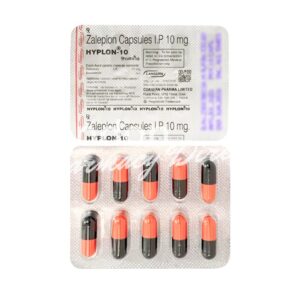
In brief
- Hyplon (zaleplon) is not licensed in the UK; zaleplon is a prescription-only medicine (POM).
- Hyplon is used for the short-term treatment of insomnia, especially difficulty falling asleep. It works as a non-benzodiazepine sedative/hypnotic by acting on GABA-A receptors to enhance the calming effect of gamma-aminobutyric acid in the brain.
- The usual adult dose is 10 mg taken immediately before bedtime. Some patients, including older adults or those with mild impairment, may start with 5 mg.
- Hyplon is taken by mouth as a film-coated tablet, usually in 5 mg or 10 mg strengths.
- It usually starts working within about 15 to 30 minutes.
- The duration of action is short, typically around 2 to 4 hours, which makes it useful for sleep-onset insomnia but not for maintaining sleep throughout the night.
- Do not drink alcohol while taking Hyplon, as it can greatly increase drowsiness, poor coordination, confusion, and the risk of dangerous breathing problems.
- The most common side effects are drowsiness, dizziness, headache, lightheadedness, and dry mouth.
- Would you like to try Hyplon without a prescription?
Basic Hyplon information
- INN (international nonproprietary name): Zaleplon
- Brand names available in the United Kingdom: Sonata is the best-known brand name; Hyplon is not licensed in the UK
- ATC code: N05CF03
- Forms and dosages: Film-coated tablets, usually 5 mg and 10 mg
- Registration status in the United Kingdom: prescription-only medicine for short-term insomnia; Hyplon is not licensed in the UK
- OTC / Rx classification: Prescription-only medicine (POM)
Everyday use and best practices
Morning vs evening dosing
People usually ask whether Hyplon is something to take after work, before a late shift, or only when sleep is already difficult.
The practical answer is simple: Hyplon for insomnia is taken immediately before bedtime, or after getting into bed if the problem is sleep onset insomnia.
It is not for daytime use, and it should only be taken when there is enough time set aside for sleep.
In the UK, many patients only use a prescription sleep aid like this after a prescriber has checked for short-term insomnia and ruled out other causes first.
Taking with or without meals
Zaleplon tablets can be taken with or without food, but a heavy meal can delay how quickly it starts working.
That matters for late UK dinners, takeaway nights, or a big meal just before bed.
If rapid sleep is needed, avoid taking it straight after a large meal.
Alcohol should also be avoided on the same evening because it increases sedative effects.
- Do take it only when you are ready to sleep.
- Do keep the evening quiet and predictable.
- Do not take it after alcohol.
- Do not take it after a heavy meal if fast onset matters.
Safety priorities
Who should avoid it
Hyplon is prescription-only and is not suitable for everyone.
MHRA warnings and product information make it clear that zaleplon should not be used if there is allergy to zaleplon, severe hepatic impairment, respiratory depression, obstructive sleep apnoea, or use with other CNS depressants.
Prescribers in the UK usually review the medicines history carefully because sedation risk and dependence concerns need to be taken seriously.
If a patient already takes other sleeping tablets or strong painkillers, that review becomes even more important.
Activities to limit
Driving after sleeping tablets is a common concern, and with Hyplon the advice is to be cautious the next day as well as on the night of use.
Night-shift work, machinery, ladders, or any task needing balance and alertness should be avoided after taking it.
Falls are a particular issue in older adults, especially if they wake during the night.
Before resuming work that needs concentration, it is sensible to ask a pharmacist or prescriber for advice.
- Do not drive if you feel sleepy or slowed down.
- Do not operate machinery after taking it.
- Do not do anything risky if balance is affected.
- Do not assume the next day will be unaffected.
Dosage and adjustments
General regimen
Adults usually take 10 mg immediately before bedtime.
Some people start at 5 mg if they are more sensitive to sedatives.
This short-course sleeping tablet is intended for sleep onset insomnia, not long-term sleep problems.
Treatment is usually kept as short as possible, commonly 7 to 10 days, and only up to 2 weeks under close supervision.
Special cases
Children are not recommended to use zaleplon because safety and efficacy are not established.
Older adults are usually started at 5 mg because of greater sensitivity, confusion risk, and falls risk.
Mild to moderate liver or kidney impairment calls for caution and usually a reduced starting dose.
Severe hepatic impairment is contraindicated, so the dose should never be self-adjusted in that situation.
| Group | Usual approach |
|---|---|
| Healthy adults | 10 mg immediately before bed |
| Sensitive adults | 5 mg starting dose |
| Elderly patients | 5 mg starting dose |
| Mild to moderate liver or kidney impairment | 5 mg with caution |
In the UK, any dose change should be agreed with the prescriber rather than made at home.
Legal status and availability in the UK
Zaleplon is a prescription-only medicine (POM) in the UK, and Hyplon is not licensed in the UK.
In our online pharmacy, Hyplon is available without a prescription, with discreet delivery to the United Kingdom in 9–21 days.
What’s inside and how it works
Ingredients overview
The INN is zaleplon; Sonata is the best-known brand name, and Hyplon is not licensed in the UK.
The common strengths are 5 mg and 10 mg tablets, usually film-coated and supplied in blister packs.
There are no creams, injections or other dosage forms for this medicine.
Mechanism basics explained simply
Zaleplon is a non-benzodiazepine sedative/hypnotic.
Its main job is to help people fall asleep faster rather than keep them asleep all night.
Because it has a short half-life, some people notice less next-day sedation than with longer-acting hypnotics.
A simple way to think about it is: bedtime dosing, quick sleep onset, then a short period of action.
Main indications
Approved uses
The main use is short-term treatment of insomnia, especially sleep onset insomnia.
It is prescribed when a rapid-onset, short-duration hypnotic is clinically preferred.
As a prescription-only medicine, it is only used within regulated prescribing systems.
Off-label considerations in UK clinics
UK clinicians usually look at sleep hygiene, pain, anxiety, caffeine intake, shift work, and other medicines before considering any hypnotic.
Persistent insomnia should be assessed for underlying causes rather than repeated short courses.
- Used for: short-term insomnia, difficulty falling asleep, carefully selected cases.
- Not suitable for: chronic insomnia without review, sleep maintenance as the main problem, repeated unsupervised use.
Interaction warnings
Food and drink interactions
Alcohol should not be taken with Hyplon because the sedative effect can become stronger and less predictable.
Late tea or coffee can also make sleep onset harder, so bedtime habits matter as much as the tablet itself.
That is especially relevant in the UK, where evening tea is part of many people’s routine.
Drug conflicts
Other medicines that cause sedation can interact with zaleplon and increase the risk of falls, confusion and breathing problems.
That includes opioid painkillers, antihistamines, antidepressants, antipsychotics, benzodiazepines, zopiclone and zolpidem.
If an unusual reaction happens, patients can report it through the MHRA Yellow Card scheme.
| Interaction level | Examples | Main concern |
|---|---|---|
| High | Alcohol, opioid painkillers, benzodiazepines | Additive sedation and breathing risk |
| Moderate | Antihistamines, antidepressants, antipsychotics | Sleepiness, confusion, unsteadiness |
| Important | Zopiclone, zolpidem | Combined hypnotic effects and falls risk |
Alternative choices
NHS prescribing alternatives
Hyplon is one option in a group that also includes zolpidem, zopiclone and temazepam.
It may suit people who need rapid onset and less next-day sedation, but it is less useful for sleep maintenance.
Patients may know the names Zimovane and Stilnoct as reference brands for related medicines.
If waking in the night is the main problem, a prescriber may consider another option or a non-drug approach instead.
| Medicine | Best for | Drawbacks | Sedation risk |
|---|---|---|---|
| Hyplon | Rapid sleep onset | Less useful for staying asleep | Lower next-day sedation for some people |
| Zolpidem | Short-term insomnia | Can still cause drowsiness | Moderate |
| Zopiclone | Sleep onset and maintenance | More lingering effects for some | Moderate to high |
| Temazepam | Short-term anxiety-related sleep problems | Dependence concerns | High |
Regulation snapshot
MHRA approval and NHS prescribing framework
Zaleplon is prescription-only and used within regulated prescribing systems. Hyplon is not licensed in the UK.
Clinicians in the UK assess dependence risk, depression, substance misuse history and liver disease before prescribing.
A valid prescription is required for zaleplon.
| Region | Status | Access route |
|---|---|---|
| United Kingdom | Prescription-only | Pharmacy supply with prescription |
FAQ
Common UK patient questions
How quickly does Hyplon work? It is taken immediately before bed and is used for sleep onset, so it is chosen when a quick start is needed.
Can I take it with food or alcohol? It can be taken with or without food, but a heavy meal may delay onset, and alcohol should be avoided.
Is it available on the NHS? Hyplon is not licensed in the UK; zaleplon is a prescription-only medicine.
What if I forget a dose? Take it only if there is still time for at least 4 hours of sleep; otherwise skip it and do not double up.
Guidelines for proper use
UK pharmacist counselling style
Take the tablet immediately before bed, exactly as prescribed, and do not exceed the dose.
Store it at 15°C to 25°C in a dry place, away from moisture, sunlight and children.
Keep it in the original packaging when travelling or transporting it.
Tell the prescriber about depression, falls, liver or kidney problems, or any history of substance misuse.
NHS patient support advice
If insomnia continues beyond the short course, follow-up is needed rather than simply repeating treatment.
Sleep hygiene still matters, so a regular bedtime, reduced screens and less late caffeine can all help.
Urgent help is needed for overdose symptoms, severe confusion, breathing problems or an allergic reaction.
- Safe use: bedtime dosing, short course, no alcohol, proper storage.
- Seek help: overdose symptoms, breathing problems, severe drowsiness, rash or swelling.
Delivery across the United Kingdom
| City | Region | Delivery time |
|---|---|---|
| London | Greater London | 9–21 days |
| Birmingham | West Midlands | 9–21 days |
| Manchester | North West England | 9–21 days |
| Glasgow | Scotland | 9–21 days |
| Edinburgh | Scotland | 9–21 days |
| Leeds | West Yorkshire | 9–21 days |
| Liverpool | North West England | 9–21 days |
| Bristol | South West England | 9–21 days |
| Sheffield | South Yorkshire | 9–21 days |
| Newcastle upon Tyne | North East England | 9–21 days |
| Nottingham | East Midlands | 9–21 days |
| Leicester | East Midlands | 9–21 days |
| Cardiff | Wales | 9–21 days |
| Belfast | Northern Ireland | 9–21 days |