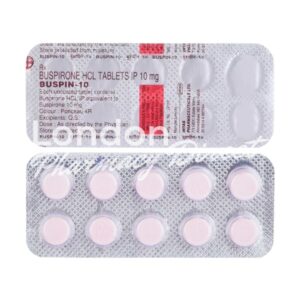
Buspar
In brief
- Buspar (buspirone) is a prescription-only medicine (POM) in the UK.
- Buspar is used mainly for generalised anxiety disorder and, off-label, as an adjunct in some depressive disorders; it is a non‑benzodiazepine anxiolytic that acts primarily as a partial agonist at 5‑HT1A (serotonin) receptors with secondary dopaminergic effects, reducing anxiety without the sedative or dependence risks of benzodiazepines.
- Usual adult dosing starts at 5 mg two to three times daily, with a typical daily dose of 15–30 mg given in two or three divided doses; the maximum recommended daily dose is 45 mg, with titration increases of about 5 mg per day every 2–3 days as needed.
- Administered orally as tablets (strengths: 5 mg and 10 mg); no injectable or extended‑release formulations are routinely marketed.
- Buspar is not fast‑acting for acute anxiety — therapeutic effects typically develop over 2–4 weeks; it is not suitable as a rescue medication for immediate relief.
- Duration of action per dose is relatively short (often around 6–8 hours), which is why it is usually given two or three times daily; sustained anxiolytic benefit is achieved with regular dosing.
- Avoid alcohol while taking buspirone as alcohol can increase dizziness and drowsiness and may worsen side effects.
- The most common side effect is dizziness (others include headache, nausea, nervousness, lightheadedness, restlessness, insomnia, fatigue and dry mouth).
- Would you like to try Buspar without a prescription?
Basic buspar information
- INN (international nonproprietary name): buspirone.
- Brand names available in the United Kingdom: generic buspirone tablets; Buspar is the original brand.
- ATC code: N05BE01 (Non‑benzodiazepine anxiolytic).
- Forms and dosages: tablets 5 mg and 10 mg.
- Manufacturers in the United Kingdom: generic manufacturers such as Teva and Mylan.
- Registration status in the United Kingdom: prescription‑only medicine licensed for anxiety disorders.
- OTC / Rx classification: Prescription-only medicine (POM).
Morning vs evening dosing
Worried about whether to take your dose in the morning or at night?
Follow your prescriber’s schedule and NHS prescription instructions when starting buspar (buspirone hydrochloride).
Typical initiation is 5 mg two to three times daily, increasing by roughly 5 mg per day every 2–3 days toward a usual range of 15–30 mg per day in divided doses, with a maximum of 45 mg per day.
Buspirone is not effective as an immediate “rescue” medicine and often takes 2–4 weeks to show benefit.
Split doses across waking hours to smooth effects and reduce the risk of insomnia; for most people one dose in the morning and one mid‑afternoon or early evening works well.
Shift workers should space doses evenly across their awake time rather than strictly morning/evening.
Taking with or without meals (UK diet habits)
Can I take buspirone with my breakfast or do I need to take it with food?
Buspirone may be taken with or without food according to the product datasheet.
Heavier UK evening meals can slow absorption and, for a minority, alter how fast effects or side effects appear.
If you notice tummy upset, try taking the tablet after food or with a light snack to reduce nausea.
Practical checklist for dose timing:
- Start on the low dose and titrate as advised by your prescriber.
- Take doses at roughly the same times each day to maintain steady levels.
- Keep a symptom diary for 4–6 weeks to monitor progress.
- Carry tablets in original packaging when travelling (airport/GP travel).
- Tell your GP or pharmacist if pregnant, breastfeeding, or have liver/kidney problems.
Who should avoid it (MHRA warnings)
Are there people who should not be prescribed buspirone?
Known hypersensitivity to buspirone or any excipient is an absolute contraindication.
Concomitant use with strong CYP3A4 inhibitors can markedly increase blood levels and should be avoided unless closely supervised.
Relative cautions include moderate to severe liver or kidney impairment, use of MAO inhibitors, and increased sensitivity in older adults.
Buspirone is prescription‑only and should be started only after a prescriber assessment following MHRA and prescribing guidance.
Activities to limit (driving, work safety)
Will buspirone make it unsafe to drive or operate machinery?
Although buspirone is generally less sedating than benzodiazepines, some people report dizziness or drowsiness.
Avoid driving or operating heavy machinery until you know how buspirone affects you.
If your role is safety‑critical, inform your line manager and discuss adjustments while treatment is being established.
Before you start:
- Review current medicines for CYP3A4 inhibitors or MAOIs.
- Declare any liver or kidney disease to your prescriber.
- Discuss pregnancy or breastfeeding plans with your clinician.
Warning signs requiring urgent review include severe dizziness, fainting, allergic reaction, or sudden worsening of mood or behaviour; report side effects via the MHRA Yellow Card scheme and consult your GP or community pharmacist for immediate advice.
General regimen (NHS guidance)
What dosing plan should I expect from my GP?
Standard initiation is 5 mg two to three times daily, with titration by about 5 mg per day every 2–3 days to a typical dose range of 15–30 mg per day in two or three divided doses, and a maximum of 45 mg per day.
Buspirone is intended for regular daily dosing and is not a PRN or rescue medication.
Special cases (elderly, comorbidities)
Do dosing rules change for older people or those with other illnesses?
Elderly patients should start at the lower end of the dosing range and titrate slowly while monitoring for dizziness, falls and cognitive effects.
For patients with liver or kidney impairment, dose reduction and closer clinical monitoring are recommended due to reduced clearance.
Buspirone is not recommended for children under 18, as safety and efficacy have not been established.
Missed dose advice: take as soon as remembered unless close to the next dose; do not double up.
In suspected overdose seek urgent medical attention; symptoms can include nausea, vomiting, dizziness and drowsiness.
Pharmacists should provide a printed titration checklist and concordance review at repeat dispensing.
Legal status and availability in the UK
Buspar (buspirone) is a prescription-only medicine (POM) in the UK.
In our online pharmacy, buspar is available without a prescription, with discreet delivery to the United Kingdom in 9–21 days.
Ingredients overview
What is in the tablet I was given?
The active ingredient is buspirone, as buspirone hydrochloride in marketed formulations.
Tablet strengths available in the UK are 5 mg and 10 mg; no injectable or extended‑release forms are marketed.
Excipients vary by manufacturer, so ask the pharmacist for the product datasheet if you have known allergies.
Mechanism basics explained simply
How does buspirone reduce anxiety?
Buspirone is classified under ATC code N05BE01 as a non‑benzodiazepine anxiolytic and works primarily on serotonin 5‑HT1A receptors and other neurotransmitter systems to reduce chronic anxiety symptoms.
It is suited to generalised anxiety disorder rather than panic or acute agitation because effects build over weeks rather than minutes.
What it treats and what it doesn’t:
- What it treats: chronic generalised anxiety and ongoing worry.
- What it doesn’t treat: acute panic attacks or immediate rescue relief.
Approved uses (MHRA listing)
For which conditions is buspirone licensed?
Buspirone is primarily licensed in the UK for generalised anxiety disorder and is prescription‑only.
NHS practice is to use buspirone as a continuous daily treatment, with follow‑up to monitor response over several weeks.
Off‑label uses in UK clinics
Do clinicians ever use buspirone for other reasons?
Off‑label uses include adjunctive treatment with antidepressants for residual anxiety, augmentation in certain resistant cases, and limited use during benzodiazepine withdrawal, though evidence varies.
Buspirone is not recommended for panic disorder or as a rescue medication.
Questions to consider:
- Do you have persistent excessive worry rather than panic attacks?
- Is there a substance misuse history making benzodiazepines unsuitable?
- Have you discussed alternatives and monitoring with your GP?
Food interactions (alcohol, tea/coffee)
Are there foods or drinks I should avoid?
Avoid mixing buspirone with heavy alcohol use since alcohol can worsen dizziness and impair cognition.
Caffeine from tea or coffee does not have a major pharmacokinetic interaction with buspirone but can exacerbate anxiety symptoms.
If alcohol consumption is likely while you start treatment, discuss this with your prescriber.
Drug conflicts
Which medicines can interact with buspirone?
Avoid strong CYP3A4 inhibitors (for example some azole antifungals, certain macrolide antibiotics and some protease inhibitors) because they can markedly raise buspirone levels.
MAO inhibitors are a serious interaction risk and should not be used concomitantly.
Tell your GP or pharmacist about all prescription medicines, OTC products and herbal remedies such as St John’s wort.
Carry a current medicines list and ask the pharmacist to screen for interactions at dispensing; report suspected interactions through the MHRA Yellow Card scheme.
NHS prescribing alternatives
What other NHS options exist for chronic anxiety?
Common alternatives include SSRIs (eg sertraline, escitalopram), SNRIs, short‑term benzodiazepines for acute severe symptoms, and CBT delivered via NHS Talking Therapies.
Pros and cons:
- SSRIs: broader efficacy for depression and anxiety but can cause sexual side effects and take weeks to work.
- Benzodiazepines: rapid relief but sedation and dependence risk make them unsuitable for many.
- CBT: durable benefits without medication side effects but may have waiting lists via NHS services.
- Buspar (buspirone): non‑sedating, lower dependence risk, slower onset and limited efficacy for panic.
When to consider switching
When is it sensible to change treatment?
Consider switching if symptom control remains poor after an adequate trial, side effects are intolerable, pregnancy is being planned, or new drug interactions arise.
Discuss switching with your GP; cross‑titration or specialist advice may be required for some drug combinations.
MHRA approval and labelling
Is buspirone regulated in the UK?
Buspirone is a prescription‑only medicine (POM) in the UK and appears under ATC code N05BE01 as a non‑benzodiazepine anxiolytic.
MHRA oversight covers labelling, contraindications and safety reporting.
NHS prescribing framework
How do GPs and pharmacists manage treatment on the NHS?
GPs prescribe according to clinical need and relevant guidance, arranging follow‑up reviews to check efficacy and tolerability.
Community pharmacists dispense and offer counselling; pharmacies participate in NHS dispensing and repeat dispensing services.
Will buspar make me sleepy?
Most people find buspirone less sedating than benzodiazepines, but dizziness and drowsiness occur in some patients.
A short driving checklist: avoid driving until you know how you feel, do not operate heavy machinery if feeling drowsy, and report persistent sedation to your GP or pharmacist.
How long until it works?
Expect 2–4 weeks to notice benefit and possibly longer for full effect.
Keep a symptom diary for 4–6 weeks and arrange a review with your GP to assess response and tolerability.
Can I drink alcohol while taking it?
Alcohol can worsen dizziness and impair judgement and is best minimised or avoided when establishing your dose.
Discuss safe levels with your prescriber if occasional drinking is important to you.
What if I miss doses?
Take a missed dose as soon as you remember unless it is close to the next scheduled dose; do not double up.
Seek urgent care for overdose symptoms such as severe drowsiness, persistent vomiting or loss of consciousness.
Contact NHS 111, your GP or A&E for red‑flag symptoms including severe dizziness, fainting, chest pain, or suicidal thoughts.
UK pharmacist counselling style
What will a community pharmacist tell me when collecting buspirone?
Expect verification of the indication, explanation of the dosing schedule and titration, warnings about interactions (strong CYP3A4 inhibitors and MAOIs), and advice on managing common side effects such as nausea and dizziness.
Pharmacies often provide a written patient information leaflet and concordance aids like dosette boxes where multiple medicines are used.
NHS patient support advice
What follow‑up should I expect from the NHS?
GPs should arrange reviews at 2–4 weeks and again at 8–12 weeks to assess efficacy and tolerability and refer to NHS Talking Therapies or mental health services if necessary.
Pharmacists can support with repeat dispensing and medication reviews.
Keep a medication card and inform all healthcare contacts that you are taking buspirone.
Delivery across the United Kingdom
| City | Region | Delivery Time |
|---|---|---|
| London | England | 9–21 days |
| Birmingham | England | 9–21 days |
| Manchester | England | 9–21 days |
| Glasgow | Scotland | 9–21 days |
| Leeds | England | 9–21 days |
| Liverpool | England | 9–21 days |
| Newcastle Upon Tyne | England | 9–21 days |
| Sheffield | England | 9–21 days |
| Bristol | England | 9–21 days |
| Cardiff | Wales | 9–21 days |
| Belfast | Northern Ireland | 9–21 days |
| Edinburgh | Scotland | 9–21 days |
| Nottingham | England | 9–21 days |