Hydroxychloroquine
In brief
- In our pharmacy, you can buy hydroxychloroquine without a prescription, with delivery throughout the United Kingdom. It is a prescription-only medicine (POM) in the UK, so use should be supervised by a clinician.
- Hydroxychloroquine is used for malaria treatment and prevention, and for autoimmune conditions such as rheumatoid arthritis and lupus (SLE). It is an antimalarial aminoquinoline that works by interfering with parasite function and modulating the immune response.
- The usual dose of hydroxychloroquine depends on the condition: for malaria treatment, 800 mg initially, then 400 mg at 6, 24 and 48 hours; for malaria prevention, 400 mg weekly; and for rheumatoid arthritis or lupus, 200–400 mg daily.
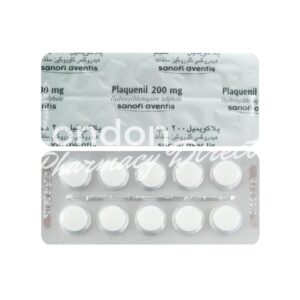
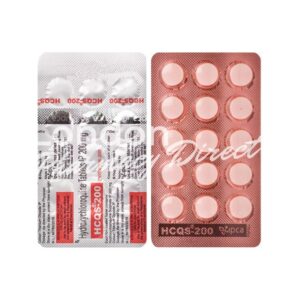
- The form of administration is a tablet, usually 200 mg taken by mouth.
- The effect of the medication may begin within a few hours for malaria, but for rheumatoid arthritis or lupus it may take several weeks to start working fully.
- The duration of action varies: malaria treatment is short term, while autoimmune disease control may last with ongoing daily use over months or years.
- Do not drink alcohol, as it may increase the risk of stomach upset, dizziness, and other unwanted effects.
- The most common side effects are nausea, vomiting, diarrhoea, abdominal pain, loss of appetite, and skin rash.
- Would you like to try hydroxychloroquine without a prescription?
Basic hydroxychloroquine information
- INN (international nonproprietary name): Hydroxychloroquine
- Brand names available in the United Kingdom: Plaquenil; generic hydroxychloroquine sulfate
- ATC code: P01BA02
- Forms and dosages: Tablets 200 mg
- Registration status in the United Kingdom: Prescription-only medicine (POM)
- OTC / Rx classification: Prescription-only medicine (POM)
Everyday use and best practices
Morning vs evening dosing
Are you trying to fit hydroxychloroquine into a busy British day without missing a dose?
That is a common worry, especially when mornings are rushed with breakfast, school runs, or an early commute.
The good news is that hydroxychloroquine tablets work best when taken at the same time each day.
Consistency matters more than the exact clock time, unless the prescriber has given different instructions.
Some people link it to a daily habit such as breakfast, a kettle boil for tea, or a reminder alarm on a phone.
Others prefer evening dosing if the tablet tends to upset the stomach, while many tolerate a morning routine better.
For shift workers, the easiest method is usually the one that can be repeated every day without confusion.
A simple tablet routine reduces missed doses and makes long-term use easier to manage, especially for lupus or rheumatoid arthritis.
Taking with or without meals
Nausea is one of the most common hydroxychloroquine side effects, so a practical routine can make a real difference.
Taking it with food or milk often helps, and it is usually better than taking it on an empty stomach.
Think of everyday UK meals such as toast, cereal, a sandwich at lunch, or a mug of tea with a snack.
Plenty of water also helps tablets go down more comfortably.
Hydroxychloroquine is supplied as 200 mg tablets, and there are no commercial creams or injections for this molecule.
Keep the tablets in the original packaging, store them at room temperature, and protect them from moisture and direct light.
As with other NHS medicines, keep the pack well away from children and do not decant tablets into loose pots unless that has been recommended.
- Daily routine tips: take at the same time each day.
- Daily routine tips: use food or milk if nausea is a problem.
- Daily routine tips: keep hydrated with water or a normal drink.
- Daily routine tips: store in the original box or blister pack.
- Daily routine tips: keep out of reach of children.
Safety priorities
Who should avoid it
Who should be extra cautious before starting hydroxychloroquine treatment?
The main red flags in UK practice include allergy to hydroxychloroquine or related 4-aminoquinoline compounds, pre-existing retinopathy, severe liver problems, and severe kidney problems.
Children under 6 should not be given tablet forms because of the choking risk, and children in general need strict weight-based dosing if a specialist decides treatment is necessary.
Extra caution is also needed in psoriasis, porphyria, G6PD deficiency, and heart rhythm problems such as QT prolongation.
That is why MHRA advice and physician supervision matter so much with hydroxychloroquine 200 mg tablets.
It is not a medicine for casual use, and it should only be used under medical supervision.
Activities to limit
Blurred vision, dizziness, or drowsiness can make everyday tasks less safe.
Driving, cycling, operating machinery, and safety-critical work should be paused if these symptoms appear.
Visual disturbance is particularly important because chronic use carries a retinopathy warning and routine eye monitoring is recommended.
If vision changes happen, speak to a pharmacist or prescriber promptly.
Overdose is a medical emergency and can cause arrhythmia, convulsions, severe confusion, headache, drowsiness, visual disturbances, and hypokalaemia.
- Stop and seek help: chest palpitations or suspected arrhythmia.
- Stop and seek help: convulsions or seizure-like activity.
- Stop and seek help: severe confusion or collapse.
- Stop and seek help: sudden visual disturbance or loss of sight clarity.
- Stop and seek help: severe rash, breathing difficulty, or fainting.
Dosage and adjustments
General regimen
What is the usual hydroxychloroquine dose in NHS-style prescribing?
For adults, the product information gives 200 to 400 mg daily for rheumatoid arthritis or lupus, either once daily or divided.
For malaria treatment, the typical regimen is 800 mg initially, then 400 mg at 6, 24, and 48 hours.
For malaria prevention, 400 mg weekly is standard, usually starting 1 to 2 weeks before travel.
Children need strict weight-based dosing and hydroxychloroquine is not routine in children unless a specialist prescribes it.
Actual NHS dosing depends on the indication, body weight, response, and specialist review, especially for long-term autoimmune use.
Special cases
Older adults, people with kidney disease, and those with liver disease often need more careful review.
Accumulation and toxicity are more likely when renal or hepatic function is reduced, so lower starting doses and close monitoring may be needed.
Severe infection can also alter how the medicine behaves in the body, which is why medical review matters in any complex illness.
When someone is taking several long-term medicines, a medication review helps reduce interaction risk and dosing mistakes.
| Group | Usual dose | Adjustment notes |
|---|---|---|
| Adults with RA or lupus | 200 to 400 mg daily | May be once daily or divided |
| Malaria treatment | 800 mg, then 400 mg at 6, 24, 48 hours | Short course under protocol |
| Malaria prevention | 400 mg weekly | Start 1 to 2 weeks before travel |
| Elderly | Specialist guided | Use lower starting doses where appropriate |
| Renal or hepatic impairment | Specialist guided | Dose reduction may be needed |
Legal status and availability in the UK
Hydroxychloroquine is a prescription-only medicine (POM) in the UK.
In our online pharmacy, hydroxychloroquine is available without a prescription, with discreet delivery to the United Kingdom in 9–21 days.
What’s inside and how it works
Ingredients overview
The INN is hydroxychloroquine, and some references describe it as hydroxychloroquine sulfate.
The common tablet strength is 200 mg, and the medicine is classified as an antimalarial agent under ATC code P01BA02.
In the UK the brand name is Plaquenil, and generic hydroxychloroquine tablets are also supplied.
Mechanism basics explained simply
In plain terms, hydroxychloroquine affects how certain cells and immune pathways behave.
That is why it has a place in malaria and autoimmune conditions such as lupus and rheumatoid arthritis.
The science is not something most patients need to memorise, but the long-term action explains why monitoring is built into treatment.
Simple explainer: tablet taken regularly → affects immune activity over time → symptoms may become easier to manage → regular reviews remain important.
Main indications
Approved uses
What conditions is hydroxychloroquine used for in UK practice?
The main approved uses are malaria treatment, malaria prevention, rheumatoid arthritis, and lupus or SLE.
Autoimmune treatment is usually long term and can continue for years, while malaria treatment is short term and measured in days or weeks.
For malaria, the treatment schedule is 800 mg initially, then 400 mg at 6, 24, and 48 hours, while prevention is commonly 400 mg weekly.
For RA and SLE, the usual adult dose is 200 to 400 mg daily, depending on clinical response and tolerability.
Off-label uses in UK clinics
Some clinicians may consider other uses only under specialist care, but routine self-use is not appropriate.
The NHS relies on diagnosis, monitoring, and medicine reconciliation before ongoing prescribing.
| Condition | Usual duration | Key monitoring point |
|---|---|---|
| Malaria treatment | Days | Correct dosing and urgent review if severe symptoms occur |
| Malaria prevention | Weeks | Travel timing and adherence |
| Rheumatoid arthritis | Long term | Side effects and eye checks |
| Lupus | Long term | Retinal and clinical monitoring |
Interaction warnings
Food interactions
Food usually helps tolerance, and hydroxychloroquine does not have the kind of major food conflicts seen with some other medicines.
Alcohol may worsen stomach upset or dizziness in some people, so it is sensible to be careful if side effects are already present.
Tea and coffee are usually fine in moderation, but caffeine should not be treated as a way to cancel out tiredness or dizziness.
Taking tablets with food or milk remains the simplest practical tip for better stomach comfort.
Drug conflicts
The bigger concern is interaction with other QT-prolonging medicines and anything that affects heart rhythm.
Always tell the prescriber and pharmacist about prescribed medicines, over-the-counter products, and herbal supplements.
Cardiac medicines, some antibiotics, and medicines that affect blood sugar should be checked carefully.
Yellow Card reporting is part of UK medicines safety, so unexpected side effects should be reported in the usual way.
- Mention at the pharmacy: heart rhythm medicines.
- Mention at the pharmacy: antibiotics being taken now.
- Mention at the pharmacy: diabetes treatment.
- Mention at the pharmacy: herbal supplements and OTC products.
- Mention at the pharmacy: any history of QT prolongation or G6PD deficiency.
Alternative choices
NHS prescribing alternatives with pros and cons
What if hydroxychloroquine is not the right fit?
For malaria, chloroquine or artemisinin-based combination therapies may be considered depending on the situation.
For autoimmune disease, methotrexate, azathioprine, mycophenolate mofetil, and biologic DMARDs are among the main alternatives.
The best option depends on diagnosis, pregnancy plans, eye health, liver and kidney function, and treatment goals.
Hydroxychloroquine is only one option in RA, SLE, and malaria management.
| Alternative | Potential advantage | Potential drawback |
|---|---|---|
| Chloroquine | Similar antimalarial class | Still needs careful supervision |
| Methotrexate | Common in RA/SLE care | Different monitoring burden |
| Azathioprine | Useful in some autoimmune cases | Monitoring required |
| Mycophenolate mofetil | Specialist option for some patients | Not suitable for everyone |
| Biologic DMARDs | Targeted treatment | Specialist prescribing and monitoring |
Regulation snapshot
MHRA approval and NHS prescribing framework
Hydroxychloroquine is a prescription-only medicine in the UK, with monitoring expectations for long-term use.
MHRA-aligned prescribing includes review of indication, dose, adverse effects, and eye screening.
Community pharmacists play an important role in checking interactions and giving counselling in high-trust NHS settings.
What this means for patients
Hydroxychloroquine should be used only under the care of a prescriber.
- Know this: hydroxychloroquine is Rx only.
- Know this: monitoring is part of safe long-term use.
- Know this: eye screening matters for chronic users.
Frequently asked questions
How long does hydroxychloroquine take to work?
For chronic autoimmune conditions, benefit may take time, so it is normal not to feel an immediate effect.
Malaria regimens work on a much shorter timescale because they are used differently.
Can I take it with food?
Yes, and that is often the easiest way to reduce nausea.
Milk or a simple meal can help if tablets upset the stomach.
Do I need eye tests?
Yes, routine ophthalmological monitoring is recommended for chronic users because of retinopathy risk.
That matters especially when hydroxychloroquine is used for years.
Can I get it on the NHS across the UK?
Yes, if it is clinically appropriate and prescribed by a clinician.
Guidelines for proper use
UK pharmacist counselling style
How should hydroxychloroquine be taken safely day to day?
Take it exactly as prescribed and do not double doses if one is missed.
If a dose is forgotten, take it as soon as remembered unless it is nearly time for the next dose.
Store tablets at room temperature between 15 and 30°C, protected from moisture and direct light.
Keep the tablets in their original packaging and away from children.
Seek urgent help for visual changes, severe rash, palpitations, fainting, severe confusion, or any suspected overdose.
NHS patient support advice
Support can come from the GP, rheumatology team, ophthalmology screening service, NHS 111 for urgent advice, and A&E for overdose or severe symptoms.
Bring a medicines list to reviews, especially if treatment is used for diabetes, heart rhythm problems, or several long-term conditions.
That small habit makes medication reviews safer and helps the pharmacist spot conflicts early.
- When to seek help: visual disturbance, severe rash, or palpitations.
- When to seek help: fainting, severe confusion, or convulsions.
- When to seek help: suspected overdose or accidental extra dosing.
- How to take safely: same time each day.
- How to take safely: with food or milk if nausea appears.
Delivery across the United Kingdom
| City | Region | Delivery time |
|---|---|---|
| London | Greater London | 9–21 days |
| Birmingham | West Midlands | 9–21 days |
| Manchester | North West England | 9–21 days |
| Glasgow | Scotland | 9–21 days |
| Edinburgh | Scotland | 9–21 days |
| Liverpool | North West England | 9–21 days |
| Leeds | Yorkshire and the Humber | 9–21 days |
| Bristol | South West England | 9–21 days |
| Cardiff | Wales | 9–21 days |
| Belfast | Northern Ireland | 9–21 days |
| Newcastle upon Tyne | North East England | 9–21 days |
| Nottingham | East Midlands | 9–21 days |
| Sheffield | Yorkshire and the Humber | 9–21 days |
| Southampton | South East England | 9–21 days |
| Aberdeen | Scotland | 9–21 days |