Sinequan
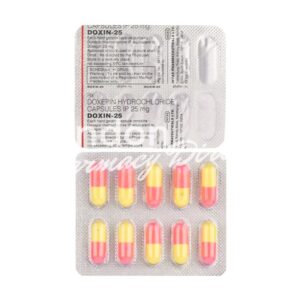
In brief
- Sinequan (doxepin) is a prescription-only medicine (POM) in the UK and should be supplied only with a valid prescription.
- Sinequan is used for depression and anxiety; it is a tricyclic antidepressant that blocks the reuptake of serotonin and noradrenaline and has strong antihistamine (sedative) and anticholinergic effects.
- Usual doses for depression/anxiety start around 75 mg/day (divided or at night), with a typical range of 75–150 mg/day and doses up to 300 mg/day under specialist care.
- Administered orally as capsules (commonly 10, 25, 50, 75 and 100 mg).
- For antidepressant effects it may take 1–3 weeks (sometimes longer) to see full benefit; the sedative/antihistamine effect used for sleep typically begins within about 30–60 minutes.
- Duration of action varies with dose and individual metabolism (half-life roughly 8–24 hours); sedative effects generally last through the night (approximately 6–8 hours), while antidepressant benefits are maintained with regular daily dosing.
- Do not consume alcohol with doxepin — alcohol increases sedation and can worsen dizziness, drowsiness, respiratory depression and orthostatic effects.
- The most common side effect is drowsiness (other frequent effects include dry mouth, dizziness, blurred vision, constipation and urinary retention).
- Would you like to try Sinequan without a prescription? Please note it is a prescription-only medicine and using it without medical supervision can be unsafe; consult a prescriber or pharmacist for advice.
Basic Sinequan information
- INN (international nonproprietary name): Doxepin
- Brand names available in the United Kingdom: Sinequan and generic doxepin products
- ATC code: N06AA12
- Forms and dosages: Capsules 10 mg, 25 mg, 50 mg, 75 mg, 100 mg
- Manufacturers in the United Kingdom: Mylan, Teva and other generic manufacturers
- Registration status in the United Kingdom: Prescription-only medicine (POM)
- OTC / Rx classification: Prescription-only medicine (POM)
Important instructions, warnings and daily-life integration for UK patients.
Sinequan (doxepin) is a prescription-only medicine in the United Kingdom and must be supplied following a consultation with an NHS GP or a private prescriber.
Avoid doxepin if you have narrow-angle glaucoma, urinary retention, a known allergy to tricyclic antidepressants, or if you have taken a monoamine oxidase inhibitor in the past 14 days.
Elderly patients and people with cardiac disease should have specialist review before starting doxepin.
Seek immediate medical help for suspected overdose, which may present as marked drowsiness, cardiac arrhythmias or seizures.
Ask your community pharmacist about interactions and side-effects before starting therapy.
Keep medicines in original packaging while travelling and carry a written list of all medicines to show your GP or pharmacist.
Do not drive or operate heavy machinery if you feel drowsy while taking doxepin.
Store doxepin at room temperature (15–30°C) and keep the patient information leaflet to check excipient details if you have allergies.
Morning versus evening dosing
Do patients worry about daytime drowsiness with doxepin?
For depression or anxiety, doxepin is commonly started as a single bedtime dose to reduce daytime sedation and help with sleep.
Typical starting adult doses often begin around 75 mg per day either divided or given at night, depending on prescriber preference and patient tolerance.
Specialist-managed cases may use higher doses titrated slowly according to response.
Taking with or without meals (UK diet habits)
Will food change how doxepin works?
Absorption of doxepin is not heavily affected by food, so it can be taken with or without a meal.
Taking doxepin with a small snack often reduces stomach upset for those who feel nauseous when starting treatment.
Older patients and people on multiple medicines should sync doxepin with an existing routine such as breakfast or bedtime to reduce missed doses.
- Step 1: Decide with your prescriber whether a night-time single dose or divided dosing suits your daily routine.
- Step 2: If you get stomach upset, take doxepin with a small snack rather than a large meal.
- Step 3: Use a pill box or tie dosing to an existing habit like brushing teeth to avoid missed doses.
- Step 4: Report persistent daytime drowsiness to your GP for a dose review or timing change.
Checklist: take at the same time each day, consider night-time dosing for sleep benefits, take with a snack if needed, and confirm timing with your pharmacist.
Who should avoid it (MHRA warnings)
Who must not take doxepin?
Absolute contraindications include known hypersensitivity to doxepin or other tricyclic antidepressants, narrow-angle glaucoma, urinary retention and monoamine oxidase inhibitor use within the previous 14 days.
Relative caution is needed in elderly patients, people with cardiac conduction disorders, severe hepatic or renal impairment, pregnancy or a history of suicide attempts.
Discuss risks versus benefits with your GP or psychiatrist before starting doxepin in these circumstances.
Activities to limit (driving, work safety)
Can doxepin affect driving or work?
Drowsiness and blurred vision are common side-effects, so avoid driving, cycling or operating heavy machinery until you know how doxepin affects you.
If your role is safety-critical, inform occupational health and your prescriber before starting treatment.
- Checklist for contraindications: known TCA allergy; recent MAOI use; narrow-angle glaucoma; urinary retention.
- High-risk groups summary: elderly patients, cardiac disease, severe hepatic/renal impairment, pregnancy, history of suicidality.
General regimen (NHS guidance)
How is doxepin usually dosed for depression and anxiety in UK practice?
Typical adult starting dose for depression or anxiety is around 75 mg per day, either divided or given at night, with a common usual range of 75–150 mg per day.
Maximum doses up to 300 mg per day are used only under specialist supervision with ECG monitoring where indicated.
NHS prescribers will usually titrate slowly and monitor response over several weeks.
Special cases (elderly, comorbidities)
How should dosing change for older patients or those with other conditions?
Elderly patients should begin at lower doses, for example 25–50 mg per day, because of increased sensitivity to anticholinergic and sedative effects.
Hepatic or renal impairment warrants dose reduction and closer monitoring due to altered drug metabolism and excretion.
Children under 12 are not recommended to use doxepin, and those over 12 should use the lowest effective dose with caution.
| Dose category | Typical starting dose | Notes |
|---|---|---|
| Adult (depression/anxiety) | 75 mg/day (divided or at night) | Titrate to 75–150 mg/day; up to 300 mg/day under specialist care |
| Elderly | 25–50 mg/day | Start low; watch for anticholinergic effects |
Titration checklist: start low, review after 2–4 weeks, check for side-effects, consider ECG if cardiac risk, adjust dose slowly.
Legal status and availability in the UK
Doxepin (Sinequan) is a prescription-only medicine (POM) in the UK and is supplied on a valid prescription.
Our pharmacy offers discreet delivery within the United Kingdom with prescription verification and customer support.
Ingredients overview
What is in doxepin products?
The active ingredient in Sinequan and generics is doxepin (INN).
Common available forms include capsules (10, 25, 50, 75, 100 mg).
Excipients vary by manufacturer, so check the patient information leaflet if you have known excipient allergies.
Mechanism basics explained simply
How does doxepin work?
Doxepin is a tricyclic antidepressant classified under ATC code N06AA12.
It inhibits the reuptake of noradrenaline and serotonin, which contributes to antidepressant effects.
It also has strong antihistamine properties, which explains its sedating effect useful for sleep but also responsible for drowsiness and anticholinergic side-effects.
- Noradrenaline/serotonin reuptake inhibition — antidepressant and anxiolytic effects.
- Antihistamine action — sedation and sleep benefits; risk of daytime drowsiness.
- Anticholinergic effects — dry mouth, constipation, urinary retention, blurred vision.
Approved uses (MHRA listing)
What is doxepin licensed for in the UK?
Doxepin is indicated for depression and certain anxiety disorders.
Sinequan and generics remain treatment options where tricyclic antidepressants are clinically appropriate.
Off-label uses in UK clinics
Are there other uses in practice?
Specialist or off-label use can include management of chronic neuropathic pain or refractory sleep disturbance when other options have failed.
Any off-label use should be discussed with the prescriber and documented with informed consent.
- Typical dose: depression/anxiety 75–150 mg/day.
- Decision guide for patients: first-line SSRIs are usually tried for depression unless a tricyclic is specifically indicated.
Food interactions (alcohol, tea/coffee)
Can food or drink change side-effects?
Alcohol increases drowsiness and cognitive impairment when combined with doxepin and should be avoided during initiation or dose changes.
Caffeine in tea or coffee can oppose sedation and may disrupt sleep, particularly when doxepin is being used to aid sleep.
There are no major metabolic food interactions, but maintaining consistent routines helps with adherence and sleep timing.
Drug conflicts
Which drugs interact dangerously with doxepin?
Concurrent use of monoamine oxidase inhibitors is contraindicated due to the risk of serotonin syndrome.
Other important concerns are interactions with QT-prolonging medications and strong CYP inhibitors that can raise doxepin plasma levels.
Report adverse effects via the MHRA Yellow Card scheme and always check with your pharmacist about interactions with prescription and over-the-counter medicines.
- Common interacting drugs: MAOIs, other TCAs, some antipsychotics, certain antiarrhythmics, and strong CYP inhibitors.
- OTC checklist: avoid combining with sedating antihistamines, check decongestants and herbal remedies with your pharmacist.
NHS prescribing alternatives with pros/cons checklist
What are reasonable alternatives on the NHS?
SSRIs such as sertraline, citalopram and fluoxetine are commonly used first-line for depression because they tend to be better tolerated and safer in overdose.
Other TCAs such as amitriptyline or nortriptyline remain options for some patients but share anticholinergic burdens with doxepin.
For insomnia, cognitive behavioural therapy for insomnia (CBT-I) and short-term hypnotics are first-line.
- Pros of SSRIs: better tolerability, safer in overdose.
- Cons of SSRIs: sexual side-effects and early activation for some patients.
- Pros of TCAs: established efficacy for certain depressive subtypes.
- Cons of TCAs: anticholinergic side-effects and risk in overdose.
How to discuss options with your GP
What questions should patients ask?
Ask about side-effect profiles, safety in overdose, impact on driving and employment, and monitoring needs such as ECG or blood tests.
Discuss lifestyle effects like weight gain and sedation and whether alternatives like SSRIs or therapy would be suitable first steps.
MHRA approval and status
Is doxepin regulated in the UK?
Doxepin is a prescription-only medicine in the United Kingdom, with branded Sinequan and various generics available via licensed manufacturers such as Mylan and Teva.
Prescribers should follow MHRA guidance and report suspected serious adverse reactions via the Yellow Card system.
NHS prescribing framework
How is doxepin prescribed on the NHS?
Prescribing typically occurs through a GP or specialist clinic with baseline assessment of cardiac history and liver function when indicated.
Regular review for efficacy and side-effects is part of standard NHS practice and pharmacists play an important counselling role at the point of dispensing.
- Regulatory steps flow: assessment → prescription → baseline investigations if needed → dispensing by pharmacy → follow-up review.
- Prescriber checklist: check contraindications, consider ECG if risk factors, start low and titrate, arrange review in 2–4 weeks.
Will doxepin make me gain weight?
Is weight gain a side-effect to expect?
Weight gain can occur with doxepin and should be discussed with your GP.
Lifestyle measures and monitoring can help, and switching to an alternative medication may be considered if weight gain is significant.
How quickly does it work and can I stop abruptly?
How fast do antidepressant effects appear?
Antidepressant benefits may take one to three weeks or longer to appear, and full effect can take several weeks.
Stopping doxepin abruptly is not advised because of the risk of discontinuation symptoms; reduce dose gradually under supervision.
Can I drink alcohol or drive?
Are alcohol and driving safe with doxepin?
Avoid alcohol while taking doxepin because it increases drowsiness and cognitive impairment.
Do not drive until you know how doxepin affects you, as drowsiness and blurred vision are common.
- When to call your GP: severe dizziness, fainting, marked urinary retention, persistent mood worsening, thoughts of self-harm.
- When to go to A&E: signs of overdose such as severe drowsiness, convulsions, chest pain or irregular heartbeat.
UK pharmacist counselling points
What will the pharmacist check when dispensing doxepin?
Confirm the indication, review current medicines and allergies, explain the dosing schedule with a start low and titrate approach, and warn about drowsiness and anticholinergic effects.
Explain missed-dose policy: take when remembered unless close to the next dose and do not double up doses.
Advise on storage at 15–30°C in original packaging and explain disposal of unwanted medication through pharmacy return schemes.
NHS patient support advice
Where can patients get more help?
Encourage patients to report side-effects on the MHRA Yellow Card system and to use NHS mental health resources or IAPT services if referred.
Recommend booking a medication review after two to four weeks of starting doxepin and advise about repeat supplies.
Patient checklist for the first week: expect some drowsiness; avoid alcohol; keep hydrated to manage dry mouth; contact GP if severe or worsening symptoms occur.
Medication card example: drug name, dose, prescriber contact, start date, emergency advice — keep a copy in your wallet for clinic visits.
Delivery across the United Kingdom
| City | Region | Delivery Time |
|---|---|---|
| London | England | 9–21 days |
| Birmingham | England | 9–21 days |
| Manchester | England | 9–21 days |
| Glasgow | Scotland | 9–21 days |
| Leeds | England | 9–21 days |
| Edinburgh | Scotland | 9–21 days |
| Bristol | England | 9–21 days |
| Belfast | Northern Ireland | 9–21 days |
| Cardiff | Wales | 9–21 days |
| Newcastle Upon Tyne | England | 9–21 days |
| Sheffield | England | 9–21 days |
| Nottingham | England | 9–21 days |
| Kingston Upon Hull | England | 9–21 days |
| Southampton | England | 9–21 days |