Escitalopram
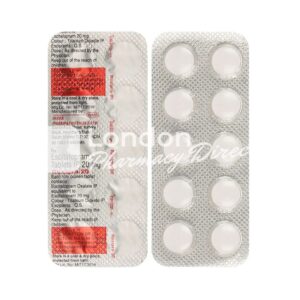
In brief
- In our pharmacy, you can buy escitalopram without a prescription, with delivery available in the UK. Discreet and anonymous packaging.
- Escitalopram is used to treat major depressive disorder, generalised anxiety disorder, panic disorder, social anxiety disorder and OCD. It is a selective serotonin reuptake inhibitor (SSRI), increasing serotonin levels in the brain by blocking its reuptake.
- The usual dose of escitalopram is 10 mg once daily for adults, with a typical range of 5–20 mg daily depending on the condition and individual response.
- The form of administration is a tablet, oral solution/drops, or orally disintegrating tablet.
- The effect of the medication usually begins within 1–2 weeks, although some people may notice early improvement in anxiety or sleep within a few days.
- The duration of action is about 24 hours, so it is usually taken once daily.
- Alcohol is not recommended with escitalopram, as it may increase dizziness, drowsiness, impaired judgment and the risk of side effects.
- The most common side effects are nausea, dry mouth, headache, dizziness, sweating, fatigue, sleep disturbance, diarrhoea and sexual dysfunction.
- Would you like to try escitalopram without a prescription?
Basic Escitalopram Information
- INN (International Nonproprietary Name): Escitalopram
- Brand names available in United Kingdom: Cipralex
- ATC Code: N06AB10
- Forms & dosages: Film-coated tablets 5 mg, 10 mg, 15 mg, 20 mg; oral drops/solution 20 mg/mL; orally disintegrating forms 10 mg, 15 mg
- Manufacturers in United Kingdom: Lundbeck, Orifarm, Ecosse, Elaiapharm
- Registration status in United Kingdom: Prescription only; EU approved
- OTC / Rx classification: Prescription (Rx) only
Escitalopram: A Practical Guide For UK Patients
Everyday Use And Best Practices
Wondering when to take escitalopram, or whether breakfast matters?
It is a once daily SSRI, so the key is consistency rather than chasing the “perfect” time.
Many UK patients prefer mornings if it seems to affect sleep, while others move it to the evening if it causes daytime nausea.
If a dose is missed, take it when remembered unless the next dose is nearly due, and do not double up.
A simple trick is to link it to a fixed habit, such as after brushing teeth or when the kettle goes on.
Escitalopram can usually be taken with or without food, and if it feels harsh on the stomach, taking it after a meal often helps.
- Drink a glass of water with the dose if the mouth feels dry.
- Try to keep bedtime and waking time steady for the first few weeks.
- Use a reminder app, pill box, or phone alarm so the routine sticks.
- Keep a short symptom diary to spot nausea, sleep changes, or early improvement.
In UK pharmacies, Cipralex tablets are commonly seen as 5 mg, 10 mg, 15 mg, and 20 mg, with oral drops and melts also available in the UK and EU.
Safety Priorities
Escitalopram is prescription only in the UK because it is not suitable for everyone.
It should not be used with MAOIs, and it is also unsuitable if there is a known allergy to escitalopram or citalopram, or if there is a prolonged QT interval.
Extra caution is needed with epilepsy, bipolar disorder, significant liver disease, severe kidney problems, low sodium risk, bleeding disorders, or another QT-prolonging medicine.
- Heart rhythm history, including any fainting or palpitations.
- All current medicines, including over-the-counter and herbal products.
- Pregnancy or breastfeeding.
- Any past episodes of mania or unusually high mood.
Early treatment may bring dizziness, sleepiness, blurred concentration, or agitation, so driving, cycling, ladders, and machinery should be approached with care until the effect is clear.
That matters in jobs where focus is safety-critical, such as healthcare, construction, transport, or childcare.
Get urgent help if mood worsens, suicidal thoughts appear, there is severe restlessness, a rash develops, or there are palpitations or fainting.
MHRA and Yellow Card reporting help keep SSRI safety under review in the UK.
Dosage And Adjustments
For major depressive disorder and generalised anxiety disorder, the common adult starting dose is 10 mg once daily, with a maximum of 20 mg/day.
For panic disorder, OCD, and social anxiety, the usual starting approach is similar, although specialist advice may vary.
Benefits often take 2 to 4 weeks to appear, and anxiety can improve more gradually than low mood.
For depression, treatment commonly continues for at least 6 months after symptoms improve.
Older adults often start at 5 mg daily and increase more slowly because they may be more sensitive to side effects.
| Group | Usual Approach | Notes |
|---|---|---|
| Adults | 10 mg once daily | May increase to 20 mg/day |
| Older adults | 5 mg daily | Increase gradually if needed |
| Liver disease | Half the usual initial dose | Maximum 10 mg/day |
| Kidney disease | Mild or moderate often no change | Severe disease needs caution |
| Adolescents | Not routinely recommended | Specialist-led use only |
Cipralex 10 mg is a common starting strength in UK practice, while 5 mg, 15 mg, and 20 mg tablets, plus 20 mg/mL oral drops, allow flexible titration.
User Testimonials
People often ask what others actually feel on escitalopram, and the honest answer is that experiences vary.
In NHS-style discussions, common positives include steadier mood, less panic, better day-to-day coping, and improved sleep once the body adjusts.
Some patients notice a slow, gradual lift rather than a sudden change.
- What patients often like: calmer mornings, fewer panic episodes, and a more manageable routine.
- What patients often struggle with: nausea, headache, feeling “flat”, sleep disturbance, and sexual side effects.
- Early period challenge: some people notice anxiety feels worse for the first 1 to 2 weeks.
If side effects feel severe, or mood drops further, contact a GP, NHS 111, or a pharmacist promptly.
Buying Guide
In the UK, escitalopram is usually supplied on an NHS prescription or a private prescription from a prescriber.
Boots, LloydsPharmacy, Superdrug, and local independent pharmacies all dispense it, with generic escitalopram often supplied alongside the Cipralex brand.
Online pharmacies can be convenient, but only registered UK services should be used, because unregulated sellers are a real risk.
For some patients, our online pharmacy can supply escitalopram without a prescription, with discreet delivery to United Kingdom in 5 to 14 days.
| Access Route | Typical Cost Pattern | Notes |
|---|---|---|
| NHS England | Standard prescription charge, unless exempt | Charge applies per item |
| Scotland, Wales, Northern Ireland | Generally free at the point of dispensing | NHS supply without standard charge |
| Private prescription | Varies by pharmacy and pack size | 28-tablet packs are common |
A pharmacist can also check stock, explain generic substitution, and confirm whether oral drops are available if swallowing tablets is difficult.
What Is Inside And How It Works
Escitalopram is the INN, and it is the S-enantiomer of citalopram.
It belongs to the SSRI class, with ATC code N06AB10.
UK forms include film-coated tablets in 5 mg, 10 mg, 15 mg, and 20 mg strengths, oral drops or solution at 20 mg/mL, and orally disintegrating forms in some markets.
The simple way to think about it is that escitalopram increases the availability of serotonin in the brain by blocking reuptake.
That may help ease low mood, worry, panic symptoms, and compulsive thoughts over time.
- What it does: supports mood and anxiety symptoms over weeks.
- What it does not do: it is not instant, and it is not a sedative in the way a sleeping tablet is.
- What it is not: it is not addictive in the same way as dependence-forming medicines.
It is often chosen because it generally has fewer CYP450 drug interactions than some older antidepressants.
Main Indications
In UK practice, escitalopram is used for major depressive disorder and generalised anxiety disorder.
It is also used for panic disorder, OCD, and social anxiety in some settings, often with specialist input.
Patients usually recognise the symptoms it is meant to target: persistent low mood, loss of interest, excessive worry, panic symptoms, and avoidance of situations that feel overwhelming.
- Approved or standard uses: depression, generalised anxiety, and related anxiety presentations.
- Common search wording: Cipralex for anxiety and escitalopram for depression.
- When specialist input helps: more complex anxiety, OCD, or mixed mental health histories.
Off-label use may appear in specialist psychiatry or primary care where there is a clear clinical reason.
That does not mean unsafe, but it should be explained and documented properly.
Many UK patients first hear about it through a GP or pharmacist, which reflects how much trust there is in pharmacy advice and NHS care.
Interaction Warnings
Can escitalopram be taken with a drink, a coffee, or ordinary food?
There is usually no major food restriction, but alcohol can worsen dizziness, sleepiness, or low mood.
Tea and coffee are usually not a formal interaction, although too much caffeine can make anxiety or sleep problems worse.
Keeping alcohol low, especially in the first few weeks, is sensible.
| Interaction Type | Examples | What To Do |
|---|---|---|
| MAOIs and other serotonergic medicines | Medicines that raise serotonin | Avoid unless specifically advised |
| Bleeding risk medicines | NSAIDs and aspirin | Ask a pharmacist before combining |
| QT-prolonging drugs | Some antimicrobials and antipsychotics | Needs review before use |
| Herbal products | St John’s wort | Tell the pharmacist before starting |
Serotonin syndrome needs urgent attention if agitation, sweating, tremor, diarrhoea, fever, or confusion develops.
Pharmacists are often the first stop for interaction checks, and the Yellow Card scheme supports reporting concerns in the UK.
Latest Evidence And Insights
Current UK and EU evidence still places escitalopram as a well-established SSRI for depression and anxiety.
Recent work continues to focus on tolerability, adherence, and real-world outcomes rather than dramatic new claims.
For many patients, the practical message is simple: benefit is often best when medicine is combined with good sleep habits, activity, talking therapies, and follow-up.
- What recent evidence suggests: it remains effective for many people and is broadly comparable with other SSRIs.
- What patients should expect: side effects are often most noticeable early on, then settle.
- What matters most: individual history, previous response, and regular monitoring.
NHS guidance commonly focuses on tracking response and side effects before making fast changes.
Alternative Choices
If escitalopram does not suit a patient, several NHS antidepressant alternatives are commonly considered.
The best option depends on symptoms, side effects, other medicines, and past response.
- Sertraline: often first line and widely used.
- Fluoxetine: longer half-life, which may suit some people.
- Citalopram: a related medicine, but QT concerns can matter in some cases.
- Duloxetine or venlafaxine: may suit mixed anxiety and pain symptoms.
Switching antidepressants needs careful tapering, and not everyone feels better on the first medicine chosen.
In UK practice, GPs often decide based on local formulary, previous tolerance, and what needs the closest monitoring.
Regulation Snapshot
Escitalopram is MHRA-approved and prescription only in the UK.
It is not an over-the-counter medicine in major markets.
NHS prescribing usually follows local formularies, GP review, and routine monitoring of response and side effects.
Pharmacists play a major role in counselling, stock checking, and interaction review, which is especially useful for patients who want a fast, plain-English explanation.
UK branding commonly includes Cipralex in 5 mg, 10 mg, 15 mg, and 20 mg tablets, with melts and oral drops also seen in some supply chains.
Generic substitution is common, so the pack may differ while the active ingredient stays the same.
Delivery Across United Kingdom
| City | Region | Delivery time |
|---|---|---|
| London | England | 5-7 days |
| Birmingham | England | 5-7 days |
| Manchester | England | 5-7 days |
| Leeds | England | 5-7 days |
| Liverpool | England | 5-7 days |
| Bristol | England | 5-7 days |
| Sheffield | England | 5-7 days |
| Newcastle upon Tyne | England | 5-7 days |
| Edinburgh | Scotland | 5-7 days |
| Glasgow | Scotland | 5-7 days |
| Cardiff | Wales | 5-7 days |
| Belfast | Northern Ireland | 5-7 days |
| Norwich | England | 5-9 days |
| Exeter | England | 5-9 days |
FAQ
How long does escitalopram take to work? It usually takes a few weeks, and anxiety can improve more gradually.
Can alcohol be taken with it? Best to keep it low, especially when starting.
Does it need to be taken forever? Not always, but many people stay on it for at least 6 months after feeling better.
What if a dose is forgotten? Take it when remembered unless the next dose is close, and never double up.
Guidelines For Proper Use
Good pharmacy counselling starts with the basics: the dose, the timing, the side effects to watch for, and the reason the medicine was prescribed.
It is also worth checking heart rhythm history, pregnancy, breastfeeding, and any interacting medicines.
Escitalopram should not be stopped suddenly without advice, because withdrawal symptoms may occur.
Storage is straightforward: keep it at room temperature, between 15 and 30°C, and protect it from moisture and light.
If too many tablets are taken, or if symptoms such as seizures, severe drowsiness, fainting, or confusion appear, urgent medical help is needed.
- Take it regularly at the same time each day.
- Do not double doses after a missed tablet.
- Report worrying mood changes, rash, palpitations, or severe restlessness.
- Keep follow-up appointments so the dose can be reviewed safely.
Support is available through the GP, NHS 111, the community pharmacist, or local mental health services if mood worsens.
Repeat prescriptions, medicine reviews, and pharmacy consultation rooms are part of normal UK support, and many patients still speak to the pharmacist first when something does not feel right.