Fulvicin
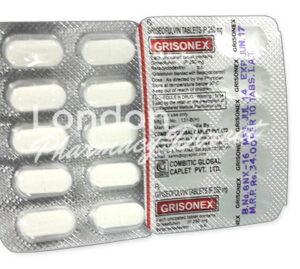
In stock
250mg
from 25,18 £
In brief
- Fulvicin is a griseofulvin tablet, prescribed when ringworm (a dermatophyte infection) has taken hold in skin, scalp, hair or nails.
- Only 250 mg is listed; the quantity choices run through 30, 60, 90, 120, 180 and 360.
- A POM in the UK, where griseofulvin is licensed as 125 mg and 500 mg tablets; the Fulvicin on offer comes from abroad.
Fulvicin and the fungi it can treat
Fulvicin is imported, and its active substance, griseofulvin, is an old antifungal. After absorption the drug settles in keratin, the protein in skin, hair and nails, so newly grown keratin is protected from the fungus and the infected tissue is gradually shed. That is why treatment takes weeks or months and why a nail or patch of skin does not clear overnight. The range is narrow: only dermatophytes are affected. Yeasts such as Candida, moulds such as Aspergillus, Malassezia furfur and the bacterium Nocardia pay no attention to it, which means a yeast infection or pityriasis versicolor is not helped by Fulvicin.
When a doctor chooses it
The UK SmPC keeps griseofulvin for tinea (ringworm) of the skin, scalp, hair and nails that is widespread, or where a cream or lotion is unsuitable or has not worked. The fungus is normally identified first, with a sample of skin, hair or nail, because plenty of red, scaly rashes have nothing to do with fungi and gain nothing from griseofulvin. Nor is it given as a preventive.
250 mg tablets and the length of a course
The 250 mg strength is the only one listed, with 30, 60, 90, 120, 180 or 360 tablets to a pack. For an adult the SmPC gives 500 to 1,000 mg a day, which is two to four tablets as a single dose or in portions, and the daily amount should not drop below 10 mg per kg of body weight. Children receive 10 mg per kg a day, split into portions. A meal containing fat helps absorption, so taking the tablets after eating is ideal. Skin and hair infections need four weeks as a minimum, nail infections six to twelve months. Treatment goes on for two weeks after the infection looks clear. Skin that looks normal after a fortnight is no proof that the fungus has gone; quitting early is a frequent cause of relapse.
When griseofulvin should not be taken
The SmPC lists pregnancy, porphyria, severe liver disease and systemic lupus erythematosus as contraindications, along with hypersensitivity to the drug. A woman must not become pregnant while taking it, nor for one month after the last dose. A man should wait six months after his last dose before trying for a child and should not father one during treatment.
Medicines that clash with it
Oral contraceptives can be less reliable on griseofulvin, so an extra barrier method is advised throughout treatment and for a month after. Warfarin-type anticoagulants and ciclosporin are weakened, while phenobarbital and similar enzyme-inducing sedatives cut the effect of griseofulvin itself. Some people cannot tolerate alcohol while on it. A doctor or pharmacist should hear about Fulvicin before any new medicine is started, since the list is longer than most people expect.
Why finishing the course matters
Fungal infections of hair and nails are slow because the drug only protects keratin that grows after it has been absorbed. A scalp infection in a child, for instance, can take weeks of daily tablets before new hair comes through free of the fungus. Missing doses allows spores that survived to start growing again, which is when a rash returns. Anyone who sees no improvement, or a worsening rash, should return to the prescriber; the diagnosis may need to be reconsidered.
Adverse reactions, and what the UK register shows
The reactions on record are stomach upset, headache, rash and hives, sensitivity to sunlight (so cover up or use sunscreen), dizziness, confusion, poor coordination, peripheral neuropathy, abnormal liver tests and a fall in white cells; serious skin reactions can occur. In the UK griseofulvin is available only on prescription. The electronic medicines compendium lists 125 mg and 500 mg tablets and carries no entry for Fulvicin, so the imported stock here is not one of those packs. The prescriber decides whether Fulvicin is sensible and for how long, taking account of the infection, the site and any other medicines.