Efudix
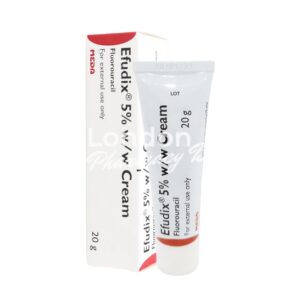
In brief
- In our pharmacy, efudix may be available without a prescription, with discreet delivery in the UK. In many countries it is a prescription-only medicine, so availability can vary depending on local regulations.
- Efudix (fluorouracil) is used to treat actinic keratosis and selected superficial basal cell carcinoma lesions. It works as a topical antimetabolite, interfering with DNA and RNA synthesis in rapidly dividing abnormal skin cells, which helps destroy the treated lesions.
- The usual dose is a thin film applied twice daily, morning and evening. For actinic keratosis, treatment is typically continued for 2–4 weeks; for superficial basal cell carcinoma, it is usually 3–6 weeks and may be extended up to 12 weeks if advised.
- Efudix is supplied as a topical cream, usually 5%, and in some markets as a topical solution. It is applied directly to the affected skin area.
- It usually starts working after several days of regular use, when redness, burning, and inflammation begin to appear in the treated area. Visible lesion improvement is generally seen over the treatment course rather than immediately.
- The duration of action lasts as long as it is applied regularly to the skin, and the treatment effect continues to develop over the full course of therapy. After stopping, the skin may take additional time to heal fully.
- Alcohol does not have a direct known interaction with topical efudix, but it may worsen skin irritation in some people. It is best to limit alcohol if you notice increased flushing, sensitivity, or discomfort during treatment.
- The most common side effects are local skin reactions such as redness, burning, stinging, dryness, scaling, pain, and mild erosion or ulceration at the application site. Photosensitivity can also occur.
- Would you like to try efudix without a prescription?
Basic Efudix Information
- INN (International Nonproprietary Name): Fluorouracil
- Brand names available in United Kingdom: Efudix; generic fluorouracil products may also be supplied
- ATC Code: D06BB03
- Forms & dosages: Topical cream 5%; topical solution 2% and 5%
- Manufacturers in United Kingdom: Not specified
- Registration status in United Kingdom: Prescription only; not OTC
- OTC / Rx classification: Prescription (Rx) only
Everyday Use And Best Practices For Efudex
Morning Vs Evening Dosing
Wondering when to fit Efudix into a normal UK routine?
For actinic keratoses and superficial basal cell carcinoma, fluorouracil cream is usually applied twice daily, once in the morning and once in the evening, exactly as prescribed.
That often works well around school runs, office hours, and evening chores.
Start with clean, dry skin, wash your hands, then apply a thin film only to the prescribed area.
Avoid the eyes, lips, nostrils, and any broken skin, because topical fluorouracil is meant for intact treatment areas only.
Many people find it easiest to build the application into habits they already have, such as after brushing teeth and again before bed.
Taking With Or Without Meals
Because this is a topical skin treatment, it is not taken with meals, and food does not affect the dose.
That makes fluorouracil cream easy to fit around normal UK mealtimes without fasting or planning around breakfast, lunch, or dinner.
Use it only on the prescribed areas, and keep the tube stored at room temperature in the original container.
- Wash and dry the skin first.
- Apply a thin film to the prescribed area.
- Wash your hands again afterwards.
- Use it morning and evening if that is how it has been prescribed.
- Store the tube at room temperature in its original container.
Safety Priorities Before Starting Efudex
Who Should Avoid It
What matters most before starting a prescription cream like Efudix?
The main contraindications are allergy to fluorouracil or any excipients, pregnancy, breastfeeding, and application to the eyes, mucous membranes, or open wounds.
People with DPD deficiency, immunocompromise, or a previous severe reaction to topical chemotherapy need extra caution.
If any of those apply, UK patients should check with the prescriber or pharmacist before starting treatment.
Activities To Limit
Efudex is not known for causing sedation, so driving is not usually the issue.
The practical problem is sore, inflamed skin, which can make outdoor work, manual work, or PPE uncomfortable.
Sun exposure can worsen photosensitivity, and shaving, scrubbing, or harsh skincare can irritate the skin further.
If pain, burning, or signs of infection develop, treatment should be paused and medical advice sought promptly.
- Do not use: on eyes, mucous membranes, open wounds, or if you are allergic to fluorouracil.
- Use with caution: if you are pregnant, breastfeeding, immunocompromised, or have DPD deficiency.
- Seek help urgently: if severe pain, spreading redness, or infection appears.
Dosage And Adjustments For UK Patients
General Regimen
How much fluorouracil 5% cream is usually needed?
For actinic keratosis, the usual regimen is a thin film twice daily for 2 to 4 weeks.
For superficial basal cell carcinoma, it is usually twice daily for 3 to 6 weeks, and sometimes up to 12 weeks.
Clinicians often advise continuing until the skin reaction is sufficient, because the inflammatory response is part of treatment.
If a dose is missed, apply it when remembered unless it is almost time for the next one, and do not double up.
Special Cases
Older adults do not usually need a routine dose adjustment, but they may be more sensitive to irritation.
Renal or liver impairment does not have a formal dose change, although caution is sensible because toxicity may be harder to tolerate.
Safety and efficacy are not established in children, so use is only considered if the benefit justifies the risk.
| Condition | Frequency | Duration | Special Advice |
|---|---|---|---|
| Actinic Keratosis | Twice daily | 2 to 4 weeks | Continue until the prescribed skin reaction is reached |
| Superficial Basal Cell Carcinoma | Twice daily | 3 to 6 weeks, up to 12 weeks | Monitor response carefully and follow clinician advice |
| Elderly | Twice daily if prescribed | As directed | No routine dose change, but irritation may be stronger |
| Children | Not established | Not established | Use only if the prescriber says benefit outweighs risk |
What Patients In The UK Commonly Report
Positive Reports From UK Patients
Why do people keep asking for Efudix when there are other options?
Many patients find it effective for sun-damaged skin and pre-cancerous lesions when it is used consistently.
It is widely used because it is first-line, cost-effective, and familiar to dermatology teams and GP practices.
Clear counselling from a pharmacist is often valued, especially when the patient wants to know what is normal and what is not.
Common Challenges
The common day-to-day issues are redness, stinging, scaling, crusting, soreness, and photosensitivity.
That visible reaction can look alarming, but it is often part of the intended treatment response rather than a sign that the cream has “gone wrong”.
If pain becomes severe, infection is suspected, or the reaction spreads beyond the treated area, the prescriber should review it.
- Pros: effective for sun-damaged lesions, first-line in many cases, and cost-effective on the NHS.
- Cons: visible irritation, soreness, and the need for careful daily adherence.
Buying Efudex In The UK
Pharmacy Sources
Efudex and Efudix are prescription only in the UK, so they should be obtained through an NHS or private prescription.
Community pharmacies, including Boots, LloydsPharmacy, and Superdrug where available, may dispense it once the prescription has been issued.
Properly regulated online pharmacies can also dispense prescription fluorouracil cream if the prescription is valid.
In our online pharmacy, efudix is available without a prescription, with discreet delivery to United Kingdom in 5-14 days.
Price Comparison
The UK pricing picture depends on where the prescription is issued.
In England, prescriptions usually carry a charge, while prescriptions are free in Scotland, Wales, and Northern Ireland.
Private prices vary by brand, pack size, and pharmacy, so checking whether the item is Efudix 5% cream or a generic fluorouracil product can make a difference.
| Supply Route | Typical UK Position | What To Check |
|---|---|---|
| NHS prescription | England usually has a charge; Scotland, Wales, and Northern Ireland are free | Prescribed brand, quantity, and local prescription rules |
| Private prescription | Price varies | Brand, pack size, and pharmacy fee |
| Online pharmacy | Depends on regulation and prescription status | Whether the pharmacy is properly regulated and the prescription is valid |
What Efudex Contains And How It Works
Ingredients Overview
The active ingredient is fluorouracil, and the ATC code is D06BB03.
In the available product data, fluorouracil comes as a 5% cream and as 2% or 5% topical solution.
Brand names differ by country, with Efudix used in Europe and Australia, and Efudex, Carac, Fluoroplex, and Tolak used in the United States.
Mechanism Basics Explained Simply
Fluorouracil is a topical chemotherapeutic agent that targets rapidly dividing abnormal skin cells.
That is why it is used for actinic keratoses and some superficial skin cancers.
As those abnormal cells break down, the skin often becomes red, sore, and flaky, which is part of the expected treatment process.
| Item | Details |
|---|---|
| Active ingredient | Fluorouracil |
| ATC code | D06BB03 |
| Main forms | 5% cream; 2% and 5% topical solution |
| Common brand names | Efudex, Efudix, Carac, Fluoroplex, Tolak |
Main Uses Of Efudex
Approved Uses
What is Efudex actually used for in everyday dermatology?
The main approved uses are actinic keratosis and superficial basal cell carcinoma.
UK patients may hear it described as treatment for sun-damaged skin or pre-cancerous lesions.
It is usually prescribed by dermatology services or primary care when a topical option is suitable.
Off-Label Uses In UK Clinics
Any off-label use should be specialist-led and should never be chosen casually by the patient.
The right treatment depends on the lesion type, location, and the person’s wider health factors.
For clinicians, the choice often comes down to whether a topical chemotherapeutic approach is the best balance of effectiveness and tolerability.
| Indication | Typical Use | Usual Duration |
|---|---|---|
| Actinic Keratosis | First-line topical treatment for sun-damaged lesions | 2 to 4 weeks |
| Superficial Basal Cell Carcinoma | Topical option for selected lesions | 3 to 6 weeks, sometimes up to 12 weeks |
Interaction Warnings And Practical Precautions
Food Interactions
Are tea, coffee, alcohol, or meals an issue?
No meaningful food interactions are expected, because Efudex is applied to the skin rather than swallowed.
Alcohol, tea, and coffee do not directly change how the cream works.
Sun exposure is a much bigger practical problem than diet, so gentle skincare and sensible sun avoidance matter more.
Drug Conflicts
Serious drug interactions are less of a concern than with oral medicines, but all creams, cosmetics, and prescription treatments should still be mentioned to the clinician.
Other irritating skin products, retinoids, or treatments that make inflammation worse can be a problem.
Any suspected side effect can be reported through the MHRA Yellow Card scheme.
- OK: normal food and drink, provided the skin is protected from excess sun.
- Use caution: retinoids, exfoliants, harsh cleansers, and other irritating topical products.
- Ask a pharmacist: if you are using several skin treatments at once.
Latest Evidence And Clinical Insight
Key UK And EU Studies
Recent UK and European practice continues to support topical fluorouracil as a well-established treatment for actinic keratoses and selected superficial non-melanoma skin cancers.
The practical message from this evidence is straightforward: adherence matters, and the treatment reaction often predicts response.
Clinicians still use Efudix and generic fluorouracil because the drug is familiar, widely available, and supported by long-standing experience.
What This Means For Patients
The best real-world outcomes tend to come when patients follow the prescribed schedule and know when to ask for review.
That matters more than trying to judge the skin day by day in isolation.
| What The Evidence Suggests | What Patients Should Do |
|---|---|
| Adherence improves outcomes | Apply the cream exactly as prescribed |
| Skin reaction is expected | Prepare for redness, stinging, and scaling |
| Review may be needed | Contact the prescriber if pain or infection becomes a concern |
Alternatives To Efudex
NHS Prescribing Alternatives
Which option is chosen depends on the lesion type, skin sensitivity, convenience, and the clinician’s preference.
Common alternatives include Aldara, which contains imiquimod; Solaraze, which contains diclofenac gel; and the former Picato, which contained ingenol mebutate.
Carac and Tolak are fluorouracil-based alternatives, so they sit closer to Efudex in terms of active ingredient.
Pros And Cons
Some people prefer shorter or less inflamed regimens, while others prefer the established track record of fluorouracil cream.
- Pros: widely used, cost-effective, strong evidence base, and familiar to UK clinicians and pharmacists.
- Cons: visible irritation, the need for daily adherence, and possible discomfort at work or in social situations.
| Alternative | Main Strength | Main Limitation |
|---|---|---|
| Aldara | Different treatment approach for selected lesions | May still cause local skin reaction |
| Solaraze | Topical option for actinic keratosis | Different response profile and suitability |
| Carac / Tolak | Fluorouracil-based alternative | Choice depends on formulation and availability |
Regulation Snapshot For The United Kingdom
MHRA Approval And NHS Prescribing Framework
Efudex and Efudix are prescription only and not available over the counter in the UK.
The wider regulatory picture includes FDA approval in the United States for actinic keratosis and superficial basal cell carcinoma, EMA availability in Europe, TGA registration in Australia, and ANMDMR registration in Romania.
For UK patients, the safe route is always through a prescriber and a legitimate pharmacy.
What Patients Should Know
Unregulated “skin cancer creams” sold online should be avoided.
A legitimate pharmacy will require a valid prescription and should provide counselling on how to use the product safely.
| Issue | UK Position |
|---|---|
| Prescription status | Prescription only |
| Over-the-counter sale | Not permitted |
| Legitimate supply | Via prescriber and regulated pharmacy |
Frequently Asked Questions
Common Questions
How long does Efudex take to work? Usually over weeks, depending on the condition and the prescribed course.
Can I use make-up or moisturiser? Only if the prescriber says it is suitable, and products should be gentle and non-irritating.
What if the skin gets very sore? Contact the prescriber or pharmacist for advice.
Is it available on the NHS? Yes, when prescribed, subject to the usual UK prescription rules.
Practical Answer Style
Short, direct answers tend to help most people, especially when the skin is already sore and they need to know what to do next.
There is no need to memorise pathology detail at home.
What matters is using the cream safely, watching for red flags, and asking for review when something does not look right.
Proper Use And Pharmacist-Style Counselling
UK Pharmacist Counselling Style
How should Efudix be used safely at home?
Wash your hands, apply a thin film to the prescribed area, avoid the eyes and lips, wash your hands again, and use sun protection.
Store the tube at room temperature, protected from excessive heat and light, and do not freeze it.
Keep it in the original container, and if a dose is missed, apply it as soon as remembered unless the next one is due soon.
- Wash hands before and after application.
- Apply only a thin film to the treated skin.
- Avoid eyes, lips, nostrils, and broken skin.
- Use sun protection and avoid extra irritation.
- Store at room temperature in the original container.
NHS Patient Support Advice
Seek help if severe pain, spreading redness, signs of infection, accidental eye contact, or swallowing the product occurs.
Contact the GP, prescriber, community pharmacist, or NHS services if anything feels unclear.
In UK practice, pharmacists are often the first and most trusted point of contact for day-to-day questions about topical fluorouracil.
- How to use safely: follow the prescribed schedule, keep the application thin, and protect the skin from sun and irritation.
- When to seek help: severe pain, infection, accidental eye exposure, or suspected swallowing of the cream.
Delivery Across United Kingdom
| City | Region | Delivery time |
|---|---|---|
| London | England | 5-7 days |
| Birmingham | England | 5-7 days |
| Manchester | England | 5-7 days |
| Leeds | England | 5-7 days |
| Liverpool | England | 5-7 days |
| Sheffield | England | 5-7 days |
| Bristol | England | 5-7 days |
| Newcastle upon Tyne | England | 5-7 days |
| Edinburgh | Scotland | 5-7 days |
| Glasgow | Scotland | 5-7 days |
| Cardiff | Wales | 5-7 days |
| Belfast | Northern Ireland | 5-7 days |
| Nottingham | England | 5-9 days |
| Southampton | England | 5-9 days |
| Aberdeen | Scotland | 5-9 days |