Premarin
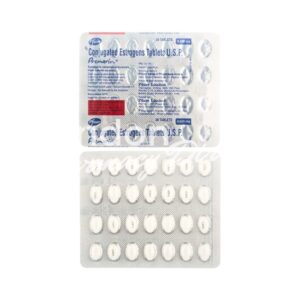
In brief
- In our pharmacy you can buy Premarin without a prescription, with delivery in 9–21 days throughout the United Kingdom. Discreet and anonymous packaging.
- Premarin (conjugated oestrogens) is used for hormone replacement therapy to relieve vasomotor and urogenital symptoms of menopause, and for prevention of postmenopausal osteoporosis; it works by replacing or supplementing endogenous oestrogens and activating oestrogen receptors.
- Usual doses in adults are 0.3–1.25 mg daily for menopausal symptoms (typical starting doses 0.3 or 0.625 mg); 0.625 mg daily is commonly used for osteoporosis prevention.
- Premarin is taken orally as tablets (0.3 mg, 0.625 mg and 1.25 mg).
- Some symptom relief may begin within days, but noticeable improvement in vasomotor symptoms is usually seen within 1–2 weeks, with maximal effect often after 2–6 weeks of treatment.
- The daily dose provides roughly 24-hour symptom control; bone-protective effects develop over months and benefits persist only while treatment is continued.
- Avoid excessive alcohol while taking premarin — alcohol can increase liver burden, may worsen side effects and can increase risks such as thromboembolism; discuss alcohol use with your prescriber or pharmacist.
- The most common side effect is headache.
- Would you like to try Premarin without a prescription?
Basic Premarin information
- INN (international nonproprietary name): Conjugated oestrogens.
- Brand names available in the United Kingdom: Premarin (Pfizer) — tablet strengths 0.3 mg, 0.625 mg and 1.25 mg; boxed in 28s.
- ATC code: G03CA57 — oestrogens for systemic use (conjugated natural oestrogens).
- Forms and dosages: Tablets 0.3 mg, 0.625 mg, 1.25 mg.
- Manufacturers in the United Kingdom: Pfizer.
- Registration status in the United Kingdom: Prescription-only medicine (POM).
- OTC / Rx classification: Prescription-only medicine (POM).
Read the MHRA patient information leaflet and follow your GP or pharmacist’s advice before starting Premarin as this is a prescription-only medicine.
Keep the batch number to hand in case of any adverse event and store Premarin at room temperature (15–30°C) in its original packaging away from moisture and light.
If you miss a dose, take it as soon as you remember or skip it if it is almost time for the next dose and do not double up.
Do not use Premarin if you smoke, have had deep vein thrombosis or stroke, or have unexplained vaginal bleeding — these are listed as contraindications and should be discussed with your prescriber.
Discuss repeat prescribing with your GP or local pharmacist.
Everyday use and best practices
Morning vs evening dosing
Many patients take Premarin at the same time each day to maintain steady blood levels and to build a simple routine.
Some people prefer morning dosing with breakfast to make the medicine part of their daily routine, while others find evening dosing reduces mild nausea.
If you work shifts or have irregular meal patterns, choose a reliable cue such as after brushing your teeth or before a regular break, and set a phone alarm.
Premarin tablets supplied in the UK commonly come in 0.3 mg, 0.625 mg and 1.25 mg strengths, and your prescriber will advise which strength suits you.
Taking with or without meals (UK diet habits)
Premarin can be taken with or without food, and taking it with a light UK-style breakfast often reduces mild nausea.
Avoid heavy alcohol the night before if you are concerned about nausea or fluid retention, and monitor any bloating or weight changes that can occur with oestrogen therapy.
For people taking several medicines, using a pill organiser or having pharmacy-managed blister packs helps adherence.
UK pharmacists are well placed to counsel on conjugated oestrogens tablets, and asking for a short demonstration of a dosing routine can be helpful.
- Daily routine checklist — take at same time; store at 15–30°C; carry patient leaflet; set an alarm; log symptoms for GP review.
- Pill organiser options — weekly organiser, blister packs from pharmacy, or pharmacy reminder services.
Safety priorities
Who should avoid it (MHRA warnings)
Premarin is contraindicated in people with unexplained vaginal bleeding, known or suspected breast or uterine cancer, active or previous DVT/PE, recent stroke or myocardial infarction, and severe liver dysfunction.
Pregnancy and breastfeeding are also absolute exclusions for systemic conjugated oestrogens.
Make sure your GP is aware of any history of thromboembolism, cardiovascular disease, or oestrogen-dependent tumours before prescribing.
Activities to limit (driving, work safety)
Some patients experience dizziness, headaches or visual disturbance while on oestrogen therapy; if these occur, avoid driving or safety-critical tasks until they clear.
Jobs that involve prolonged immobility or safety-critical responsibilities should prompt a VTE risk discussion with the prescriber, especially if you smoke or are obese.
Stop smoking using NHS Stop Smoking services to lower thromboembolic risk, stay active, and seek emergency help for sudden leg swelling or breathlessness.
- Red flags — sudden shortness of breath, chest pain, unilateral leg swelling, severe abdominal pain, sudden severe headache, unexplained vaginal bleeding.
| Absolute contraindications | Relative contraindications |
|---|---|
| Undiagnosed vaginal bleeding; known or suspected breast/uterine cancer; active/past DVT/PE; recent stroke/MI; severe liver dysfunction; pregnancy/breastfeeding. | Chronic hypertension; diabetes; hereditary angioedema; moderate organ impairment; obesity/smoking/prolonged immobilisation. |
Dosage and adjustments
General regimen (NHS guidance)
For menopausal symptoms Premarin is usually prescribed at 0.3–1.25 mg once daily, with common starting doses being 0.3 mg or 0.625 mg.
For prevention of postmenopausal osteoporosis a dose of 0.625 mg daily is commonly used where HRT is appropriate.
NHS practice is to start at the lowest effective dose and to review symptoms and side effects at around three months, using the minimal duration required.
Special cases (elderly, comorbidities)
Elderly patients should receive the lowest effective dose and be screened for VTE, stroke and cardiovascular risk factors before and during therapy.
Use cautiously in renal impairment and avoid in severe hepatic dysfunction.
| Indication | Typical dose |
|---|---|
| Menopausal symptoms | 0.3–1.25 mg daily (start 0.3 or 0.625 mg) |
| Osteoporosis prevention | 0.625 mg daily |
| Other oestrogen-deficiency states | Individualised by the prescriber |
- Monitoring checklist — baseline VTE/cardiovascular assessment, 3-month review, annual reassessment, record brand and batch for safety monitoring.
Legal status and availability in the UK
Premarin is a prescription-only medicine (POM) in the UK.
In our online pharmacy, Premarin is available without a prescription, with discreet delivery to the United Kingdom in 9–21 days.
What’s inside and how it works
Ingredients overview
The active substance in Premarin is conjugated oestrogens, historically derived from equine sources and consisting of a mixture of naturally occurring oestrogens.
The product is classified under ATC code G03CA57 as systemic conjugated natural oestrogens.
Tablet strengths available in the UK include 0.3 mg, 0.625 mg and 1.25 mg, and excipients can vary so check the patient leaflet for lactose or dyes if you have allergies.
Mechanism basics explained simply
Premarin supplies systemic oestrogen to replace falling endogenous levels at menopause and reduces vasomotor symptoms such as hot flushes and night sweats.
Oestrogen acts on receptors in the brain, bone, vaginal tissue and cardiovascular system, improving symptoms and helping to maintain bone density.
When a uterus is present a progestogen is usually added to HRT to reduce the risk of endometrial cancer associated with unopposed oestrogen.
| Active ingredient | ATC code | Common tablet strengths |
|---|---|---|
| Conjugated oestrogens | G03CA57 | 0.3 mg, 0.625 mg, 1.25 mg |
Main indications
Approved uses (MHRA listing)
Premarin is licensed for use as hormone replacement therapy to relieve vasomotor and urogenital symptoms of menopause.
It is also licensed for prevention of postmenopausal osteoporosis in women at increased risk of fracture who cannot take other suitable medicines.
Off-label uses in UK clinics
In some UK clinical settings clinicians tailor oestrogen regimens for premature ovarian insufficiency or as part of transgender care, always with informed consent and monitoring.
Off-label use should be documented and accompanied by a clear discussion of risks and benefits and an agreed follow-up plan including bone health monitoring where relevant.
- Indication checklist — menopausal vasomotor symptoms, urogenital atrophy, osteoporosis prevention.
- Monitoring steps — baseline risk assessment, symptom review at 3 months, bone density if used for osteoporosis prevention.
Interaction warnings
Food interactions (alcohol, tea/coffee)
Premarin has no specific food interactions requiring avoidance of particular foods, but alcohol can worsen nausea and affect liver function, so moderation is advised.
High caffeine intake from tea or coffee may aggravate anxiety or sleep disturbance for some patients on oestrogen therapy; monitor symptoms and reduce intake if needed.
Drug conflicts
CYP enzyme-inducing medicines such as some anticonvulsants and rifampicin can lower oestrogen levels and reduce effectiveness, so prescribers may need to adjust therapy.
Anticoagulant therapy requires careful INR monitoring if started or changed while taking systemic oestrogens.
Herbal remedies such as St John’s wort may interact and should be discussed with your pharmacist; report any suspected adverse reactions via the MHRA Yellow Card scheme.
| Drug/class | Action required |
|---|---|
| Enzyme Inducers (e.g., rifampicin, some anticonvulsants) | May reduce oestrogen levels; consider dose change or alternative therapy |
| Anticoagulants | Monitor INR closely when starting/stopping oestrogen therapy |
Alternative choices
There are several NHS-prescribed alternatives to Premarin including estradiol-based oral tablets such as Progynova, transdermal patches such as Evorel and gels such as Oestrogel.
Transdermal estradiol bypasses first-pass hepatic metabolism and is often preferred for patients with higher VTE risk.
Local vaginal oestrogens such as Ovestin or low-dose estriol preparations provide targeted relief for urogenital symptoms with minimal systemic absorption.
Non-hormonal options for hot flushes include certain SSRIs/SNRIs and gabapentin for those who cannot take HRT.
| Option | Pros | Cons |
|---|---|---|
| Premarin (conjugated oestrogens) | Effective systemic relief | Absolute contraindications; systemic risks |
| Oral estradiol | Similar efficacy; familiar formulations | First-pass hepatic effects |
| Transdermal estradiol | Lowers VTE risk vs oral; steady delivery | Patch site reactions |
| Vaginal oestrogens | Targeted for urogenital symptoms; low systemic absorption | Not for systemic vasomotor symptoms |
Regulation snapshot
Premarin (conjugated oestrogens, ATC G03CA57) is a prescription-only medicine manufactured by Pfizer.
The MHRA oversees safety updates and product information, and clinicians follow NICE and local formularies when initiating HRT.
GPs perform baseline risk assessments covering breast, cardiovascular and VTE risk, issue repeat prescriptions with scheduled reviews (commonly at three months then annually) and manage pharmacovigilance actions.
Suspected adverse reactions should be reported via the MHRA Yellow Card scheme and complex cases referred to secondary care as needed.
- Regulatory checklist — confirm MHRA updates, check local formulary, perform baseline screening, arrange follow-up.
- Who to contact — GP for prescribing, pharmacist for counselling, MHRA for Yellow Card reporting.
FAQ
Will Premarin make me gain weight?
Weight change and fluid retention can occur with oestrogen therapy; monitor diet and activity and discuss persistent weight gain with your GP for dose review.
How long before I feel better?
Many patients notice improvement in hot flushes within 1–4 weeks, while full benefits can take up to three months; arrange a three-month review with your GP.
Can I take Premarin if I have had A DVT in the past?
No — a history of DVT or PE is an absolute contraindication to systemic conjugated oestrogens and alternative therapies or specialist referral are required.
Is Premarin available without a prescription?
No. In the UK Premarin is a prescription-only medicine (POM).
- What to tell your prescriber — any past VTE, current medicines, smoking status, recent surgeries, family history of breast cancer, and any allergies.
Guidelines for proper use
Pharmacist counselling should confirm your identity and indication, verify tablet strength (0.3 mg, 0.625 mg, 1.25 mg), explain dosing schedule and missed-dose action and review storage advice at 15–30°C in the original pack.
Counselling should also cover contraception if relevant, signs of VTE and when to seek urgent care for unexplained bleeding or new severe symptoms.
Encourage use of adherence aids such as blister packs, reminder apps or pharmacy-managed repeat dispensing and signpost to NHS menopause services for complex needs.
NHS patient support usually includes a GP review at three months, discussion about continuing HRT if under 50, and baseline checks such as blood pressure and weight where indicated.
- Pharmacist counselling checklist — identity, indication, dose/strength, missed dose guidance, storage, adverse event reporting via Yellow Card.
- Patient leaflets — offer NHS and MHRA leaflets and signpost to local menopause clinics for additional support.
Delivery across the United Kingdom
| City | Region | Delivery Time |
|---|---|---|
| London | England | 9–21 days |
| Birmingham | England | 9–21 days |
| Manchester | England | 9–21 days |
| Glasgow | Scotland | 9–21 days |
| Leeds | England | 9–21 days |
| Liverpool | England | 9–21 days |
| Bristol | England | 9–21 days |
| Sheffield | England | 9–21 days |
| Edinburgh | Scotland | 9–21 days |
| Cardiff | Wales | 9–21 days |
| Belfast | Northern Ireland | 9–21 days |
| Newcastle | England | 9–21 days |
| Nottingham | England | 9–21 days |
| Southampton | England | 9–21 days |
| Plymouth | England | 9–21 days |