Mirapex
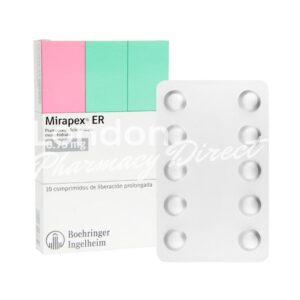
In brief
- In our pharmacy you can buy Mirapex without a prescription, with delivery across the United Kingdom in 9–21 days and discreet, anonymous packaging.
- Mirapex (pramipexole) is used to treat Parkinson’s disease and restless legs syndrome (RLS); it is a dopamine agonist that stimulates D2/D3 receptors in the brain to restore dopaminergic activity.
- Usual dosages: Parkinson’s — start 0.125 mg three times daily (IR) or 0.375 mg once daily (ER), increase by 0.125 mg TID every 5–7 days as needed, maximum 4.5 mg/day; RLS — 0.125 mg once daily 2–3 hours before bedtime, titrate up to 0.5 mg/day.
- Form of administration: oral tablets (immediate‑release and extended‑release) in multiple strengths ranging from about 0.088 mg to ER formulations up to 4.5 mg.
- Onset time: plasma levels for IR tablets peak in approximately 1–3 hours (ER formulations are slower); symptomatic improvement may be noticed within days, with fuller benefit over several weeks.
- Duration of action: immediate‑release dosing typically provides symptom control for around 8–12 hours; extended‑release preparations are formulated for once‑daily, roughly 24‑hour coverage.
- Alcohol warning: avoid or limit alcohol while taking mirapex — alcohol can increase drowsiness, dizziness and the risk of orthostatic hypotension and impaired alertness.
- The most common side effect is nausea; other frequent adverse effects include drowsiness/fatigue, dizziness, insomnia, dry mouth, constipation, hallucinations and peripheral oedema.
- Would you like to try Mirapex without a prescription?
Initial instructions, warnings and daily-life integration
Pramipexole (branded Mirapexin in the United Kingdom) is prescription-only and must be obtained via your GP or a neurology clinic.
Keep the pharmacy leaflet and MHRA/NHS advice to hand and read them when you start or change dose.
Watch for sudden sleepiness, dizziness, hallucinations and changes in behaviour such as gambling or hypersexuality and tell your prescriber straight away.
Do not stop pramipexole suddenly; discuss a gradual taper with your GP or neurologist.
Overdose requires urgent hospital care; store tablets at 15–30°C in the original blister and keep out of reach of children.
Use a weekly pillbox, phone reminders or the NHS app to track repeats, and tell family or carers about potential behavioural changes.
Basic Mirapex information
- INN (international nonproprietary name): Pramipexole.
- Brand names available in the United Kingdom: Mirapexin; generic pramipexole tablets.
- ATC code: N04BC05.
- Forms and dosages: Immediate-release tablets 0.088 mg to 1.1 mg (pramipexole base); extended-release tablets 0.375 mg to 4.5 mg (salt).
- Manufacturers in the United Kingdom: Boehringer Ingelheim (innovator, Mirapexin) and generics supplied by Teva, Accord, Sandoz, Stada, Zentiva, Mylan, Krka.
- Registration status in the United Kingdom: MHRA-licensed; pramipexole is prescription-only.
- OTC / Rx classification: Prescription-only medicine (POM)
Everyday use and best practices
Morning vs evening dosing
Do you wonder whether to take pramipexole in the morning or evening?
For Parkinson’s disease, immediate‑release pramipexole is usually given three times daily while extended‑release works once daily for convenience.
Extended‑release (ER) formulations are often taken in the morning, providing steady plasma levels and fewer daytime peaks and troughs.
For restless legs syndrome (RLS), a single small evening dose usually 2–3 hours before bed is typical to aid sleep onset.
Taking with or without meals (UK diet habits)
Pramipexole may be taken with or without food and a starchy English breakfast or evening meal does not markedly alter effect.
Taking tablets with food can reduce early nausea, a common side effect when treatment starts.
Avoid very large amounts of alcohol around dosing as it may increase drowsiness and hypotension.
Practical timing and tips
- Set NHS app reminders or phone alarms for each dose.
- Use a blister calendar or weekly pillbox if using IR tablets TID.
- If using ER once‑daily, take at the same time each morning for best adherence.
- Carry an up-to-date medicines list when attending NHS clinics or A&E.
- Ask your pharmacist to check for interactions with other medicines.
Checklist for adherence
- Confirm whether your prescription is IR or ER.
- Note the start date and current dose in the NHS record.
- Inform carers about behavioural warning signs.
- Use repeat dispensing or electronic repeat prescriptions where eligible.
Safety priorities
Who should avoid it (MHRA warnings)
Who must be reviewed carefully before starting pramipexole?
Do not use pramipexole if you have a known hypersensitivity to the drug or any excipient.
Use caution in severe renal impairment as dose adjustments or longer dosing intervals are required.
Patients with psychotic disorders, active hallucinations or a history of impulsive behaviours need close specialist review.
Pregnancy and breastfeeding require a careful risk‑benefit discussion and pramipexole is generally avoided unless essential.
Activities to limit (driving, work safety)
Pramipexole can cause drowsiness, dizziness and sudden sleep onset; avoid driving or operating machinery until you know how it affects you.
The DVLA requires drivers to inform them if medication causes sleepiness or alters alertness.
Tell your employer or occupational health if you hold a safety-critical post; adjustments may be needed.
Contraindications and actions
| Contraindication / caution | Recommended action |
|---|---|
| Hypersensitivity to pramipexole | Do not prescribe; return medicine and seek alternative. |
| Severe renal impairment | Reduce starting dose and extend titration intervals. |
| History of impulse-control disorders | Monitor closely; stop if problematic behaviours occur. |
| Psychotic disorders | Avoid if active psychosis; specialist input required. |
Dosage and adjustments
General regimen (NHS guidance)
How is pramipexole usually started and increased?
For Parkinson’s disease immediate‑release (IR) commonly starts at 0.125 mg three times daily with increments by about 0.125 mg TID every 5–7 days to effect up to a usual max of 4.5 mg/day.
Extended‑release (ER) starts at 0.375 mg once daily and is titrated according to response and tolerability.
For RLS, a single 0.125 mg dose 2–3 hours before sleep is a typical initiation with cautious titration up to 0.5 mg/day.
Special cases (elderly, comorbidities)
Elderly patients need slower titration and lower maintenance doses because of increased sensitivity and common renal impairment.
In moderate to severe renal impairment extend dosing intervals and reduce doses per the product datasheet.
There is no established paediatric dosing and use in children is not recommended.
Dosage table and checklist
| Condition | Typical start | Maintenance / max |
|---|---|---|
| Parkinson’s (IR) | 0.125 mg TID | Titrate, up to 4.5 mg/day |
| Parkinson’s (ER) | 0.375 mg once daily | Titrate as needed |
| RLS | 0.125 mg once nightly | Up to 0.5 mg once daily |
- Document current dose in the NHS record and on repeat prescriptions.
- Ask your pharmacist to confirm tablet strengths — UK packs include 0.088, 0.18, 0.7 mg and ER options.
Legal status and availability in the UK
Mirapex is a prescription-only medicine (POM) in the UK.
In our online pharmacy, Mirapex is available without a prescription, with discreet delivery to the United Kingdom in 9–21 days.
What’s inside and how it works
Ingredients overview
The active ingredient is pramipexole (INN).
Immediate‑release tablets are available in a range from 0.088 mg to 1.1 mg (base) and extended‑release tablets from 0.375 mg to 4.5 mg in the UK.
The UK brand is Mirapexin, with generics from Teva and others; excipients vary by manufacturer so check the leaflet for allergies.
Mechanism basics explained simply
Pramipexole is a dopamine agonist that stimulates dopamine receptors in the brain to help restore dopaminergic signalling lost in Parkinson’s disease.
In RLS it reduces sensory-motor symptoms and helps patients fall asleep sooner.
ER formulations maintain steadier blood levels to reduce fluctuations and support once‑daily dosing.
Ingredient table and practical note
| Component | Role |
|---|---|
| Pramipexole | Active dopamine agonist |
| Excipients | Tablet core and release modifiers; differ between manufacturers |
If you have allergies to tablet excipients, request an alternative manufacturer via the pharmacist.
Main indications
Approved uses (MHRA listing)
Pramipexole is authorised in the UK for Parkinson’s disease as monotherapy in early disease and as adjunctive therapy with levodopa.
It is also authorised for Restless Legs Syndrome (RLS) as a monotherapy option.
The MHRA lists both immediate‑release and extended‑release formulations for these indications.
Off-label uses in UK clinics
Some neurologists tailor regimens for specific movement disorder phenotypes to manage levodopa-related fluctuations; such approaches are clinician-directed.
Pramipexole is not recommended for children because dosing is not established.
Indication checklist
- Confirm indication on the prescription (Parkinson’s or RLS).
- Check whether the prescriber intended IR or ER formulation.
- Arrange monitoring for side effects and behavioural changes.
| Condition | Typical regimen |
|---|---|
| Parkinson’s | IR TID start 0.125 mg or ER once‑daily start 0.375 mg |
| RLS | Single small evening dose 0.125 mg |
Interaction warnings
Food interactions (alcohol, tea/coffee)
There are no major interactions with ordinary foods but alcohol can add to drowsiness and worsen orthostatic hypotension.
Caffeine from tea or coffee may mask tiredness but will not prevent sudden sleep episodes caused by pramipexole.
Advise moderation of alcohol particularly when starting or increasing dose.
Drug conflicts
Pramipexole may interact with other central nervous system depressants increasing sedation.
Some antipsychotics may antagonise dopamine agonists and reduce efficacy; specialist input is required if these are co-prescribed.
Pharmacists routinely screen for interactions and should be shown all OTC medicines and supplements at collection.
Practical interaction checklist
- Show a full medicines list to your pharmacist.
- Report serious adverse events to the MHRA Yellow Card scheme.
- Keep the NHS record up-to-date with all new medicines and supplements.
Alternative choices
NHS prescribing alternatives with pros/cons checklist
What are the common alternatives to pramipexole on the NHS?
Ropinirole (Requip/generics) has similar efficacy and tolerability for many patients.
Rotigotine (Neupro) is a transdermal patch offering steady delivery and is useful for patients with swallowing problems.
Apomorphine is reserved for advanced fluctuations as rescue therapy and requires specialist review.
When to discuss switching
Consider switching if side effects such as severe hallucinations, marked somnolence or impulse‑control disorders occur.
Switch also when symptom control is inadequate or renal impairment makes continued dosing difficult.
Changes should be planned with a GP or neurologist and supported by the dispensing pharmacist.
Quick pros/cons checklist
| Option | Pros | Cons |
|---|---|---|
| Ropinirole | Oral, similar effect | Similar behavioural risks |
| Rotigotine patch | Once daily patch, good for swallowing issues | Skin reactions possible |
| Apomorphine | Rescue for off periods | Specialist supervised, injection form |
Regulation snapshot
MHRA approval and NHS prescribing framework
Pramipexole is authorised in the UK as the brand Mirapexin, and many generics are available.
The MHRA sets guidance on indications, labelling and safety monitoring.
Pramipexole remains a prescription-only medicine under UK law.
Prescriptions, repeats and online supply rules
GPs and specialists issue prescriptions which can be dispensed at community pharmacies or via NHS repeat prescriptions.
Online pharmacies must hold a valid prescription and be registered with the General Pharmaceutical Council to supply pramipexole.
Prescribing pathway checklist
- Initial prescription from GP or specialist.
- Follow-up monitoring arranged by clinic or GP.
- Repeat dispensing through community pharmacy where eligible.
FAQ
Will pramipexole make me sleepy?
Yes, pramipexole can cause drowsiness and may trigger sudden sleep episodes in some people.
Avoid driving until you know how the medicine affects you and report excessive sleepiness to your GP.
Can I drink alcohol?
Moderate alcohol may increase drowsiness and orthostatic effects and should be limited when starting or increasing dose.
What if I miss a dose?
Take the missed dose as soon as you remember unless it is close to the next scheduled dose and do not double up.
Follow the leaflet for ER formulations as timing guidance differs from IR tablets.
How long before I see benefit?
RLS benefit can be seen within one night or a few days of a small evening dose.
Parkinson’s symptom improvement usually takes several weeks with titration to effect.
Red flags requiring urgent care
- Severe confusion, agitation or hallucinations.
- Syncope or severe hypotension.
- Sudden uncontrollable behavioural changes or suicidal thoughts.
Guidelines for proper use
UK pharmacist counselling style
Pharmacists should confirm indication, dose, formulation and review renal function when counselling patients on pramipexole.
Common side effects to counsel on include nausea, somnolence, hallucinations, constipation and peripheral oedema.
Pharmacists should check pack strength and offer written leaflets and MHRA guidance where appropriate.
NHS patient support advice
GPs and neurology teams arrange follow-up for dose adjustments and monitoring of behavioural effects and blood pressure.
Use the NHS app to manage repeat prescriptions and local support groups for Parkinson’s or RLS for peer support.
Carers should be briefed to watch for impulse‑control signs and sudden sleep episodes.
Practical counselling checklist and script
- Confirm name and indication on the prescription.
- Explain start dose, titration plan and timing (IR vs ER).
- Advise storage at 15–30°C in the original blister, away from children.
- Encourage Yellow Card reporting and follow-up with GP if side effects appear.
Delivery across the United Kingdom
| City | Region | Delivery Time |
|---|---|---|
| London | Greater London | 9–21 days |
| Birmingham | West Midlands | 9–21 days |
| Manchester | Greater Manchester | 9–21 days |
| Glasgow | Scotland | 9–21 days |
| Leeds | West Yorkshire | 9–21 days |
| Liverpool | Merseyside | 9–21 days |
| Bristol | South West England | 9–21 days |
| Edinburgh | Scotland | 9–21 days |
| Sheffield | South Yorkshire | 9–21 days |
| Newcastle | Tyne and Wear | 9–21 days |
| Cardiff | Wales | 9–21 days |
| Belfast | Northern Ireland | 9–21 days |