Amoxicillin
In brief
- Amoxicillin is a prescription-only medicine (POM) in the UK. It is used for bacterial infections, including sinusitis, otitis media, chest infections, urinary tract infections, and as part of combination treatment for Helicobacter pylori. It works by inhibiting bacterial cell wall synthesis, which kills susceptible bacteria.
- The usual dose of amoxicillin depends on the infection: adults commonly take 500 mg every 8 hours (up to 1 g every 8 hours in severe infection); children are usually dosed by weight, often 20–50 mg/kg/day in divided doses, with higher doses used for some infections. Always follow the prescriber’s instructions or local guidelines.
- Amoxicillin is available as capsules, tablets, dispersible tablets, powder for oral suspension, sachets, and as an injection for hospital use.
- The effect usually begins within 1 to 2 hours after taking a dose, although symptom improvement may take 24 to 72 hours as the infection starts to clear.
- The duration of action is around 8 to 12 hours, which is why it is often taken three times daily.
- Alcohol does not have a major direct interaction with amoxicillin, but it is best avoided or limited because it may worsen side effects such as stomach upset and can slow recovery from infection.
- The most common side effects are diarrhoea, nausea, vomiting, abdominal discomfort, rash, and headache. Seek urgent help if signs of allergy occur, such as swelling, wheezing, or difficulty breathing.
- Would you like to try amoxicillin without a prescription?
Basic amoxicillin information
- INN (international nonproprietary name): Amoxicillin
- Brand names available in the United Kingdom: Amoxil; generic amoxicillin is supplied more often than brand names
- ATC code: J01CA04
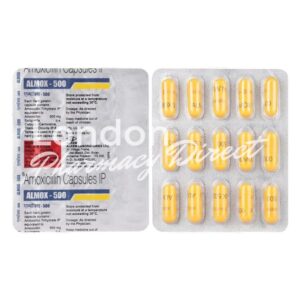
- Forms and dosages: Capsules 250 mg, 500 mg; tablets 500 mg; oral suspension powder 125 mg/5 mL, 250 mg/5 mL; dispersible tablets; sachets; injection 500 mg, 1 g (hospital use)
- Manufacturers in the United Kingdom: GlaxoSmithKline, Sandoz, Mylan, Sun Pharma
- Registration status in the United Kingdom: Prescription-only medicine (POM)
- OTC / Rx classification: Prescription-only medicine (POM)
Everyday use and best practices
Taking amoxicillin can feel straightforward, but the small details matter when you are trying to fit treatment around a normal day.
The NHS dosing routine is usually about evenly spaced times, exactly as prescribed by the GP or prescriber.
If you have twice-daily amoxicillin tablets or amoxicillin capsules, it helps to link them to school runs, work breaks, and bedtime so the doses are not missed.
A late-night dose should usually be taken as advised rather than shifting the whole schedule without checking first.
For families using amoxicillin suspension, a simple checklist often works best:
- Take the dose at the same times each day.
- Set phone reminders for morning and evening.
- Keep the bottle where it will be seen, but safely out of children’s reach.
- Use the measuring spoon, syringe, or cup supplied with the medicine.
Amoxicillin can usually be taken with or without food.
If you or your child has a sensitive stomach, taking it after a light meal or snack may help reduce nausea.
Simple UK examples include breakfast toast, a lunchtime sandwich, or an evening meal.
That makes amoxicillin 500mg or amoxicillin 250mg easier to remember, especially when life is busy.
Morning vs evening dosing
Morning and evening doses are often the easiest to stick to because they fit around getting up and going to bed.
For people working shifts, the real aim is to keep the spacing even, not to make every dose land at the same clock time forever.
That matters because regular timing helps keep treatment steady, whether you have amoxicillin tablets, amoxicillin capsules, or a liquid.
Taking with or without meals
Food is not usually required, but it can make a difference if you feel queasy.
A light meal is often enough, so there is no need for a heavy lunch if that does not suit you.
For many UK patients, the easiest routine is simply taking the dose after breakfast, after lunch, or after tea.
Safety priorities
Before starting amoxicillin, the main question is simple: is it safe for you?
Because amoxicillin is prescription-only, it should not be used by anyone with a known allergy to amoxicillin, penicillins, excipients, or a previous anaphylactic reaction to beta-lactam antibiotics.
Extra caution is needed in people with asthma, frequent allergies, glandular fever, renal impairment, or severe liver disease.
If there has ever been an antibiotic rash, speak to a pharmacist, NHS 111, a GP, or the prescriber before taking it.
Who should avoid it
Any history of a serious penicillin allergy needs careful review.
That includes swelling, breathing problems, or a severe skin reaction after a beta-lactam antibiotic.
People with a tendency to allergies may still be able to take treatment, but it should be checked properly first.
Activities to limit
Most people can carry on with day-to-day life, including work and family commitments.
However, dizziness, tummy upset, or generally feeling unwell can affect driving or operating machinery.
Stop the medicine and seek urgent help if any of the following happen:
- Severe rash.
- Wheeze.
- Facial swelling.
- Breathing difficulty.
- Collapse or feeling faint.
Any suspected serious reaction should be reported through the MHRA Yellow Card scheme.
Mild amoxicillin side effects such as nausea, vomiting, diarrhoea, headache, or taste disturbance are more common than severe problems, but they still need monitoring if they become troublesome.
Dosage and adjustments
Amoxicillin dosing depends on the infection, age, kidney function, and the prescriber’s instructions.
Common adult doses include 500 mg every 8 hours (up to 1 g every 8 hours in severe infection), depending on the condition being treated.
For streptococcal tonsillitis or pharyngitis, 500 mg every 12 hours is a common adult pattern, and a 10-day course is often prescribed.
Children’s doses are weight-based, and oral suspension is often preferred for children under 10 years.
General regimen
| Patient group | Typical dose | Usual notes |
|---|---|---|
| Adults | 500 mg every 8 hours (up to 1 g every 8 hours in severe infection) | Depends on infection and prescriber instructions |
| Children | 20 to 40 mg/kg divided every 8 to 12 hours | Weight-based; oral suspension often preferred under 10 years |
| Streptococcal tonsillitis/pharyngitis | 500 mg every 12 hours | Often prescribed for 10 days |
| Renal impairment | Intervals may need extending to 12 to 24 hours | Particularly when GFR is below 30 mL/min |
For urinary tract infection, 500 mg every 8 to 12 hours is a common adult pattern, while children need the dose tailored to weight.
Never change the dose just because symptoms improve early.
Finishing the prescribed course matters unless the prescriber tells you otherwise.
Special cases
Elderly patients may start on standard adult doses, but renal monitoring is important.
Renal adjustment is needed when kidney function is reduced, and severe liver disease also calls for caution and monitoring.
If you are unsure whether amoxicillin 500mg, amoxicillin 250mg, or a suspension is the right form, ask the pharmacy team before starting.
Legal status and availability in the UK
Amoxicillin is a prescription-only medicine (POM) in the UK.
In our online pharmacy, amoxicillin is available without a prescription, with discreet delivery to the United Kingdom in 9–21 days.
What’s inside and how it works
Amoxicillin contains one main active ingredient, amoxicillin.
In the UK, amoxicillin is supplied mostly as generics; the brand is Amoxil.
Available forms include capsules, tablets, dispersible tablets, sachets, and oral suspension powder.
Ingredients overview
The active ingredient is a penicillin antibiotic, and its ATC code is J01CA04.
That classification places it among antibacterials for systemic use.
Mechanism basics explained simply
In plain English, amoxicillin interferes with bacterial cell wall building.
That weakens susceptible bacteria and helps kill them.
It is useful for bacterial infections, not colds or flu.
| Illness type | Will amoxicillin help? |
|---|---|
| Bacterial infection | Often yes, if the bacteria are susceptible |
| Viral illness | No, not for colds or flu |
Main indications
Amoxicillin is used for infections that a clinician has diagnosed or assessed as bacterial.
The most common uses include upper and lower respiratory tract infections, otitis, sinusitis, streptococcal tonsillitis or pharyngitis, and urinary tract infections.
H. pylori eradication is another use, but only as part of combination therapy and not usually in children.
Approved uses
| Indication | Usual adult dose | Typical duration |
|---|---|---|
| Upper or lower respiratory tract infection, otitis, sinusitis | 500 mg every 8 hours (up to 1 g every 8 hours in severe infection) | 5 to 7 days |
| Streptococcal tonsillitis or pharyngitis | 500 mg every 12 hours | 10 days |
| Urinary tract infection | 500 mg every 8 to 12 hours | 5 to 7 days |
| H. pylori eradication | Up to 1 g every 12 hours as part of a combination | Per prescribed combination course |
Off-label uses in UK clinics
Some clinicians may prescribe amoxicillin in other circumstances based on local guidance, culture results, or individual risk factors.
That still needs proper supervision and evidence-based prescribing.
A sore throat, cough, or ear pain does not always mean antibiotics are needed.
Interaction warnings
Amoxicillin generally has no major food interaction, but taking it with food may ease nausea.
Alcohol is not usually a direct interaction, yet it can worsen dehydration, tummy upset, and recovery.
Tea and coffee do not need to be avoided specifically, although hydration is sensible during illness.
Food interactions
A light meal is often the simplest way to reduce stomach upset.
That can be as easy as toast, cereal, a sandwich, or an evening meal.
Drug conflicts
Always tell the prescriber or pharmacist about other antibiotics, anticoagulants, and medicines that may be affected if you become dehydrated or unwell.
Check with a pharmacist before using over-the-counter indigestion, diarrhoea, or cold remedies alongside antibiotics.
Any suspected serious reaction should be reported via the MHRA Yellow Card scheme.
- Other antibiotics.
- Anticoagulants.
- Medicines affected by dehydration.
- Over-the-counter diarrhoea or cold remedies.
Alternative choices
Sometimes amoxicillin is not the best fit, and the prescriber may choose a different beta-lactam instead.
That decision depends on infection type, allergy history, and local resistance patterns.
NHS prescribing alternatives
Common alternatives include cefalexin and co-amoxiclav, also known as Augmentin, where clinically appropriate.
Co-amoxiclav may be used when broader coverage is needed, but it is not automatically better for everyone.
Pros and cons checklist
- Cefalexin: different class, with similar indications in some cases.
- Co-amoxiclav: broader coverage, but often more stomach side effects and not always necessary.
- Penicillin allergy: this will strongly influence the choice.
The “best” option is the one that suits the infection and the patient, not simply the broadest one.
Regulation snapshot
Amoxicillin is a prescription-only medicine (POM) in the UK and is used within normal NHS prescribing frameworks.
UK patients may see different brands or formulations, but the active ingredient remains amoxicillin.
MHRA approval and NHS prescribing framework
Local prescription rules, pack sizes, and dispensing labels may vary.
That is why the box or label should always be checked for strength, directions, and expiry date.
What UK patients should know
- Check the strength on the label.
- Check the dosing directions carefully.
- Check the expiry date before use.
- Use registered prescribers and pharmacies.
Delivery across the United Kingdom
| City | Region | Delivery time |
|---|---|---|
| London | Greater London | 9–21 days |
| Birmingham | West Midlands | 9–21 days |
| Manchester | North West England | 9–21 days |
| Glasgow | Scotland | 9–21 days |
| Edinburgh | Scotland | 9–21 days |
| Liverpool | North West England | 9–21 days |
| Leeds | West Yorkshire | 9–21 days |
| Sheffield | South Yorkshire | 9–21 days |
| Bristol | South West England | 9–21 days |
| Nottingham | East Midlands | 9–21 days |
| Cardiff | Wales | 9–21 days |
| Belfast | Northern Ireland | 9–21 days |
| Newcastle upon Tyne | North East England | 9–21 days |
| Leicester | East Midlands | 9–21 days |
Frequently asked questions
Can I take amoxicillin with food?
Yes, amoxicillin can usually be taken with or without food.
If it upsets your stomach, take it after a meal or snack.
What should I do if I miss a dose?
Take it as soon as you remember, unless it is nearly time for the next one.
Do not double up.
Will it work for a cold or flu?
No, amoxicillin does not treat viral infections such as colds or flu.
It is for bacterial infections when a clinician has decided an antibiotic is needed.
When should I seek urgent help for a rash or swelling?
Seek urgent help if there is a severe rash, wheeze, facial swelling, or breathing difficulty.
Those symptoms can suggest a serious allergic reaction.
Guidelines for proper use
Take amoxicillin exactly as prescribed, space doses evenly, and finish the course unless told otherwise.
Storage matters too: tablets and capsules should be kept below 25°C and dry, while reconstituted suspension should be refrigerated and discarded according to the label.
If you miss a dose, take it when remembered unless the next one is close, and never double up.
UK pharmacist counselling style
Set phone reminders, use a pill organiser if it suits you, and ask the pharmacy team to show you how to measure liquid doses correctly.
That is especially useful with amoxicillin suspension or amoxicillin oral liquid for children.
NHS patient support advice
Contact a pharmacist, GP, or NHS 111 if symptoms worsen, side effects are severe, or the medicine seems ineffective.
Antibiotic use should always be based on proper diagnosis and antimicrobial stewardship.
That is the safest way to get the right outcome from amoxicillin 500mg, amoxicillin 250mg, or any other strength.