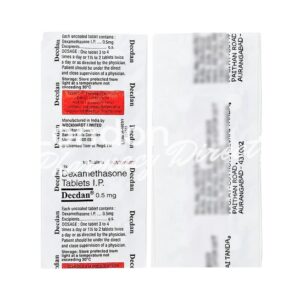
Decadron
In brief
- Decadron (dexamethasone) is a prescription-only medicine (POM) in the UK.
- Decadron is used to treat inflammation, allergic and autoimmune conditions, certain cancers, cerebral oedema, prevention of chemotherapy-induced nausea and severe COVID-19; it is a synthetic glucocorticoid that binds glucocorticoid receptors to change gene transcription and suppress inflammation and immune responses.
- Usual adult doses vary by indication: oral 0.5–9 mg/day (split doses) for many inflammatory conditions, up to 24–40 mg/day in severe cases; cerebral oedema often 10 mg IV then 4 mg IV/IM every 6 hours; antiemetic or oncologic regimens may use 8–40 mg depending on protocol; severe COVID-19 commonly 6 mg daily for up to 10 days; paediatric dosing typically 0.02–0.3 mg/kg/day.
- Decadron is available as tablets, oral solution, injectable vials/ampoules, eye drops and ophthalmic implants.
- Onset of action depends on route: oral effects usually begin within 1–2 hours, intravenous administration can produce clinical effects within minutes to an hour, and topical/ocular effects within hours.
- Decadron is a long-acting steroid with a biological half-life typically around 36–72 hours, so effects can persist for 1–3 days and adrenal suppression may last longer after prolonged therapy.
- Avoid excessive alcohol while taking Decadron; alcohol can increase gastrointestinal irritation and bleeding risk, worsen blood glucose control and amplify mood or behavioural side effects—exercise caution with liver disease or peptic ulceration.
- The most common side effect is insomnia.
- Would you like to try Decadron without a prescription?
Basic Decadron information
- INN (international nonproprietary name): Dexamethasone
- Brand names available in the United Kingdom: Decadron; Dexamethasone (tablets, oral solution, ampoules/vials)
- ATC code: H02AB02
- Forms and dosages: Tablets (0.5 mg, 0.75 mg, 1 mg, 2 mg, 4 mg, 6 mg, 8 mg); Oral solution (0.5 mg/5 mL, 1 mg/mL, 4 mg/mL); Injectable solution (4 mg/mL, 10 mg/mL); Eye drops (0.1%); Implants (ophthalmic 700 mcg Ozurdex)
- Manufacturers in the United Kingdom: Mylan, Aspen, Pfizer, Sandoz, Teva, Hikma and other suppliers
- Registration status in the United Kingdom: Licensed by the MHRA for multiple systemic and local indications (prescription-only)
- OTC / Rx classification: Prescription-only medicine (POM)
Instructions, warnings and daily-life integration (for UK patients)
Are you worried about starting a steroid and how it will affect your daily life?
Decadron (dexamethasone) is a prescription-only glucocorticoid used for many inflammatory, allergic and oncological indications.
Do not start or stop long courses suddenly as tapering is required after courses longer than two weeks.
Avoid live vaccines while on therapy because dexamethasone suppresses the immune response.
Store dexamethasone below 25°C and keep it away from children and pets.
MHRA safety checks and NHS guidance apply when this drug is prescribed in the UK.
Daily-life tips: carry a steroid card, schedule doses around work and meals, monitor mood and sleep, and check blood sugar if you have diabetes.
Steroid alert card contents:
- Drug name, dose and start date.
- Prescriber contact details and emergency instructions.
- Warning about adrenal suppression and need for steroid cover in illness.
- Alert to avoid live vaccines while on treatment.
Immediate red flags — act now and contact NHS 111 or your GP if you experience any of these:
- Signs of severe infection such as high fever, severe sore throat or breathing difficulty.
- New or severe mood changes, hallucinations or suicidal thoughts.
- Chest pain or sudden severe breathlessness.
Everyday use and best practices
Morning vs evening dosing
Which is better — morning or evening dosing?
For many short courses a single morning dose aligns with the body’s natural cortisol rhythm and reduces the risk of insomnia.
Some NHS regimens split doses for specific conditions, so always follow the prescriber’s instructions.
If instructed to take a single daily dose, aim for the morning unless told otherwise.
Shift workers or those with irregular schedules should discuss timing with their GP to reduce sleep disturbance.
Taking with or without meals (UK diet habits)
Should dexamethasone be taken with food?
Take tablets with food if you experience heartburn or indigestion, which can occur with typical UK breakfasts such as bacon or a fry-up.
If you have reflux or a history of peptic ulcer disease, your pharmacist may advise antacid cover or a proton pump inhibitor.
Practical tips: set a phone alarm for each dose and keep a steroid card in your wallet.
Avoid excessive caffeine and alcohol while taking steroids because they can worsen insomnia and affect blood pressure and glucose control.
- Dos: take at the same time each day, carry a steroid card, log mood and sleep changes.
- Don’ts: don’t stop suddenly after prolonged use, avoid live vaccines, don’t double a missed dose.
Safety priorities
Who should avoid it (MHRA warnings)
Who needs a careful review before taking dexamethasone?
Avoid dexamethasone in known systemic fungal infections and check for uncontrolled infections before starting treatment.
People with diabetes, peptic ulcer disease, severe hypertension, osteoporosis, active psychiatric illness or glaucoma require careful review and monitoring.
Pregnant or breastfeeding patients should only use dexamethasone if clearly needed and under specialist advice.
Activities to limit (driving, work safety)
Can dexamethasone affect your ability to drive or work?
Steroids can cause dizziness, mood swings and visual disturbance so avoid driving or operating heavy machinery until you know how the drug affects you.
If you work in safety-critical roles such as HGV driving or rail operations tell occupational health and your employer, as fitness-to-work checks may be needed.
Monitoring
Monitoring during treatment should include regular blood pressure checks, bone-health assessment, blood glucose monitoring for diabetics and visual checks for long-term users.
| Contraindication / risk | Monitoring schedule |
|---|---|
| Diabetes | Blood glucose checks at baseline and during treatment |
| Osteoporosis or long-term use | DEXA scan and calcium/vitamin D review annually or as advised |
| Hypertension | Blood pressure checks within weeks of starting and periodically |
| Eye disease (glaucoma/cataract) | Ophthalmic review at baseline and during long-term therapy |
- Immediate red flags: severe infection, chest pain, sudden vision loss, severe psychiatric symptoms.
Dosage and adjustments
General regimen (NHS guidance)
What dose will my clinician prescribe?
Dexamethasone doses vary by indication and can range from low maintenance regimens to high-dose oncology protocols.
For inflammatory conditions typical oral dosing is between 0.5–9 mg per day, sometimes given as split doses depending on the condition.
For cerebral oedema acute hospital IV dosing often begins with 10 mg followed by 4 mg every six hours.
In severe COVID-19 requiring critical care a 6 mg daily regimen for up to 10 days has been used.
Special cases (elderly, comorbidities)
Elderly patients should start at a low dose and be monitored closely for delirium, falls and worsening osteoporosis.
Hepatic or renal impairment merits starting at the lower end of the dosing range with slow titration.
Paediatric dosing is weight-based (roughly 0.02–0.3 mg/kg/day) with growth monitoring for prolonged courses.
Tapering is required after more than two weeks of therapy to avoid adrenal insufficiency, and missed-dose advice is not to double up.
| Indication | Typical dose |
|---|---|
| Inflammation / allergy | 0.5–9 mg daily oral (condition dependent) |
| Cerebral oedema | 10 mg IV then 4 mg IV/IM every 6 hours |
| Prevention of chemotherapy nausea | 8–12 mg oral or IV for 1–4 days |
| Severe COVID-19 (ICU) | 6 mg daily for up to 10 days |
Legal status and availability in the UK
Decadron (dexamethasone) is a prescription-only medicine (POM) in the UK.
In our online pharmacy, Decadron is available without a prescription, with discreet delivery to the United Kingdom in 9–21 days.
What’s inside and how it works
Ingredients overview
What is dexamethasone made of?
The active ingredient is dexamethasone (INN) and excipients vary by manufacturer, so check the patient information leaflet if you have allergies.
Common available strengths include tablets from 0.5 mg up to 8 mg, oral solutions, injectables at 4 mg/mL and 10 mg/mL, eye drops 0.1% and the 700 mcg Ozurdex implant.
Mechanism basics explained simply
How does dexamethasone reduce inflammation?
Dexamethasone is a potent glucocorticoid that suppresses immune mediators and down-regulates inflammatory gene expression.
It acts systemically when taken orally or injected and locally when used as eye drops or intravitreal implants.
Because it suppresses the immune response, infection risk increases and live vaccines should be avoided while on treatment.
- Forms and typical uses: tablets for systemic inflammation, injectables for acute inpatient use, eye drops/implants for ophthalmic disease.
Main indications
Approved uses (MHRA listing)
What conditions is dexamethasone used for?
Authorised indications include inflammatory and allergic conditions, some autoimmune diseases, cerebral oedema, oncology protocols and specific ophthalmic uses.
It is also used to prevent chemotherapy-induced nausea as a short course and appears on the WHO essential medicines list.
Off-label uses in UK clinics
Which off-label uses are common?
Short-course antiemetic adjuncts in anaesthesia and oncology and specialist palliative care regimens are common off-label uses in UK practice.
Ozurdex implants are used by ophthalmologists for macular oedema under specialist care to limit systemic exposure.
| Indication | Typical use |
|---|---|
| Asthma exacerbation | Short course oral dexamethasone for rapid control |
| Cerebral oedema | IV dosing in hospital (10 mg then 4 mg q6h) |
| Oncology anti-emesis | 8–12 mg oral or IV for short periods |
Interaction warnings
Food interactions (alcohol, tea/coffee)
Do foods change how dexamethasone works?
There are no strong food-drug interactions that prevent taking dexamethasone with common UK foods.
Alcohol can worsen gastric irritation, sleep problems and metabolic effects, and high caffeine intake from tea or coffee may amplify insomnia and anxiety.
Drug conflicts
Which medicines interact with dexamethasone?
Dexamethasone is metabolised by CYP3A4 and can interact with many antivirals, azole antifungals and some antiepileptic drugs, altering levels of either drug.
It may reduce vaccine efficacy and increase the risk of gastrointestinal bleeding if combined with NSAIDs or anticoagulants.
Practical step: request a full medication interaction check at your pharmacy and carry a current list of medicines alongside your steroid card.
- High-risk interactions to flag: strong CYP3A4 inhibitors, NSAIDs, anticoagulants, live vaccines.
Alternative choices
NHS prescribing alternatives with pros and cons
Are there alternatives to dexamethasone?
Yes; prednisolone/prednisone, methylprednisolone and hydrocortisone are commonly used on the NHS depending on the condition.
Topical steroid options or ophthalmic implants may limit systemic exposure for eye disease, while steroid-sparing immunosuppressants and biologics are options for chronic autoimmune disease.
- Pros of steroids: rapid symptom control.
- Cons of steroids: systemic side effects with prolonged use.
When to ask for a steroid-sparing option
If you require repeated courses, have diabetes, osteoporosis or work in safety-critical roles, discuss steroid-sparing strategies with your GP or specialist.
Steroid-sparing agents take longer to work and need monitoring but reduce long-term steroid harms.
Regulation snapshot
MHRA approval and NHS prescribing framework
How is dexamethasone regulated in the UK?
Dexamethasone is licensed in the UK for systemic and local indications and is prescription-only with ATC code H02AB02.
GPs and hospital specialists prescribe according to clinical guidelines and shared-care agreements that allocate monitoring responsibilities.
Patient rights and reporting (Yellow Card)
What should patients know about reporting side effects?
Report adverse reactions using the MHRA Yellow Card scheme online or via the app, and you have a right to clear written information on why the medicine is prescribed and the monitoring plan.
Prescribers must follow MHRA safety updates and include relevant warnings in the patient information leaflet.
Frequently asked questions
Will dexamethasone affect my blood sugar?
Yes — dexamethasone can raise blood glucose, so people with diabetes need closer monitoring and may need adjustments to diabetes medication.
Can I stop suddenly after several weeks?
No — courses longer than about two weeks usually require a gradual taper to prevent adrenal insufficiency, so follow your prescriber’s tapering plan.
Can I get it on repeat prescription?
Long-term use is managed by shared-care agreements and GPs can issue repeat prescriptions when appropriate with monitoring in place.
If you miss a dose take it the same day if remembered, but do not double up; for chronic therapy contact your prescriber for specific advice.
Guidelines for proper use
UK pharmacist counselling style
What will the pharmacist tell me when dispensing dexamethasone?
UK pharmacists should give clear, patient-centred counselling covering the purpose of treatment, dose and timing, side effects to watch for and the need for a steroid card.
They will advise on gastric protection if necessary and check for contraindications such as systemic fungal infection.
NHS patient support advice
Your GP or specialist should provide written tapering instructions for longer courses and arrange monitoring for blood pressure, glucose and bone health.
Use NHS 111 for urgent side effects and report reactions to the MHRA Yellow Card scheme; keep a copy of your prescription and steroid card accessible.
- Pharmacist counselling checklist: dose, timing, interactions, steroid card, when to seek urgent care.
Delivery across the United Kingdom
| City | Region | Delivery Time |
|---|---|---|
| London | England | 9–21 days |
| Birmingham | England | 9–21 days |
| Manchester | England | 9–21 days |
| Glasgow | Scotland | 9–21 days |
| Leeds | England | 9–21 days |
| Edinburgh | Scotland | 9–21 days |
| Liverpool | England | 9–21 days |
| Bristol | England | 9–21 days |
| Sheffield | England | 9–21 days |
| Newcastle Upon Tyne | England | 9–21 days |
| Leicester | England | 9–21 days |
| Coventry | England | 9–21 days |
| Belfast | Northern Ireland | 9–21 days |
| Cardiff | Wales | 9–21 days |