Griseofulvin
In brief
- In our pharmacy, you can buy griseofulvin without a prescription, with delivery available across the United Kingdom in discreet packaging.
- Griseofulvin is used to treat dermatophyte fungal infections such as tinea capitis, tinea corporis, tinea pedis and tinea unguium (onychomycosis). It works by inhibiting fungal cell mitosis via binding to microtubules, helping stop the fungus from growing.
- The usual dose of griseofulvin is 500–1000 mg daily in adults, or 10–20 mg/kg/day in children, depending on the infection and formulation used.
- Griseofulvin is usually taken by mouth as tablets or an oral suspension.
- It typically begins working within a few days, but visible improvement may take 2–6 weeks, especially for skin and scalp infections.
- The duration of action is tied to regular daily dosing and the treatment course, which is usually 2–6 weeks for skin and scalp infections and several months for nail infections.
- Do not drink alcohol, as griseofulvin may cause a disulfiram-like reaction and can increase the risk of side effects, especially if you have liver problems.
- The most common side effects are headache, dizziness, nausea, vomiting, diarrhoea, and photosensitivity.
- Would you like to try griseofulvin without a prescription?
Basic Griseofulvin information
- INN (international nonproprietary name): Griseofulvin
- Brand names available in the United Kingdom: Griseofulvin is usually supplied as generic griseofulvin tablets or oral suspension.
- ATC code: D01BA01
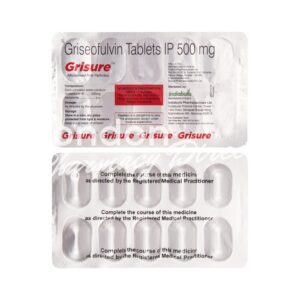
- Forms and dosages: Tablets 125mg and 500mg; oral suspension 125mg/5mL
- Registration status in the United Kingdom: Licensed in the UK; prescription-only medicine (POM), supplied under clinical oversight
- OTC / Rx classification: Prescription-only medicine (POM)
Everyday use and best practices
Morning vs evening dosing
Wondering whether griseofulvin is better taken in the morning or at night?
The short answer is that consistency matters more than the exact hour.
Griseofulvin prescribing is usually simple: take it exactly as prescribed, and try to take it at the same time each day.
Griseofulvin is often taken once daily, although some regimens are split across the day depending on the prescription.
Because it is usually taken with food to improve absorption and reduce stomach upset, many people choose breakfast or the evening meal.
For some, a dose with a cooked breakfast feels easier on the stomach than taking tablets on an empty commute.
For others, the evening meal works better after a busy school run or shift at work.
Phone reminders, blister packs, and linking the dose to a routine, such as tea time or the last school pickup, can help people stick to the plan.
- Do take it with food unless your prescriber says otherwise.
- Do use a reminder if your day is busy or shifts change.
- Don’t change the timing from day to day without a good reason.
- Don’t stop early just because the rash or scalp patch looks better.
Taking with or without meals (UK diet habits)
Can it be taken with a quick sandwich, a full fry-up, or a family dinner?
Yes, and in UK practice it is usually best with food.
A meal helps the medicine absorb better and may lessen nausea, which is useful if breakfast is light or lunch is rushed.
People often tolerate griseofulvin tablets more comfortably with something solid, such as toast, cereal, a jacket potato, or an evening meal.
If the stomach is sensitive, avoid taking it completely on an empty stomach unless your clinician has specifically advised otherwise.
How to fit treatment into school, work, and family routines
Parents managing a child’s prescription often find the oral suspension easier to fit around school mornings.
Adults working early shifts may prefer a dose with breakfast, while night workers often anchor it to the main meal before work.
If tablets come in 125mg or 500mg strengths, a pharmacist can help explain the pack and how it fits the day’s routine.
Keeping the medicine in the kitchen cupboard, not the bathroom, also makes it easier to remember after meals.
Safety priorities
Who should avoid it (MHRA warnings)
Griseofulvin is prescription only because it has important risks and may need monitoring.
People with severe liver disease should not use it.
It should also be avoided if there is known hypersensitivity to griseofulvin or any excipient, porphyria, or pregnancy.
Pregnancy avoidance matters because of teratogenic risk, and contraception advice may be needed for up to 6 months after use.
Photosensitivity is common enough that sun protection is worth taking seriously, especially on holiday, at school sports day, or during outdoor work.
Activities to limit (driving, work safety)
Dizziness, headache, and fatigue can affect driving, cycling, ladder work, and using machinery.
If symptoms make concentration poor, it is safer to pause higher-risk tasks until the effect settles.
People with outdoor jobs should also think about extra cover for sun exposure because sunburn can happen more easily.
When to seek urgent help
Seek urgent medical help if any of the following happen:
- Severe rash or blistering.
- Swelling of the face, lips, tongue, or throat.
- Breathing problems.
- Yellowing of the skin or eyes.
- Unusual bruising or bleeding.
Common side effects of griseofulvin include dizziness, headache, nausea, rash, and tiredness, but red flags always need prompt assessment.
Dosage and adjustments
General regimen (NHS guidance)
What dose is usually used in the UK?
For adults, standard treatment is often 500–1000mg daily in single or divided doses, depending on the infection and the prescriber’s plan.
Children’s doses are weight-based, commonly around 10–25mg/kg/day, with oral suspension often preferred for flexibility.
Treatment length depends on where the infection is.
| Condition | Typical dose pattern | Typical duration |
|---|---|---|
| Tinea capitis | Weight-based in children; 500–1000mg daily in adults | 2–6 weeks |
| Tinea corporis | Weight-based in children; 500–1000mg daily in adults | 2–6 weeks |
| Tinea pedis | As prescribed | Usually several weeks |
| Tinea unguium | Often higher doses and longer courses | 4–6 months for fingernails, 6–12 months for toenails |
Nail infections often need months of treatment, so improvement in the first few weeks does not mean the course is finished.
Stopping early raises the chance of the infection coming back.
Special cases (elderly, comorbidities)
Elderly patients do not usually need an automatic dose change, but liver function and drug interactions should be watched more closely.
No major renal adjustment is required, although clinical monitoring is still sensible.
In liver impairment, mild or moderate disease calls for caution, while severe hepatic failure is a contraindication.
For children, the suspension can help with flexible dosing and easier swallowing.
Missed dose and overdose basics
If a dose is missed, take it when remembered unless it is nearly time for the next one.
Do not double up.
Overdose symptoms may include nausea, vomiting, and dizziness.
Urgent medical advice or poison advice should be sought straight away if too much is taken.
Legal status and availability in the UK
Griseofulvin is a prescription-only medicine (POM) in the UK.
In our online pharmacy, griseofulvin is available without a prescription, with discreet delivery to the United Kingdom in 9–21 days.
What’s inside and how it works
Ingredients overview
Griseofulvin is the INN, and the medicine is usually supplied as tablets or oral suspension.
Different manufacturers may use different excipients, so anyone with allergies should check the patient information leaflet carefully.
That is particularly important with oral suspension in children, where the rest of the formulation can vary.
Mechanism basics explained simply
This is an oral antifungal that targets dermatophyte fungi, the group that causes ringworm-type infections.
It works by inhibiting fungal cell mitosis through a tubulin-related mechanism.
That means it helps stop the fungus growing and spreading.
It does not treat yeast infections, bacterial skin infections, or most non-dermatophyte fungi.
| What it treats | What it does not treat |
|---|---|
| Tinea capitis | Thrush |
| Tinea corporis | Bacterial skin infection |
| Tinea pedis | Most yeast infections |
| Tinea unguium | Non-fungal rashes |
Main indications
Approved uses (MHRA listing)
Which infections is griseofulvin used for in practice?
It is used for dermatophyte infections including tinea capitis, tinea corporis, tinea unguium, and tinea pedis.
Scalp ringworm in children is a common reason for treatment.
Adults may be prescribed it for nail or foot infection when an oral antifungal is needed.
Off-label uses in UK clinics
Off-label use is specialist territory and not something to assume from generic advice.
In routine UK practice, clinicians may choose it when a liquid is needed, or when a particular infection pattern suits it.
It is not first choice for every fungal problem, and alternatives are often preferred for some nail infections.
| Condition | Typical course | Who it may suit |
|---|---|---|
| Tinea capitis | 2–6 weeks | Children, especially when suspension is helpful |
| Tinea corporis | 2–6 weeks | People needing oral treatment |
| Tinea pedis | Several weeks | When topical treatment is not enough |
| Tinea unguium | Months | Selected nail infection cases |
Interaction warnings
Food interactions (alcohol, tea/coffee)
Because griseofulvin is usually taken with food, mealtimes are the practical focus here.
Alcohol should be avoided or kept to a minimum because alcohol abuse is a relative contraindication and there can be liver stress and an unpleasant disulfiram-like reaction.
There is no strong evidence-based need to avoid tea or coffee specifically, although keeping dosing tied to a meal is still the easiest way to remember it.
Drug conflicts
Always tell the prescriber or pharmacist about every medicine being taken, including long-term prescriptions and contraception.
Particular caution is needed with warfarin and hormonal contraception.
UK pharmacists are a key safety checkpoint here because they can spot interactions before the medicine leaves the pharmacy.
If a side effect seems unusual or severe, Yellow Card reporting helps build safety data for the UK.
- Ask your pharmacist if you take warfarin, contraception, or long-term medicines for epilepsy, infection, or liver conditions.
- Ask your pharmacist if you take anything bought over the counter, including herbal products.
- Ask your pharmacist if you have liver disease, lupus, or heavy alcohol use.
Alternative choices
NHS prescribing alternatives with pros/cons checklist
What might be used instead of griseofulvin?
Common alternatives include terbinafine, itraconazole, and fluconazole.
Terbinafine may be preferred for some nail infections, while azoles may suit different infection patterns.
Griseofulvin can still be chosen when a child needs a suspension, or when a clinician wants a well-established option.
| Medicine | General advantage | General limitation |
|---|---|---|
| Griseofulvin | Well-established option, oral suspension available | Often longer treatment courses |
| Terbinafine | Often preferred for some nail infections | Not always the best fit for every patient |
| Itraconazole | Useful in selected fungal infections | Interaction and monitoring considerations |
| Fluconazole | Used in some fungal infections | Not a direct like-for-like switch for every case |
- Age: children may benefit from a suspension.
- Site of infection: scalp, skin, feet, or nails can change the choice.
- Liver health: matters for every oral antifungal.
- Drug interactions: can influence the best option.
Regulation snapshot
MHRA approval and NHS prescribing framework
In UK terms, griseofulvin is a prescription-only medicine (POM) and its availability depends on licensing, local formulary decisions, and the prescriber’s judgement.
The MHRA regulates medicines safety in the UK, while NHS prescribing usually follows local clinical need and local formulary rules.
| Regulator | Status | Patient impact |
|---|---|---|
| MHRA | UK medicines regulator | Controls safety, licensing, and supply rules |
| NHS prescribing | Based on clinical need | Local formulary and prescriber choice matter |
Frequently asked questions
How long does Griseofulvin take to work?
Some people notice improvement within a few weeks, but treatment can last much longer for nail infections.
For best results, it should usually be continued at least 2 weeks after clinical resolution.
Can I drink alcohol?
It is safer to avoid alcohol or keep it minimal.
That is because alcohol abuse is a relative contraindication and can increase the risk of unpleasant effects and liver stress.
What if I miss a dose?
Take it as soon as remembered unless it is nearly time for the next dose.
Do not double the next dose.
How should I store it?
Store at room temperature, between 15 and 30°C.
Keep it in the original packaging, away from moisture and sunlight.
Do not freeze suspensions, and shake them well before use.
Guidelines for proper use
UK pharmacist counselling style
The safest way to use griseofulvin is to take it exactly as directed, with food, and for the full course.
Do not stop early because the skin has improved.
Protect the skin from sunlight, because photosensitivity can make sunburn more likely.
Watch for signs of liver trouble or allergy, and report concerns promptly.
If blood tests are requested, attend them, because monitoring is part of safe prescribing for some patients.
NHS patient support advice
NHS pharmacists are often the most accessible source of advice in the UK.
Local pharmacy teams can also help with blister packs, routine reminders, and practical adherence support.
Seek help from NHS 111 for urgent advice, from the GP practice if side effects are troubling or the infection is not improving, and from the pharmacy if the dose schedule is confusing.
Pregnancy should be avoided during treatment, and contraception advice may be needed for up to 6 months after use.
That final point matters for both men and women.
Delivery across the United Kingdom
| City | Region | Delivery time |
|---|---|---|
| London | Greater London | 9–21 days |
| Birmingham | West Midlands | 9–21 days |
| Manchester | North West England | 9–21 days |
| Glasgow | Scotland | 9–21 days |
| Edinburgh | Scotland | 9–21 days |
| Cardiff | Wales | 9–21 days |
| Belfast | Northern Ireland | 9–21 days |
| Liverpool | North West England | 9–21 days |
| Leeds | Yorkshire and the Humber | 9–21 days |
| Sheffield | Yorkshire and the Humber | 9–21 days |
| Nottingham | East Midlands | 9–21 days |
| Newcastle upon Tyne | North East England | 9–21 days |
| Bristol | South West England | 9–21 days |
| Leicester | East Midlands | 9–21 days |
| Coventry | West Midlands | 9–21 days |