Tobradex
In brief
- In many pharmacies Tobradex can be obtained at the counter; officially it is a prescription-only medicine in most countries (including the UK, EU, Canada, Australia and the USA), but in some local pharmacies or regions it may be supplied without a receipt—check local regulations and consult your pharmacist.
- Tobradex is used for treatment of steroid‑responsive ocular inflammation where bacterial infection is suspected or confirmed and for post‑surgical prophylaxis; it combines tobramycin (an aminoglycoside antibiotic that inhibits bacterial protein synthesis) with dexamethasone (a corticosteroid that reduces inflammation via glucocorticoid receptor‑mediated suppression of inflammatory mediators).
- The usual dose for adults and elderly is 1–2 drops in the affected eye(s) every 4–6 hours, which may be increased to every 2 hours initially; typical courses last 5–14 days (up to 24 days with clinical review). Children aged 2 years and older generally follow the same regimen; use in children under 2 years is not routinely recommended.
- Administration is topical to the eye: ophthalmic suspension (eye drops, typically 5 mL) or ophthalmic ointment (tube, e.g. 3.5 g).
- Symptom relief from the steroid component can begin within a few hours; measurable antibacterial clinical improvement is often seen within 24–48 hours—seek medical review if there is no improvement within 48 hours.
- The therapeutic effect of a single dose generally lasts about 4–6 hours (hence typical dosing intervals); the full treatment course is usually 5–14 days depending on the condition.
- There is no specific alcohol restriction for topical ocular use of Tobradex, but avoid excessive alcohol if unwell or taking systemic medicines and consult your doctor or pharmacist for personalised advice.
- The most common side effec is eye irritation (burning, stinging or redness); other possible adverse effects include eyelid oedema, secondary eye infection with prolonged use, raised intraocular pressure and, rarely with long‑term use, cataract formation.
- Would you like to try tobradex without a prescription?
Basic Tobradex Information
- INN (International Nonproprietary Name): Tobramycin/dexamethasone.
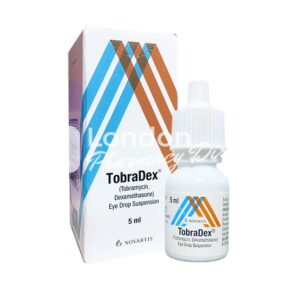
- Brand Names Available In United Kingdom: Tobradex, marketed in the UK by Novartis Pharmaceuticals UK Ltd, commonly supplied as a 5 mL dropper bottle.
- ATC Code: S01CA01 (Corticosteroids And Antiinfectives In Combination For Ophthalmological Use).
- Forms & Dosages: Ophthalmic suspension — tobramycin 3 mg/mL + dexamethasone 1 mg/mL (5 mL, 10 mL bottles); ophthalmic ointment — same strengths per g (3.5 g tube).
- Manufacturers In United Kingdom: Novartis Pharmaceuticals UK Ltd (Alcon/Novartis are the global primary suppliers).
- Registration Status In United Kingdom: Approved by the MHRA and classified as Rx-only (prescription medicine).
- OTC / Rx Classification: Prescription-only (Rx-only).
Instructions & Quick Warnings For UK Patients
Is Tobradex a prescription medicine and how will I get it?
Tobradex is a prescription-only medicine containing tobramycin 3 mg/mL and dexamethasone 1 mg/mL, and must be obtained on an NHS or private prescription in the UK.
Major high-street chains such as Boots, LloydsPharmacy and Superdrug and registered online pharmacies supply it after a valid prescription.
Prescription charging rules differ across the UK, so check NHS England charges and your local NHS board for Scotland, Wales and Northern Ireland entitlements.
How should I store it and use it day-to-day?
Store unopened and opened bottles between 2–25°C, protect from light, and discard 28 days after opening the bottle.
Keep the bottle out of reach of children and follow the expiry date on the label.
What immediate safety warnings should I know?
Do not use Tobradex for suspected viral (including herpetic) or fungal eye infections, or with known hypersensitivity to tobramycin, dexamethasone or any excipient.
If you have glaucoma or have previously shown steroid-related pressure rises, tell your prescriber before starting treatment.
Practical tip for the pharmacy visit.
Bring your NHS number and a current medicines list to the pharmacy and ask the pharmacist to demonstrate eye-drop technique if unsure.
Everyday Use & Best Practices
Morning Vs Evening Dosing
How should doses fit around a typical UK day?
For most adults, the standard regimen is 1–2 drops into the affected eye(s) every 4–6 hours, with prescribers sometimes advising every 2 hours at treatment start for severe cases.
Morning doses are convenient before breakfast or commuting, and evening doses help control overnight inflammation.
Use an alarm or phone reminder to keep to schedule and mark the bottle opening date on a calendar to observe the 28‑day discard rule.
Taking With Or Without Meals (UK Diet Habits)
Do meals affect topical eye drops?
Food does not affect the local action of topical Tobradex, so ordinary UK meals such as tea and toast or sandwiches do not change efficacy.
Avoid rubbing the eyes after handling oily foods or applying face creams near the lashes to reduce contamination risk.
Practical eye-drop technique (step-by-step):
- Wash hands thoroughly and remove contact lenses if instructed.
- Tilt head back and pull down the lower eyelid to form a small pocket.
- Instil one drop into the pocket without touching the eye with the bottle tip.
- Close the eye gently for 1–2 minutes and press the inner corner to reduce drainage.
- Wait 5–10 minutes between different eye medicines to avoid washout.
If taking systemic antibiotics or other eye treatments, tell your prescriber or community pharmacist who can advise on timing and interactions.
Safety Priorities
Who Should Avoid It (MHRA Warnings)
Who must not use Tobradex?
Do not use Tobradex for herpetic keratitis, viral conjunctival or corneal infections, fungal eye infections or tuberculous eye disease.
Stop and seek urgent review if a viral infection such as herpes is suspected, because steroids can worsen these conditions.
Also avoid it if there is known hypersensitivity to tobramycin, dexamethasone or any excipient.
Tell the prescriber if you have glaucoma, a history of steroid‑responsive pressure rises, diabetes, or if the patient is under two years of age.
Activities To Limit (Driving, Work Safety)
Can Tobradex affect my vision or work?
Instillation can cause transient blurring of vision or stinging, so avoid driving, cycling or operating machinery until vision is clear.
Those working at heights or in manual trades should delay returning to safety‑critical tasks until vision is uncompromised or wear appropriate eye protection.
Safety checklist to show your prescriber or pharmacist:
- Allergy history (tobramycin, dexamethasone, neomycin).
- Glaucoma or steroid-response history.
- Current systemic steroid use.
- Pregnancy or breastfeeding status.
- Contact lens use and recent eye surgery.
Dosage & Adjustments
General Regimen (NHS Guidance)
What is the usual NHS dosing for adults and children aged two years and over?
Tobradex ophthalmic suspension 3 mg/mL + 1 mg/mL is usually prescribed as 1–2 drops into the affected eye(s) every 4–6 hours.
Prescribers may increase frequency to every 2 hours during the initial phase for severe presentations.
Typical treatment courses range from 5–14 days, with specialist review needed if therapy approaches or exceeds about 24 days.
Special Cases (Elderly, Comorbidities)
Are dose changes required for older adults or those with other conditions?
No routine dose adjustment is required for elderly patients, but monitor for corticosteroid effects such as raised intraocular pressure and cataract risk.
Systemic absorption is minimal, so renal or hepatic impairment rarely requires dose change, although exercise clinical caution in severe systemic disease.
When carers administer drops for frail patients, ensure correct technique is taught and dosing times are documented to prevent missed or duplicated doses.
Quick practical adjustment points:
- Reduce frequency as signs improve under clinical advice.
- Do not extend treatment without review by GP or ophthalmologist.
- Seek review if no improvement within 48–72 hours or if symptoms worsen.
User Testimonials
Positive Reports From UK Patients
What do UK patients say about using Tobradex?
Many reports on NHS forums and pharmacy feedback describe quick reduction in redness and discharge, often within 24–72 hours, particularly following eye surgery or in bacterial conjunctivitis.
Pharmacy counselling at Boots or LloydsPharmacy is commonly mentioned as reassuring when staff demonstrate instillation technique and explain steroid monitoring.
Common Challenges (Patient.info, NHS Forums)
What problems do people commonly report?
Temporary stinging, irritation or brief blurred vision on instillation are frequently mentioned on Patient.info and NHS discussion threads.
Older adults can find maintaining the dosing schedule difficult and some report tremor or dexterity issues when aiming drops.
Practical suggestions from forum staff and pharmacists:
- Ask for a hands‑on demonstration in the pharmacy and use teach‑back.
- Request a written dosing chart or dosette-style chart for carers.
- Keep clinic or GP contact details handy for follow-up if symptoms change.
Buying Guide
Pharmacy Sources (Boots, LloydsPharmacy, Superdrug)
Where can Tobradex be obtained in the UK?
Tobradex is prescription-only and supplied by major high-street pharmacies such as Boots, LloydsPharmacy and Superdrug, independent community pharmacies, hospital eye services and registered online pharmacies after a valid prescription.
Hospital ophthalmology departments commonly provide post‑operative supplies directly to patients.
Price Comparison (NHS Prescription Charge Vs Private)
What will it cost me?
On the NHS, prescription charges apply in England, while Scotland, Wales and Northern Ireland operate different entitlement rules and many patients in those nations receive prescriptions free of charge.
Private purchase prices vary between pharmacies and online suppliers; ask for a quote and check whether a dispensing fee applies.
Practical buying tips:
- Compare NHS prescription against private supply costs and any dispensing fee.
- Ask the pharmacist whether they can source branded Tobradex (Novartis/Alcon) if preferred.
- Avoid unregulated online sellers; verify pharmacy registration and request English labelling and a patient information leaflet.
Note on ordering from this pharmacy.
In our online pharmacy Tobradex is supplied to customers after a valid prescription, with discreet delivery to the United Kingdom typically within 5–14 days.
What’s Inside & How It Works
Ingredients Overview
What are the active ingredients in Tobradex?
Tobradex contains tobramycin, an aminoglycoside antibiotic, at 3 mg/mL and dexamethasone, a corticosteroid, at 1 mg/mL.
It is available as an ophthalmic suspension for drops and as an ophthalmic ointment, typically in a 5 mL dropper bottle or a 3.5 g ointment tube.
Mechanism Basics Explained Simply
How do the two medicines work together?
Tobramycin acts to kill or inhibit susceptible bacteria that cause eye infections.
Dexamethasone reduces the inflammation, redness and swelling that accompany infection or surgical irritation.
The combination provides both antibacterial cover and rapid control of inflammatory symptoms, but the steroid can mask some signs of infection and must therefore be used only where bacterial infection is suspected or confirmed.
Key patient points:
- Antibiotic = fights bacteria.
- Steroid = calms inflammation but can increase eye pressure with prolonged use.
- Do not stop medication prematurely without clinical advice.
Storage reminder: keep between 2–25°C, protect from light and discard 28 days after opening.
Main Indications
Approved Uses (MHRA Listing)
What is Tobradex licensed to treat?
Tobradex is indicated for steroid‑responsive ocular inflammation where a bacterial infection is present or suspected, and for prevention and treatment of infection after ocular surgery.
Its ATC classification is S01CA01 for corticosteroid and antiinfective combinations used in ophthalmology.
Off‑Label Uses In UK Clinics
Do UK specialists ever use it differently?
Ophthalmologists sometimes use combination drops for mixed inflammatory presentations after surgery or when simultaneous anti‑inflammatory and antibiotic cover is desirable, with close monitoring of intraocular pressure when the steroid is used.
Clinical cues for patients to watch for:
- Purulent discharge with redness suggests bacterial involvement.
- Dendritic lesions or cold‑sore history suggest viral cause — steroids are contraindicated and urgent review is needed.
- If symptoms fail to improve in 48–72 hours, return to GP or your eye clinic for reassessment.
Interaction Warnings
Food Interactions (Alcohol, Tea/Coffee)
Will food or drink affect my eye drops?
Topical Tobradex has negligible systemic absorption, so normal foods or drinks including alcohol, tea and coffee do not affect its local eye action.
There is no need to schedule doses around meals.
Drug Conflicts (MHRA Yellow Card Reports)
What other medicines could interact?
Systemic drug interactions are uncommon due to minimal absorption, but concurrent systemic or topical steroids increase total steroid exposure.
Concurrent use of other topical eye medicines can cause irritation; combining multiple topical antibiotics should be avoided unless directed by a specialist.
Patients on systemic aminoglycosides should mention this to their prescriber, as a theoretical additive ototoxicity risk exists despite minimal ocular absorption.
Report serious or unexpected adverse reactions to the MHRA Yellow Card scheme, and ask your pharmacist or GP if you need help filing a report.
Action points: always give a full medicines list to your prescriber and avoid unprescribed eye drops.
Latest Evidence & Insights
Key UK & EU Studies 2022–2025
What does recent research say about combination antibiotic‑steroid drops?
Up to 2025, UK and EU observational studies support short courses of combination antibiotic‑steroid drops such as Tobradex for managed bacterial conjunctivitis and post‑operative prophylaxis.
Recent work emphasises careful patient selection to avoid steroid use in viral or fungal disease and the need for antimicrobial stewardship when prescribing antibiotic components.
Evidence supports follow-up where steroid therapy continues beyond two to three weeks because of the risk of raised intraocular pressure.
What this means for patients:
- Prescribers generally prefer targeted short courses and will reassess if symptoms persist.
- Expect clinicians to consider the likelihood of bacterial infection before issuing combination drops.
- Local NHS formulary guidance and hospital eye service leaflets are useful references for up-to-date practice.
Alternative Choices
NHS Prescribing Alternatives With Pros/Cons Checklist
What other eye medicines are used instead of Tobradex?
NHS formularies often include standalone topical antibiotics such as tobramycin alone or chloramphenicol for primary bacterial conjunctivitis, topical steroid options like prednisolone acetate for pure inflammation, and alternative combinations such as Maxitrol (neomycin + polymyxin B + dexamethasone) or Zylet (tobramycin + loteprednol) depending on local availability.
Pros and cons checklist:
- Tobradex — pros: one bottle for both infection and inflammation; cons: steroid component is inappropriate for viral/fungal disease and carries IOP/cataract risk with prolonged use.
- Maxitrol — pros: different antibiotic spectrum; cons: neomycin allergy risk in some patients.
- Chloramphenicol — pros: no steroid so suitable for straightforward bacterial conjunctivitis; cons: slower resolution of inflammation.
Discuss options with your GP or ophthalmologist so the chosen therapy matches infection likelihood, allergy history and steroid risk profile.
Regulation Snapshot
MHRA Approval & NHS Prescribing Framework
Is Tobradex a regulated medicine in the UK?
Tobradex is approved by the MHRA and supplied as a prescription-only medicine in the United Kingdom.
GPs and hospital ophthalmology clinics prescribe it according to local NHS formulary guidance, and some trusts supply post-operative prescriptions directly to patients.
Dispensing pharmacies are required to provide patient information leaflets in English and counsel on steroid risks and storage.
Packaging & Legal Status In The UK
What should packaging show?
Look for the manufacturer (Novartis/Alcon), strength (tobramycin 3 mg/mL and dexamethasone 1 mg/mL) and the 5 mL dropper bottle format.
Labels should show expiry and a note to discard the bottle 28 days after opening.
Adverse events should be reported via the MHRA Yellow Card scheme with support from pharmacists or GPs.
FAQ Section
Common Patient Questions
-
Can I use Tobradex for viral pink eye?
No — steroids can worsen viral infections such as herpetic keratitis; seek GP or ophthalmology review if viral infection is suspected.
-
How long can I use it?
Typical courses are 5–14 days; use beyond this typically requires specialist review and monitoring for raised intraocular pressure and cataract risk, with specialist input advised for any course up to about 24 days.
-
Can I wear contact lenses?
Remove lenses before instillation and avoid wearing them during active infection unless your prescriber advises otherwise.
-
What if I miss a dose?
Instil as soon as remembered unless the next dose is due soon — do not double up the dose.
Guidelines For Proper Use
UK Pharmacist Counselling Style
What should a pharmacist cover when dispensing Tobradex?
Pharmacists should confirm the indication and allergy history, demonstrate instillation technique and explain the 28‑day discard rule.
Counselling should include advice on transient blurring and to avoid driving until vision is clear, plus warning signs that need GP or eye clinic review.
Use a teach‑back approach — ask the patient to show one instillation so technique can be corrected on the spot.
NHS Patient Support Advice
How does the NHS support patients on this medicine?
Advise patients about prescription charges applicable in England versus Scotland, Wales and Northern Ireland, and arrange follow‑up if symptoms persist beyond 48–72 hours.
For post‑operative patients, ensure clinic follow‑up is booked and clear ophthalmology contact details are provided.
Provide a small printed checklist with the start date, discard date, dosing times and red‑flag signs such as worsening pain or vision loss, together with Yellow Card reporting instructions.
Delivery Across United Kingdom
| City | Region | Delivery Time |
|---|---|---|
| London | Greater London | 5-7 days |
| Birmingham | West Midlands | 5-7 days |
| Manchester | Greater Manchester | 5-7 days |
| Glasgow | Scotland | 5-7 days |
| Leeds | West Yorkshire | 5-7 days |
| Liverpool | Merseyside | 5-7 days |
| Edinburgh | Scotland | 5-7 days |
| Bristol | South West England | 5-7 days |
| Sheffield | South Yorkshire | 5-7 days |
| Newcastle Upon Tyne | North East England | 5-7 days |
| Nottingham | Nottinghamshire | 5-9 days |
| Leicester | Leicestershire | 5-9 days |
| Coventry | West Midlands | 5-9 days |
| Plymouth | Devon | 5-9 days |
| Aberdeen | Scotland | 5-9 days |