Co-amilofruse
In brief
- Co-amilofruse is a prescription-only medicine (POM) in the UK.
- Co-amilofruse combines furosemide (a loop diuretic) and amiloride (a potassium‑sparing diuretic) and is used to treat fluid retention (oedema) associated with heart failure, liver or kidney disease; furosemide inhibits the Na+-K+-2Cl− transporter in the thick ascending limb of Henle to produce diuresis, while amiloride blocks epithelial sodium channels in the distal nephron to reduce potassium loss.
- The usual adult dose is one tablet (40 mg furosemide / 5 mg amiloride) in the morning, which can be increased to two tablets per day if required (typically divided AM/noon); the maximum amiloride dose is 20 mg/day (i.e. up to 4 tablets/day) and elderly or renal‑impaired patients should start at the lowest effective dose and be titrated carefully.
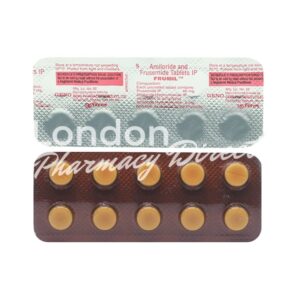
- Oral tablets (scored for splitting) taken by mouth; the product is commonly presented as orange tablets marked “FRUMIL” on one side.
- Effects usually begin within about 30–60 minutes after an oral dose (furosemide has a relatively rapid onset; potassium‑sparing effects from amiloride may take slightly longer).
- The diuretic effect typically lasts around 6–12 hours after an oral dose, though clinical duration can vary with dose, renal function and individual response.
- Avoid excessive alcohol while taking co-amilofruse — alcohol can worsen dehydration, low blood pressure and dizziness associated with diuretics; limit or abstain and seek advice from a clinician.
- The most common side effect is increased urination; other frequent effects include dizziness (especially on standing), mild dehydration, electrolyte disturbances (low sodium or potassium abnormalities), gastrointestinal upset and possible rash.
- Would you like to try co-amilofruse without a prescription?
Basic co-amilofruse information
- INN (international nonproprietary name): Furosemide (also known as frusemide) and amiloride hydrochloride.
- Brand names available in the United Kingdom: Frumil 40mg/5mg (orange, scored tablets marked “FRUMIL”, supplied in blister packs) and generic co-amilofruse products.
- ATC code: C03EB01.
- Forms and dosages: Tablet, 40 mg furosemide + 5 mg amiloride, oral route; standard tablet is scored for splitting.
- Manufacturers in the United Kingdom: Sanofi (originator) and generic manufacturers.
- Registration status in the United Kingdom: Licensed as a Prescription Only Medicine (POM) by the MHRA; patient information leaflet (PIL) and summary of product characteristics (SPC) are available online.
- OTC / Rx classification: Prescription-only medicine (POM).
Instructions and immediate warnings
Can I start this medicine without asking my GP?
Co-amilofruse is a prescription-only medicine (POM), so do not start, stop or change the dose without a prescriber.
Carry a current list of all medicines and the dates of recent blood tests when you visit NHS services or see a pharmacist.
Seek urgent help for severe dizziness, fainting, marked muscle weakness or signs of dehydration such as very low urine output or extreme light-headedness.
Take your tablet in the morning to reduce overnight toilet trips; the standard product Frumil is an orange, scored tablet containing 40 mg furosemide + 5 mg amiloride.
Store the medicine below 25°C and keep the blister intact until use.
Practical tip: keep a simple home checklist for daily weight, urination pattern and a weekly photo of swollen ankles to show your clinician.
Everyday use and best practices
Morning vs evening dosing
Worried about getting up in the night to go to the toilet?
The standard adult starting dose is one tablet (40 mg/5 mg) taken once each morning to reduce nocturia and fit with typical UK routines such as breakfast and travel.
If the prescriber increases the dose to two tablets a day, the usual approach is to split doses between the morning and around lunchtime rather than taking in the evening.
Elderly people often start more slowly and may prefer to take the tablet with a small snack to reduce dizziness on standing.
Avoid taking the tablet immediately before bedtime to prevent disruptive overnight urination.
Taking with or without meals (UK diet habits)
Worried that tea and breakfast will interfere with your tablet?
Co-amilofruse can be taken with or without food, and pairing it with a light breakfast such as toast or porridge can help improve adherence.
Limit alcohol while on treatment because alcohol may amplify dizziness and increase dehydration risk.
Beware of large cups of coffee or very strong tea as caffeine can increase urine output and may worsen bother from frequent urination.
- Morning dosing tips: Take one tablet after breakfast, keep a daily alarm, and carry a spare dose if travelling.
- Fluid advice: Maintain usual fluid intake but avoid large fluid restriction unless advised by your clinician.
- What to avoid: Excess alcohol and very large caffeinated drinks until you know how the tablet affects you.
Safety priorities
Who should avoid it (MHRA warnings)
Concerned you might be unsafe on this medicine?
Absolute contraindications include severe renal failure or anuria, hyperkalaemia, Addison’s disease and known allergy to furosemide, amiloride or sulfonamides.
Pregnancy and breastfeeding are also listed as conditions needing clinician assessment before use.
Use with caution in people with diabetes, gout, moderate renal impairment or liver disease; these patients require closer electrolyte and renal monitoring.
Refer to the MHRA PIL and SPC for the full list of contraindications and safety information.
Activities to limit (driving, work safety)
Worried about feeling dizzy or faint after a dose?
Common side-effects include dizziness and orthostatic hypotension, so avoid driving, operating heavy machinery or working at height until you know how the medicine affects you.
Shift workers and those in manual jobs should discuss dosing time with their GP or occupational health service to minimise safety risks.
- Red flags to stop and seek care: Fainting, severe muscle weakness, very low urine output or symptoms of severe dehydration.
- Tell your clinician if: You have a history of falls, low blood pressure or are taking other medicines that affect blood pressure.
Dosage and adjustments
General regimen (NHS guidance)
Wondering what dose you will be started on?
The usual initial adult dose is one tablet (40 mg furosemide + 5 mg amiloride) once daily in the morning.
If greater diuresis is required a prescriber may increase to two tablets a day, split between morning and around midday.
The maximum amiloride stated in product data is 20 mg daily, which corresponds to four tablets, though such high doses are uncommon.
If you miss a dose, take it as soon as you remember unless it is near the next scheduled dose; do not double up.
Special cases (elderly, comorbidities)
Worried about age or other illnesses changing your dose?
Elderly patients should start at the lowest effective dose and titrate slowly because of increased sensitivity, fall risk and multiple health conditions.
Severe renal impairment or anuria is a contraindication; mild to moderate renal impairment requires careful use with frequent electrolyte checks.
In liver disease titrate cautiously and monitor for signs of hepatic encephalopathy.
- Titration steps: Start 1 tablet once daily, review response and blood tests before increasing.
- Monitoring intervals: Baseline renal function and electrolytes, repeat within 1–2 weeks of change, then as advised by clinician.
- When to seek specialist input: Marked renal impairment, repeated electrolyte disturbances, or uncertain response to treatment.
Legal status and availability in the UK
Co-amilofruse is a prescription-only medicine (POM) in the UK.
In our online pharmacy, co-amilofruse is available without a prescription, with discreet delivery to the United Kingdom in 9–21 days.
What’s inside and how it works
Ingredients overview
Curious what the tablet actually contains?
Co-amilofruse combines two active ingredients: furosemide (also called frusemide) and amiloride hydrochloride.
The standard tablet strength sold is 40 mg furosemide with 5 mg amiloride and tablets are orange and scored.
Sanofi is the originator and generic versions are also available; always check the active ingredient statement when switching brands.
Mechanism basics explained simply
Want to know how the two medicines work together?
Furosemide is a loop diuretic that blocks sodium and chloride reabsorption in the loop of Henle, producing a rapid increase in urine output and removing excess fluid.
Amiloride is a potassium-sparing diuretic that reduces potassium loss in urine and helps offset hypokalaemia caused by furosemide.
- Active ingredients: Furosemide + amiloride hydrochloride.
- Strength: 40 mg/5 mg per tablet.
- Why combined: Effective fluid removal with reduced risk of low potassium.
Understanding this helps explain why clinicians order regular blood tests for electrolytes and kidney function.
Main indications
Approved uses (MHRA listing)
Wondering what conditions this tablet treats?
Co-amilofruse is licensed for the treatment of oedema associated with heart failure, liver cirrhosis and renal disease where diuretic therapy is indicated.
It is not typically used as first-line monotherapy for hypertension.
Prescribers should follow the MHRA SPC and the patient information leaflet for details of approved uses.
Off-label uses in UK clinics
Curious about practices beyond the licence?
Some clinicians may use co-amilofruse off-label for resistant oedema or when a potassium-sparing effect is desirable and simplifies therapy, but off-label use should be explained and documented.
Shared decision-making and a clear monitoring plan for weights and blood tests are essential when using the medicine outside standard indications.
- Common indications: Heart failure oedema, cirrhotic oedema, renal oedema.
- When a clinician might choose it: To combine loop diuresis with potassium-sparing effects in one tablet.
- When to prefer alternatives: If monitoring cannot be arranged or if contraindications exist.
Interaction warnings
Food interactions (alcohol, tea/coffee)
Worried that what you eat or drink could change how the tablet works?
Avoid excessive alcohol because it may increase dizziness, orthostatic hypotension and dehydration risk while taking co-amilofruse.
Large amounts of caffeine from strong tea or coffee may increase urine output and add to daytime urinary frequency.
Drug conflicts
Worried about mixing this with other medicines?
Co-amilofruse can interact with ACE inhibitors and ARBs, NSAIDs, other diuretics, digoxin, lithium and potassium supplements, affecting potassium levels and renal function.
Always share a full medicines list including over-the-counter products and supplements with your GP or pharmacist.
- High-risk interactions to mention: ACE inhibitors/ARBs, NSAIDs, digoxin, lithium, potassium supplements.
- Reporting: Report suspected adverse interactions via the MHRA Yellow Card scheme.
Alternative choices
Wondering if there are other options on the NHS?
Choices depend on the indication, but alternatives include Moduretic (amiloride + hydrochlorothiazide), spironolactone for cirrhotic or heart-failure oedema, or furosemide alone when potassium levels are stable.
- Co-amilofruse: Single-tablet convenience with potassium-sparing benefit but needs electrolyte checks.
- Moduretic: Amiloride plus a thiazide; may suit mild oedema with potassium-sparing effect.
- Spironolactone: Effective for certain types of oedema but carries a hyperkalaemia and hormonal side-effect profile.
Discuss options with your GP and check local formularies and clinical commissioning guidance for preferred choices and monitoring requirements.
Regulation snapshot
Curious about how co-amilofruse is regulated in the UK?
The MHRA classifies co-amilofruse (Frumil) as a prescription-only medicine and the SPC and PIL are publicly accessible for prescribers and patients.
The product is categorised under ATC code C03EB01 as a combination of loop and potassium-sparing diuretics.
Sanofi is the originator while generics are also available.
| Regulatory fact | Detail |
|---|---|
| MHRA status | Prescription-only medicine (POM); PIL and SPC online |
| ATC code | C03EB01 |
| Packaging note | Orange, scored tablet marked “FRUMIL” |
Frequently asked questions
Have quick questions about everyday concerns?
Can I drive on co-amilofruse? Not until you know how it affects you; dizziness and fainting are possible and you should avoid driving until you are sure it is safe.
How often will I need blood tests? Typically baseline tests, repeat within 1–2 weeks of a dose change, then periodic checks depending on renal function and comorbidities.
Is it available on the NHS? Yes, it is a prescription-only medicine and can be prescribed on the NHS by a GP or specialist.
What if I miss a dose? Take the missed dose as soon as you remember unless it is close to the next dose; do not take a double dose.
- Immediate red flags: Stop and seek urgent care for fainting, marked weakness or little/no urine.
- Routine monitoring steps: Daily weight, urine pattern logging, and early blood tests after starting or changing dose.
- What to tell pharmacists and GPs: Full medicine list, recent blood test dates, allergies and any pregnancy/breastfeeding status.
Always report suspected side effects via the UK Yellow Card scheme.
Guidelines for proper use
UK pharmacist counselling style
Worried you will miss something important at the pharmacy?
Confirm the indication and review current medicines including OTC and supplements before handing over the medicine.
Ask for recent blood results for renal function and electrolytes, check for known allergies and pregnancy status.
Explain dosing clearly: start one tablet each morning, common side-effects such as increased urination and dizziness, and urgent signs that need immediate attention.
Offer a printed leaflet and suggest setting phone reminders for doses and follow-up blood tests.
NHS patient support advice
Want practical support from the NHS while taking this medicine?
Arrange blood tests via your GP or local phlebotomy clinic and ask about NHS repeat dispensing or electronic prescriptions for stable therapy.
Keep an organised record of daily weight and light-headed episodes for the first two weeks.
- First two weeks checklist: Daily weight, note urine frequency, record any light-headedness and share these with your prescriber.
- Reporting and follow-up: Use the Yellow Card system for adverse events and book a review after dose adjustments.
Delivery across the United Kingdom
| City | Region | Delivery Time |
|---|---|---|
| London | England | 9–21 days |
| Birmingham | England | 9–21 days |
| Manchester | England | 9–21 days |
| Glasgow | Scotland | 9–21 days |
| Leeds | England | 9–21 days |
| Liverpool | England | 9–21 days |
| Bristol | England | 9–21 days |
| Edinburgh | Scotland | 9–21 days |
| Newcastle Upon Tyne | England | 9–21 days |
| Sheffield | England | 9–21 days |
| Nottingham | England | 9–21 days |
| Belfast | Northern Ireland | 9–21 days |
| Cardiff | Wales | 9–21 days |