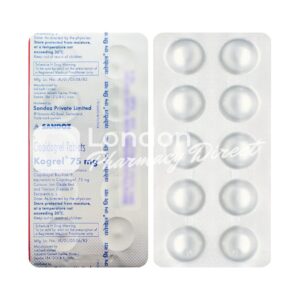
Clopidogrel
In brief
- In our pharmacy, clopidogrel is supplied as a prescription-only medicine (Rx) and cannot legally be sold without a prescription in the UK and most other countries; branded (eg, Plavix) and many generic 75 mg tablets are widely available with prescription and delivery services.
- Clopidogrel is used to prevent blood clots in acute coronary syndromes, after percutaneous coronary intervention (PCI), and for secondary prevention of stroke, myocardial infarction and peripheral arterial disease; it is an antiplatelet agent that irreversibly inhibits the P2Y12 ADP receptor on platelets, reducing platelet aggregation.
- Usual dosing: a loading dose of 300–600 mg once for urgent situations (eg, ACS/PCI) followed by a maintenance dose of 75 mg once daily; for stroke/M I/PAD prevention no loading dose is normally used and 75 mg once daily is the standard maintenance dose.
- Form of administration: oral tablet (film‑coated), commonly 75 mg for maintenance and 300 mg for loading; fixed‑dose combinations with aspirin exist in some markets.
- Onset time: antiplatelet effect begins within about 2 hours after a loading dose (300–600 mg) with more complete inhibition over several hours; on routine 75 mg dosing full effect accumulates over 3–7 days.
- Duration of action: clopidogrel irreversibly inhibits platelets so its effect persists for the life of affected platelets — typically 5–10 days after stopping therapy while new platelets are produced.
- Alcohol warning: avoid excessive alcohol as it increases bleeding risk; discuss safe alcohol use with your prescriber while taking clopidogrel.
- The most common side effect is bruising and minor bleeding (eg, nosebleeds, gum bleeding); other common effects include diarrhoea, abdominal pain and rash; rare but serious events include gastrointestinal or intracranial haemorrhage and thrombotic thrombocytopenic purpura.
- Would you like to try clopidogrel without a prescription?
Basic Clopidogrel Information
- INN (International Nonproprietary Name): Clopidogrel
- Brand Names Available In United Kingdom: not specified
- ATC Code: B01AC04
- Forms & Dosages: Tablets 75 mg (maintenance) and 300 mg (loading); film-coated formulations commonly supplied.
- Manufacturers In United Kingdom: not specified
- Registration Status In United Kingdom: not specified
- OTC / Rx Classification: Prescription-only Medicine (Rx)
Everyday Use & Best Practices
Morning Vs Evening Dosing
Take clopidogrel once daily, usually 75 mg, at a consistent time each day to keep levels steady.
For most UK patients the NHS regimen is a single morning dose to fit routines, typically after breakfast.
Some people find taking clopidogrel in the evening reduces minor stomach upset and prefer that timing.
If your clinician advised a loading dose of 300–600 mg after an acute coronary event, that is a one-off; maintenance remains 75 mg daily.
Practical tip: link the tablet to a daily habit such as tea or toothbrushing, and set a phone alarm or use the NHS app reminder.
Taking With Or Without Meals (UK Diet Habits)
Clopidogrel can be taken with or without food, so it fits most UK eating patterns from a light breakfast to a full English.
If you have a sensitive stomach after a hearty or spicy meal, take the tablet after food to reduce dyspepsia.
Avoid large amounts of grapefruit juice for caution with certain medicines, although there is no strong evidence it changes clopidogrel effect.
Keep tablets in their original packaging and store at room temperature between 15–30°C to protect them from moisture.
- Daily tips: take at the same time each day; store in original pack; use a reminder alarm; tell clinicians about clopidogrel 75 mg use.
- Carry: a medicines card or update the NHS app with clopidogrel tablets listed.
- Missed dose: take as soon as you remember unless the next dose is due; do not double up.
- If major bleeding occurs, call 999 or attend A&E immediately.
Safety Priorities
Who Should Avoid It (MHRA Warnings)
Do not use clopidogrel in the presence of active pathological bleeding such as a peptic ulcer or intracranial haemorrhage.
Known allergy to clopidogrel or any tablet excipients is a contraindication and must be reported to prescribers and pharmacists.
Discuss recent or planned surgery with your GP or surgeon because they may advise pausing treatment before some procedures.
Exercise caution in severe liver disease and expect closer monitoring if clopidogrel is continued.
Always tell every clinician — dentist, ophthalmologist, podiatrist — and your pharmacist that you take clopidogrel, and carry an alert card or keep the NHS app medicines list up to date.
Activities To Limit (Driving, Work Safety)
Clopidogrel increases bruising and bleeding risk, so avoid contact sports and heavy manual handling until you know how it affects you.
Driving and operating machinery are usually safe unless you experience dizziness or vision changes, in which case report symptoms and follow DVLA guidance if advised.
| Do | Don’t | Tell Clinician |
|---|---|---|
| Avoid sharp sports until stable | Ignore unexplained bruising | Planned surgery or dental extraction |
| Carry a medicines card | Combine with OTC NSAIDs without advice | Use of anticoagulants or recent major bleed |
- Bleeding signs requiring urgent care: sudden heavy bleeding, fainting, severe headache, vomiting blood — call 999 or attend A&E.
Dosage & Adjustments
General Regimen (NHS Guidance)
The standard maintenance dose of clopidogrel is 75 mg once daily for most indications including secondary prevention after myocardial infarction, ischaemic stroke and peripheral arterial disease.
For acute coronary syndromes or percutaneous coronary intervention a loading dose of 300–600 mg may be given once, followed by 75 mg daily.
Duration after ACS/PCI is commonly at least 12 months, depending on stent type and individual risk profile.
Prescriptions are prescription-only; patients receive clopidogrel from their GP, hospital consultant or NHS outpatient clinics.
Special Cases (Elderly, Comorbidities)
No routine dose reduction is recommended for the elderly, but bleeding risk increases with age so monitor closely.
Mild to moderate renal impairment usually requires no dose adjustment; use caution in severe renal disease and monitor for bleeding.
Hepatic impairment has limited data and requires caution; monitor liver function and bleeding signs where indicated.
Clopidogrel is not approved for children and should not be used outside specialist paediatric advice.
- When to call GP/hospital for dosing review: new anticoagulant start, recurrent bleeding, major surgery planned, significant weight change or liver/renal deterioration.
User Testimonials
Positive Reports From UK Patients
Many patients report that clopidogrel effectively reduces further cardiovascular events and fits an easy once-daily routine.
Several describe feeling reassured after starting therapy post-PCI and praise NHS nurse and pharmacist counselling for clear instructions.
Acceptance of branded Plavix and generics such as Teva or Mylan is high on NHS prescriptions, and community pharmacists across Boots, LloydsPharmacy and independents are trusted for queries.
Patients who switched from aspirin often mention fewer stomach issues and simple pill routines with clopidogrel 75 mg tablets.
Common Challenges (Patient.info, NHS Forums)
Common themes include increased bruising, minor nosebleeds and occasional dyspepsia after starting clopidogrel.
Patients frequently ask about stopping before dental procedures and worry about interactions with OTC painkillers such as ibuprofen.
Some report delays when coordinating clopidogrel around surgery or when switching to alternatives like ticagrelor or prasugrel.
- “I bruise easily now but my cardiologist said the benefit outweighs the inconvenience.”
- “Pharmacy explained generic Plavix 75 mg is equivalent and cheaper on my prescription.”
- “I carry a card so dentists know I’m on clopidogrel.”
What To Tell Your Pharmacist: current medicines, recent bleeding, planned operations, allergy history.
Buying Guide
Pharmacy Sources (Boots, LloydsPharmacy, Superdrug)
In the UK clopidogrel is prescription-only, dispensed from high-street pharmacies such as Boots, LloydsPharmacy and Superdrug, as well as independent community pharmacies and hospital pharmacies after inpatient stays.
Online UK-registered pharmacies can dispense after receiving an electronic or paper prescription; always check GPhC registration and follow MHRA advice when ordering online.
Generics (Clopidogrel Teva, Mylan, KRKA) are commonly dispensed and are approved equivalents to branded Plavix according to European approvals.
In our online pharmacy, clopidogrel is available without a prescription, with discreet delivery to United Kingdom in 5-14 days.
Price Comparison (NHS Prescription Charge Vs Private)
In England a standard NHS prescription charge applies per item; prescription charges are free in Scotland, Wales and Northern Ireland.
Private prescriptions and private online clinics will usually charge more than NHS dispensing.
Asking the pharmacy for a generic substitute often reduces cost because generics are routinely used on NHS formularies.
| Option | Typical Cost |
|---|---|
| NHS Prescription (England) | Standard prescription charge per item |
| Scotland, Wales, Northern Ireland | Generally free |
| Private Prescription / Online Clinic | Higher; varies by provider |
What’s Inside & How It Works
Ingredients Overview
The active ingredient is clopidogrel, commonly supplied as clopidogrel bisulfate in many formulations.
Tablets are film-coated and typically available as 75 mg maintenance and 300 mg loading doses.
Brand examples include Plavix and multiple generics such as Teva, Mylan and KRKA; excipients vary by manufacturer so check packaging if you have known allergies.
Mechanism Basics Explained Simply
Clopidogrel is an antiplatelet agent in ATC class B01AC04 that prevents platelets from sticking together by irreversibly blocking the P2Y12 receptor.
The drug requires metabolic activation in the liver, so medicines that affect liver enzymes can change its effectiveness.
There is no specific antidote for clopidogrel; major bleeding is managed supportively and may require platelet transfusion in severe cases.
- Mode of Action: irreversible P2Y12 blockade reduces arterial clot formation and hence the risk of heart attack and stroke.
- Formulations: clopidogrel film-coated tablets, 75 mg and 300 mg strengths.
Main Indications
Approved Uses (MHRA Listing)
Clopidogrel is approved for the prevention of atherothrombotic events after myocardial infarction, ischaemic stroke and in established peripheral arterial disease.
It is commonly used after acute coronary syndromes and following PCI with stent implantation, where a 300–600 mg loading dose provides immediate antiplatelet effect.
Maintenance therapy is normally 75 mg once daily for secondary prevention in these conditions, in line with MHRA-aligned practice and EMA/NICE guidance where applicable.
Off-Label Uses In UK Clinics
Off-label use is less common but clinicians may select clopidogrel for patients who are intolerant of aspirin or in combination with aspirin in time-limited dual antiplatelet therapy where clinically justified.
Any off-label choice should be clinician-led, documented and explained to the patient with consent recorded.
| Indication | Typical Dose | Usual Duration |
|---|---|---|
| After ACS/PCI | Loading 300–600 mg, then 75 mg daily | Commonly at least 12 months |
| Stroke/MI/PAD Prevention | 75 mg daily | Often long-term |
Interaction Warnings
Food Interactions (Alcohol, Tea/Coffee)
Excessive alcohol increases bleeding risk so moderate consumption is advised and patients should follow GP guidance on alcohol intake.
Tea and coffee do not have clinically important interactions with clopidogrel, but avoid sudden large changes in caffeine intake if you notice new side effects.
Routine dietary restrictions are minimal, but maintain consistent habits and inform prescribers of significant dietary changes.
Drug Conflicts (MHRA Yellow Card Reports)
Certain strong CYP2C19 inhibitors can reduce the metabolic activation of clopidogrel and potentially lower its antiplatelet effect.
Combining clopidogrel with anticoagulants, other antiplatelets such as aspirin, or NSAIDs increases bleeding risk and should be managed by clinicians.
Proton pump inhibitors have raised interaction concerns in the past; pantoprazole is commonly preferred if gastroprotection is needed.
- High-risk interactions include strong CYP2C19 inhibitors and concurrent anticoagulant therapy.
- Report adverse reactions via the MHRA Yellow Card system; common reports include bleeding and bruising.
Latest Evidence & Insights
Key UK & EU Studies 2022–2024
Recent UK and EU analyses from 2022–2024 have refined strategies for antiplatelet therapy after ACS and PCI, focusing on the duration of dual antiplatelet therapy and subgroup comparisons versus ticagrelor and prasugrel.
Meta-analyses advocate individualising DAPT duration to balance ischaemic protection against bleeding risk, and clopidogrel remains widely used where bleeding risk or cost considerations favour it.
Observational NHS-linked registry studies provide real-world data on bleeding rates and adherence challenges with clopidogrel-based regimens.
Practical Takeaways For Patients
Evidence supports a personalised plan where cardiologists weigh age, prior bleeding, kidney and liver function and stent type when choosing antiplatelet therapy.
For many UK patients clopidogrel is effective and cost-efficient, particularly when prescribed as a generic on NHS formularies.
Genotype-guided therapy is under investigation and may influence future practice, but routine genotyping is not yet universal in NHS practice.
| Evidence | What It Means For Me |
|---|---|
| DAPT duration studies | Therapy length is personalised by cardiology teams |
Alternative Choices
NHS Prescribing Alternatives With Pros/Cons Checklist
Ticagrelor (Brilinta) and prasugrel (Efient) are common alternatives on the NHS and often offer greater platelet inhibition in selected ACS patients.
Pros of ticagrelor and prasugrel include stronger platelet suppression in some settings; cons include higher cost, different side effects such as dyspnoea with ticagrelor, and potentially greater bleeding risk.
Aspirin remains used, often in combination for short periods as part of dual antiplatelet therapy, with durations guided by cardiology teams.
- Pros: increased antiplatelet potency for selected patients.
- Cons: higher bleeding risk and different adverse-effect profiles.
How Your Clinician Chooses
Clinicians base decisions on indication, stent type, patient age and weight, prior stroke history, renal and hepatic function, bleeding history and drug interactions.
Patients intolerant of one agent may be switched to another under specialist supervision.
If cost or access is a concern ask about generics such as Clopidogrel Teva, Mylan or KRKA which are widely approved equivalents to Plavix.
Regulation Snapshot
MHRA Approval & NHS Prescribing Framework
Clopidogrel is prescription-only in the UK and MHRA safety recommendations align with wider EMA and NICE guidance.
Plavix was the original branded product, and many generics are authorised across Europe with manufacturers including Teva, Mylan and KRKA listed in approvals.
NHS prescribing follows local trust formularies and some trusts specify preferred generics for procurement.
Reporting Problems & Recalls
If you suspect a batch problem, adverse reaction or packaging issue report via the MHRA Yellow Card scheme and notify the dispensing pharmacy.
For formulary or cost queries contact your GP practice pharmacist or the local medicines management team.
| Who To Contact — Issue Type | Contact |
|---|---|
| Medicine supply or label query | Pharmacy |
| Clinical concern or dosing question | GP or consultant |
| Adverse reaction or batch recall | MHRA Yellow Card / MHRA |
FAQ Section
Common UK Patient Question 1–2
Q1: “Can I stop clopidogrel for a dental extraction?”
A: Always check with both your dentist and cardiologist before stopping clopidogrel.
Many procedures require temporary stopping only if bleeding risk outweighs thrombotic risk and clinicians coordinate the timing.
Q2: “What if I miss a dose?”
A: Take the missed dose as soon as you remember unless it is nearly time for your next dose; do not double up.
For major bleeding call 999 or attend A&E immediately.
Common UK Patient Question 3–4
Q3: “Will my prescription be free?”
A: In England there is a prescription charge per item unless you are exempt; prescriptions are generally free in Scotland, Wales and Northern Ireland.
Q4: “Should I have tests while on clopidogrel?”
A: Routine blood monitoring is not required for everyone, but clinicians may check a full blood count or liver function tests if clinically indicated or if bleeding occurs.
- When To Call GP/A&E: new unexplained bruising, prolonged bleeding, sudden weakness, severe headache or fainting.
Guidelines for Proper Use
UK Pharmacist Counselling Style
Pharmacists should confirm the indication and dosing, emphasising the usual 75 mg daily dose and the role of any loading dose given in hospital.
They should advise on storage at room temperature (15–30°C), how to spot signs of bleeding and which medicines to avoid or discuss, such as OTC NSAIDs and certain PPIs.
Pharmacists can offer Medicines Use Reviews and check the NHS app medicines list or a printed medicines card for accuracy.
Encourage reporting of adverse effects via the MHRA Yellow Card system and ensure the patient knows who to contact with queries about NHS versus private supply.
NHS Patient Support Advice
Keep an up-to-date medication list on the NHS app and carry a medicines card when attending clinics or dental appointments.
Use pill boxes, phone reminders or pharmacy blister packs to support adherence, and request pharmacist counselling if unsure about interactions.
If you experience serious bleeding, sudden weakness, severe headache or unexplained bruising contact NHS 111 for advice or call 999 for emergencies.
- Pharmacist Counselling Checklist: indication, dose, storage, interactions, bleeding signs, Yellow Card reporting.
- Emergency Signs Checklist: heavy bleeding, fainting, sudden neurological symptoms, severe abdominal pain.
Delivery Across United Kingdom
| City | Region | Delivery Time |
|---|---|---|
| London | England | 5–7 days |
| Birmingham | England | 5–7 days |
| Manchester | England | 5–7 days |
| Glasgow | Scotland | 5–7 days |
| Leeds | England | 5–7 days |
| Edinburgh | Scotland | 5–7 days |
| Bristol | England | 5–7 days |
| Liverpool | England | 5–7 days |
| Sheffield | England | 5–9 days |
| Newcastle | England | 5–9 days |
| Nottingham | England | 5–9 days |
| Belfast | Northern Ireland | 5–9 days |
| Cardiff | Wales | 5–9 days |