
Bempedoic Acid
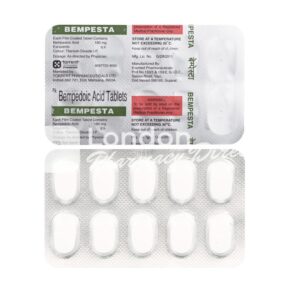
In brief
- In our pharmacy, you can buy bempedoic acid without a prescription, with delivery in 5–14 days throughout the United Kingdom and discreet packaging; note that bempedoic acid is legally prescription-only (Rx) in major markets such as the US and EU.
- Bempedoic acid is used to lower LDL‑cholesterol in adults with primary hypercholesterolaemia or mixed dyslipidaemia, either as an adjunct to diet and maximally tolerated statin therapy or for statin‑intolerant patients; it works as an ATP citrate lyase (ACL) inhibitor, reducing cholesterol synthesis upstream of HMG‑CoA reductase.
- The usual dose is 180 mg taken orally once daily; when combined with ezetimibe the fixed dose is 180 mg/10 mg once daily for greater LDL‑C reduction.
- The form of administration is a film‑coated oral tablet (180 mg as monotherapy or 180 mg/10 mg as a fixed‑dose combination with ezetimibe).
- The onset of measurable LDL‑cholesterol reduction is typically seen within about 4 weeks, with clinical reassessment generally recommended at 4–12 weeks.
- Duration of action: taken once daily, LDL‑C lowering is maintained with continued long‑term use; effects decline after stopping the medicine.
- Alcohol warning: avoid excessive alcohol intake—alcohol may increase the risk of liver enzyme elevations and can worsen conditions such as gout; exercise caution if you have hepatic impairment.
- The most common side effects include increased uric acid or hyperuricaemia (which may precipitate gout), muscle spasms and musculoskeletal pain (back/limb pain), upper respiratory tract infection, abdominal pain and diarrhoea, fatigue, and elevations in liver enzymes.
- Would you like to try bempedoic acid without a prescription?
Basic Bempedoic Acid Information
- INN (International Nonproprietary Name): Bempedoic acid
- Brand Names Available In United Kingdom: Nilemdo (bempedoic acid 180 mg), Nustendi (bempedoic acid 180 mg/ezetimibe 10 mg)
- ATC Code: C10AX21
- Forms & Dosages: Film-coated tablet 180 mg (monotherapy); film-coated tablet 180 mg/10 mg (fixed combination with ezetimibe)
- Manufacturers In United Kingdom: Daiichi Sankyo Europe (marketing and distribution for Nilemdo and Nustendi)
- Registration Status In United Kingdom: Licensed for use in Europe including the UK; marketed as Nilemdo and Nustendi with post-authorisation oversight by the UK regulator (MHRA)
- OTC / Rx Classification: Prescription only (Rx)
Initial Patient Instructions, Warnings And Daily-Life Integration (UK Patients)
Worried about starting a new cholesterol tablet and how it fits into life in the UK?
Follow the prescription from your GP or cardiologist exactly; bempedoic acid 180 mg once daily is prescription-only.
Keep medicines in their original packaging and store at 15–30°C, protected from moisture.
- Checklist: Keep the prescription, patient information leaflet and pharmacy contact details to hand.
- Checklist: Note your GP or clinic review date for lipid checks (usually 4–12 weeks).
- Checklist: Know how to report suspected adverse reactions via the MHRA Yellow Card scheme.
Do not start bempedoic acid if you are pregnant, breastfeeding, or planning pregnancy; pregnancy and breastfeeding are contraindications.
Report any known hypersensitivity to bempedoic acid or excipients to your prescriber immediately.
If you have gout, severe kidney or liver disease, or a history of tendon problems tell your prescriber because extra monitoring may be needed.
Missed dose advice: take as soon as you remember unless it is near the time for your next dose; do not double up.
Daily-life tip: pair the tablet with a morning routine item such as your toothbrush or morning tea to help adherence.
Keep NHS medicines information and your local pharmacy (Boots, LloydsPharmacy, Superdrug or a registered online pharmacy) contact details to hand for counselling and queries about NHS versus private costs.
Everyday Use & Best Practices
Morning Vs Evening Dosing
Which time of day is best is a common question.
Bempedoic acid is normally one 180 mg tablet once daily.
Choose a consistent time each day to take it to build a habit.
Many UK patients take it in the morning with breakfast to match daily routines and habit-stacking.
Some people prefer evening dosing when taking other lipid medicines that are commonly taken at night.
Reassess with your GP 4–12 weeks after starting to check LDL-C response and side effects.
Taking With Or Without Meals (UK Diet Habits)
Bempedoic acid may be taken with or without food which helps when mealtimes vary.
If you experience mild stomach upset, trying the tablet with food or after a meal often helps.
- Adherence checklist: Take the tablet at the same time each day, link it to another daily habit, use a pill box if needed, set a phone reminder.
- Adherence checklist: Keep a simple diary of dose times and any symptoms to discuss at review.
| Timing | Pros | Cons |
|---|---|---|
| Morning | Matches breakfast and morning routines; good for habit-stacking | May clash with other morning medicines for some patients |
| Evening | Useful if you already take other lipid medicines at night | Less convenient if evenings are variable or if you forget doses after work |
Safety Priorities
Who Should Avoid It (MHRA Warnings)
Safety first: certain people should not take bempedoic acid.
- Contraindications: pregnancy and breastfeeding.
- Contraindications: known hypersensitivity to bempedoic acid or any excipients.
- Caution: severe renal impairment (eGFR <30 mL/min/1.73 m²) and severe hepatic impairment — discuss with your prescriber.
- Caution: history of gout or hyperuricaemia; bempedoic acid can raise uric acid.
- Caution: history of tendon disorders or tendon rupture; monitor for tendon pain.
Activities To Limit (Driving, Work Safety)
What to watch for while on treatment.
- Red-flag checklist: new severe muscle pain, weakness or dark urine — stop activity and seek urgent review.
- Red-flag checklist: sudden tendon pain or swelling — stop strenuous use of the affected limb and contact your clinician immediately.
- Red-flag checklist: dizziness or symptoms that affect alertness — avoid driving or operating heavy machinery until assessed.
- Occupational advice: manual workers or those requiring strong grip should report new tendon pain and consider temporary duty modification pending review.
Dosage & Adjustments
General Regimen (NHS Guidance)
Standard adult dose is 180 mg orally once daily either alone or as the fixed combination with ezetimibe.
Typical clinical practice is to start the licensed dose and review effect and tolerability.
Reassess lipids and safety bloods such as liver function and uric acid at about 4–12 weeks after starting or changing treatment.
Special Cases (Elderly, Comorbidities)
No routine dose change is required for elderly patients; monitor for tolerability.
No dose adjustment is needed in mild to moderate renal impairment (eGFR ≥30 mL/min/1.73 m²), but use caution if eGFR <30.
Mild hepatic impairment usually does not require a change; avoid use in severe hepatic disease.
Not approved for children; paediatric use is not recommended.
| Population | Dosage Guidance | Monitoring |
|---|---|---|
| Adults | 180 mg once daily | LDL-C at 4–12 weeks; monitor LFTs and uric acid as clinically indicated |
| Elderly | 180 mg once daily (no routine adjustment) | Standard clinical monitoring and review of tolerability |
| Mild/Moderate Renal Impairment | No dose adjustment required | Monitor renal function; caution if eGFR falls |
| Severe Renal Impairment | Caution; limited data | Consider specialist advice and closer monitoring |
| Severe Hepatic Impairment | Not recommended | Avoid use |
| Children | Not approved | Not applicable |
User Testimonials
Positive Reports From UK Patients
What do people say in clinics and on forums?
- Many patients report clear LDL-C improvements when bempedoic acid is added to maximally tolerated statins.
- Statin-intolerant patients often highlight that bempedoic acid is a helpful oral alternative with fewer muscle complaints.
- Patients value the single daily tablet and the lack of strict food restrictions.
- Combining bempedoic acid with ezetimibe (Nustendi) is frequently mentioned as effective for extra LDL-C lowering.
Common Challenges (Patient.info, NHS Forums)
Real-world threads also flag downsides.
- Cons: some patients report gout flares due to raised uric acid.
- Cons: mild digestive upset, muscle or joint aches have been reported by some users.
- Cons: confusion about NHS eligibility and possible private prescription costs is a common theme.
Checklist: keep a symptom diary noting gout flares, new muscle or tendon pain, and any abdominal symptoms to discuss at your 4–12 week review.
Buying Guide
Pharmacy Sources (Boots, LloydsPharmacy, Superdrug)
Bempedoic acid is prescription-only and must be prescribed by a GP or specialist clinic for lawful supply in the UK.
High-street chains such as Boots, LloydsPharmacy and Superdrug can dispense prescriptions and provide in-store counselling.
Registered online pharmacies in the UK can also dispense to your address after receiving a valid prescription.
In our online pharmacy, bempedoic acid is available without a prescription, with discreet delivery to United Kingdom in 5-14 days.
Price Comparison (NHS Prescription Charge Vs Private)
| Source | Typical Cost To Patient | Notes |
|---|---|---|
| NHS Prescription (England) | Standard NHS prescription charge applies unless exempt | Scotland, Wales and Northern Ireland have different prescription arrangements; check local rules |
| Private Prescription | Varies by clinic and pharmacy dispensing fees | Branded products (Nilemdo, Nustendi) may vary in price; compare suppliers |
| Online Pharmacy Dispensing | Varies; delivery fees may apply | Ensure the seller is a UK-registered pharmacy |
- Checklist: Always confirm whether the cost is NHS or private before ordering.
- Checklist: Avoid unregulated overseas sellers and verify the pharmacy is MHRA / GPhC registered.
What’s Inside & How It Works
Ingredients Overview
The active ingredient in monotherapy is bempedoic acid 180 mg per tablet.
The fixed-dose combination pairs bempedoic acid 180 mg with ezetimibe 10 mg in one tablet (Nustendi/Nexlizet formats).
Excipients vary by brand; check the pack leaflet if you have specific allergies.
Mechanism Basics Explained Simply
Bempedoic acid inhibits ATP citrate lyase (ACL), an enzyme upstream of HMG-CoA reductase in the cholesterol synthesis pathway.
This reduces hepatic cholesterol synthesis and lowers LDL-C, complementary to statin mechanisms.
Bempedoic acid is activated in the liver which may account for lower skeletal muscle exposure compared with statins.
| Feature | ACL Inhibitor (Bempedoic Acid) | Statins (HMG-CoA Reductase Inhibitors) |
|---|---|---|
| Primary Action | Inhibits ATP citrate lyase upstream of cholesterol synthesis | Inhibits HMG-CoA reductase directly |
| Activation | Prodrug activated in the liver | Active compounds circulate systemically |
| Typical Side-Effect Signal | Raises uric acid; tendon caution | Muscle-related side effects more commonly reported |
Main Indications
Approved Uses (MHRA Listing)
Licensed indication: adults with primary hypercholesterolaemia or mixed dyslipidaemia as an adjunct to diet and maximally tolerated statin therapy or for statin-intolerant patients.
Fixed-dose combination with ezetimibe is available for greater LDL-C reduction.
Off-Label Uses In UK Clinics
Off-label use is uncommon and should be documented and supported by specialist advice when it occurs.
NHS lipid clinics commonly consider bempedoic acid for patients not reaching LDL targets on statins or reporting statin intolerance.
- Checklist: Typical NHS candidates include those on maximally tolerated statin who still need LDL-C lowering.
- Checklist: Consider statin-intolerant adults who require additional oral LDL‑C reduction.
- Checklist: Specialist lipid clinic review and documented rationale support any non-standard use.
Interaction Warnings
Food Interactions (Alcohol, Tea/Coffee)
Bempedoic acid has no major food interactions and may be taken with or without food.
Discuss alcohol intake with your clinician if you have liver disease or elevated liver enzymes.
Drug Conflicts (MHRA Yellow Card Reports)
Bempedoic acid can raise uric acid and may increase the risk of gout flares when used with drugs that raise urate.
Concomitant use with ezetimibe is licensed and available as a fixed-dose combination.
- Common interacting medicines to mention to your pharmacist: medications for gout, strong hepatotoxic drugs, and other lipid-modifying therapies.
- Checklist: Tell your pharmacist about all prescription medicines, over-the-counter drugs, and herbal remedies before starting bempedoic acid.
Latest Evidence & Insights
Key UK & EU Studies 2022–2025
Regulatory approvals followed the large clinical programme and the EMA approval in April 2020 supports use across the EU and UK markets.
Real-world data from 2022–2025 report consistent LDL‑C lowering and acceptable tolerability with attention to uric acid and liver enzyme monitoring.
| Year | Study / Report | Key Finding | Implication |
|---|---|---|---|
| 2020 | Regulatory Approval (EMA) | Nilemdo and Nustendi authorised in Europe | Licensed option for LDL‑C lowering as adjunct or alternative |
| 2022–2025 | Real-World Observational Data | Consistent LDL reductions; monitoring for uric acid and LFTs highlighted | Supports clinic use with routine safety checks |
What This Means For Patients
For patients this means a licensed, once-daily oral option that can be used when statins are insufficient or not tolerated.
Discuss absolute risk reduction and cardiovascular outcomes with your clinician, who will place LDL-C changes in the context of personal risk.
Alternative Choices
NHS Prescribing Alternatives With Pros/Cons Checklist
The NHS offers several alternatives or additional steps where LDL targets are not met.
| Option | Pros | Cons |
|---|---|---|
| Maximising Statin Therapy | Proven outcome benefit | Can cause muscle-related side effects in some patients |
| Ezetimibe | Oral, well tolerated, synergistic with statins | Smaller LDL reductions than PCSK9 inhibitors |
| PCSK9 Inhibitors (Alirocumab, Evolocumab) | Powerful LDL lowering and outcome data | Injectable, eligibility and cost constraints on the NHS |
| Bempedoic Acid | Oral, useful for statin-intolerant patients or as add-on | May raise uric acid; monitoring required |
- Checklist: Discuss with your lipid clinic which option best balances LDL‑C reduction, side effects and NHS eligibility.
- Checklist: Ask about lifestyle measures and whether combination therapy is appropriate for your risk level.
When To Discuss PCSK9 Inhibitors Or Ezetimibe
Consider ezetimibe when modest additional LDL reduction is needed and an oral option is preferred.
Consider PCSK9 inhibitors for high-risk patients who require large LDL reductions and meet NHS eligibility criteria.
Regulation Snapshot
MHRA Approval & NHS Prescribing Framework
Bempedoic acid is prescription-only and available in the UK market under brand names Nilemdo and Nustendi.
EMA approval in April 2020 supported European licensing and post-Brexit the MHRA oversees UK product authorisations and pharmacovigilance.
Prescribers should follow NHS formularies and local lipid pathways when initiating therapy.
Packaging, Brands And Legal Status In UK
| Brand Name | Packaging | Manufacturer / Licensee |
|---|---|---|
| Nilemdo | Tablets, 180 mg blister | Daiichi Sankyo Europe |
| Nustendi | Tablets, 180 mg/10 mg blister (fixed combo) | Daiichi Sankyo Europe |
| Nexletol | Tablets, 180 mg blister | Esperion Therapeutics / CSL Seqirus (regions) |
| Nexlizet | Tablets, 180 mg/10 mg blister | Esperion Therapeutics / CSL Seqirus (regions) |
Standard storage: keep in original packaging at 15–30°C and protect from moisture.
FAQ Section
Will It Replace My Statin?
Q: Will bempedoic acid replace my statin?
A: It may be used when statins are not tolerated or as an add-on to maximally tolerated statin therapy; your prescriber will decide based on LDL targets and tolerability.
How Soon Will I See Cholesterol Changes?
Q: How soon will I see changes?
A: Lipid checks are typically done 4–12 weeks after starting; expect measurable LDL‑C reductions within this window.
What About Side Effects?
Q: What about side effects?
A: Common side effects include raised uric acid, muscle spasms, mild gastrointestinal upset and occasional increases in liver enzymes; report severe symptoms promptly.
Can I Stop Abruptly?
Q: Can I stop abruptly?
A: Discuss any plan to stop with your clinician; stopping is not usually immediately dangerous but will likely raise LDL levels and should be managed within your care plan.
Guidelines For Proper Use
UK Pharmacist Counselling Style
Pharmacists should check indication and confirm the patient has a valid prescription before supply.
Review the patient’s full medicines list including OTC and herbal products and advise on dosing of 180 mg once daily.
Explain storage (15–30°C), how to take the tablet, common side effects and what signs need urgent review such as tendon pain or severe muscle symptoms.
- Pharmacist counselling checklist: Confirm indication, review interactions, advise on missed-dose rules and provide the Yellow Card reporting link for suspected ADRs.
- Pharmacist counselling checklist: Provide a monitoring schedule including a lipid check at 4–12 weeks and suggested blood tests for LFTs and uric acid if clinically indicated.
NHS Patient Support Advice
Provide a simple printable patient action plan listing who to contact for side effects, when to seek urgent care and the date for the next lipid review.
Encourage lifestyle changes (diet, exercise, smoking cessation) alongside pharmacotherapy as per NHS heart-health advice.
Delivery Across United Kingdom
| City | Region | Delivery time |
|---|---|---|
| London | England | 5-7 days |
| Birmingham | West Midlands, England | 5-7 days |
| Manchester | Greater Manchester, England | 5-7 days |
| Glasgow | Scotland | 5-7 days |
| Leeds | West Yorkshire, England | 5-7 days |
| Liverpool | Merseyside, England | 5-7 days |
| Sheffield | South Yorkshire, England | 5-7 days |
| Edinburgh | Scotland | 5-7 days |
| Cardiff | Wales | 5-7 days |
| Belfast | Northern Ireland | 5-7 days |
| Bristol | South West England | 5-7 days |
| Newcastle upon Tyne | North East England | 5-7 days |
| Nottingham | East Midlands, England | 5-9 days |
| Southampton | South East England | 5-9 days |