Doxycycline
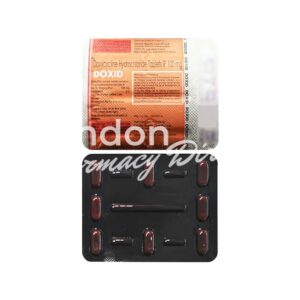
In brief
- In our pharmacy, doxycycline can be purchased without a prescription, with delivery throughout the United Kingdom. It is commonly supplied in discreet packaging.
- Doxycycline is an antibiotic used for infections such as respiratory tract infections, chlamydia, acne, rosacea, Lyme disease, malaria prevention, and post-exposure anthrax prophylaxis. It works by inhibiting bacterial protein synthesis, stopping bacteria from growing and multiplying.
- The usual dose depends on the condition: commonly 100 mg twice daily on the first day, then 100 mg once daily for infections; 40–100 mg daily for acne and rosacea; and 100 mg daily for malaria prophylaxis.
- The form of administration is oral capsules or dispersible tablets.
- Doxycycline usually starts to work within a few hours, although noticeable improvement in symptoms may take 1–3 days depending on the infection.
- The duration of action is approximately 12–24 hours, which is why it is often taken once or twice daily. Treatment courses commonly last 7–21 days, or longer for acne, rosacea, or malaria prevention.
- Alcohol should be limited or avoided, as it may increase the risk of side effects and can reduce the effectiveness of treatment if used heavily.
- The most common side effects are nausea, diarrhoea, abdominal pain, headache, skin rash, photosensitivity, and irritation of the stomach or throat.
- Would you like to try doxycycline without a prescription?
Basic doxycycline information
- INN (international nonproprietary name): Doxycycline
- Brand names available in the United Kingdom: Vibramycin-D, Efracea (rosacea); generic doxycycline is most often supplied
- ATC code: J01AA02
- Forms and dosages: Capsules 50mg and 100mg; dispersible tablets 100mg; modified-release capsules 40mg (rosacea)
- Manufacturers in the United Kingdom: Pfizer (Vibramycin-D), Galderma (Efracea) and generic manufacturers
- Registration status in the United Kingdom: Prescription-only medicine (POM); authorised by the MHRA
- OTC / Rx classification: Prescription-only medicine (POM)
Everyday use and best practices
Trying to fit doxycycline into a normal day can be awkward at first, especially if you are juggling the school run, a commute into town, or rotating shifts.
The good news is that doxycycline tablets and doxycycline capsules are usually easy to build into a routine once you settle on a set time.
Morning vs evening dosing depends on your prescription, but the key point is to take doxycycline at the same time each day.
That helps with daily dosing, keeps levels steadier, and makes it less likely you will miss a dose on a busy day.
If mornings are chaotic, many UK patients prefer an evening dose after work, but only if that suits the schedule on the label and the prescriber’s advice.
How to take it safely every day:
- Take it at the same time each day.
- Swallow it with a full glass of water.
- Stay upright for at least 30 minutes afterwards.
- Take it with food if it upsets your stomach.
- Keep it away from iron, calcium, antacids, and some supplements.
Tea, breakfast cereals, milk, yoghurt, and multivitamins are common in UK diets, so it is worth checking the timing carefully.
If nausea is the problem, taking doxycycline 100mg with a light meal can help, but dairy and mineral supplements can reduce absorption.
That is why UK pharmacist advice often focuses on meal timing as much as the dose itself.
Morning vs evening dosing
Morning dosing can suit people who want to link treatment to breakfast or the start of the school day.
Evening dosing may be easier for shift workers, provided it is still taken consistently and not alongside a late-night snack heavy in dairy or supplements.
If you work nights, it can help to choose a dose time that stays fixed relative to your sleep pattern, rather than the clock on the wall.
Taking with or without meals
Doxycycline can be taken with or without food, but food is often the practical choice if nausea or reflux is an issue.
Just keep it separate from calcium, iron, magnesium, antacids, bismuth, and multivitamins that contain minerals.
That simple spacing rule makes a big difference to absorption and is often the difference between a smooth course and one that feels fiddly.
Safety priorities
Before starting a doxycycline antibiotic, it is worth checking the main red flags first.
Some people should not take it, and some symptoms mean urgent help is needed.
Do not take / seek urgent help:
- Do not take it if you are allergic to tetracyclines or doxycycline.
- Do not take it in pregnancy, especially in the second or third trimester.
- Do not give it to children under 8 years unless a specialist has specifically advised it.
- Use extra caution if you have liver disease, lupus, or myasthenia gravis.
- Seek urgent help for a severe rash, swelling, breathing problems, severe headache, or persistent vomiting.
These are standard MHRA warning points and are taken seriously in UK practice.
Photosensitivity is one of the everyday issues patients notice most often with doxycycline capsules and doxycycline tablets.
That means stronger reactions to sunlight, so sunscreen, protective clothing, and avoiding sunbeds are sensible precautions.
If you feel dizzy, have blurred vision, or feel unwell, do not drive or operate machinery until you feel safe again.
Most people can continue normal routines, but it pays to be cautious on the first few days, especially if you are commuting, driving long distances, or working in heat.
Who should avoid it
Patients with a known allergy to tetracyclines should avoid doxycycline completely.
The same applies if a doctor has warned you that it is unsuitable because of pregnancy, age, or a significant medical condition.
If you have an autoimmune condition or muscle weakness, mention that when asking a pharmacist or GP about doxycycline.
Activities to limit
Sun exposure is the main lifestyle issue, so keep sun safety in mind on holidays, at the beach, or even on a bright lunchtime walk.
Alcohol is not the main interaction, but it may worsen stomach upset in some people, so moderation is sensible.
If you are having persistent symptoms, the safest step is to speak to NHS 111, your GP, or a pharmacist promptly.
Dosage and adjustments
The exact doxycycline dosage depends on the reason it was prescribed and the prescriber’s instructions.
In NHS prescribing, the course length matters as much as the strength, so completing treatment is important even when you feel better.
For older adults, there is usually no routine dose change, but monitoring renal and hepatic function may be sensible.
People with kidney or liver impairment may also need closer supervision, even though a standard dose is often used.
Children under 8 years usually avoid doxycycline unless a clinician judges it to be necessary.
General regimen
| Condition | Usual adult dose | Typical duration | Key note |
|---|---|---|---|
| Respiratory infections | 100mg twice daily on day 1, then 100mg daily | 7–14 days | Follow prescriber advice |
| Acne and rosacea | 40–100mg daily | 6–12 weeks | Often taken for longer courses |
| Malaria prophylaxis | 100mg daily | Before, during, and after exposure | Start 1–2 days before travel |
| Chlamydia | 100mg twice daily | 7–10 days | Course length depends on diagnosis |
| Lyme disease | 100mg twice daily | 10–21 days | Needs prompt medical review |
| Anthrax post-exposure | 100mg twice daily | 60 days | Specialist or public-health scenario |
Special cases
For malaria prevention, the usual advice is to start one to two days before exposure and continue during travel and for four weeks after leaving the endemic area.
If a dose is missed, take it as soon as you remember unless it is nearly time for the next one.
Never double up.
In the event of overdose, seek medical help immediately, especially if nausea, vomiting, diarrhoea, or a severe allergic reaction occurs.
Legal status and availability in the UK
Doxycycline is a prescription-only medicine (POM) in the UK.
In our online pharmacy, doxycycline is available without a prescription, with discreet delivery to the United Kingdom in 9–21 days.
What is inside and how it works
Doxycycline is the INN for a tetracycline antibiotic with ATC code J01AA02.
In the UK it comes as capsules and dispersible tablets, including a low-dose modified-release capsule for rosacea.
Brands include Vibramycin-D and Efracea, although generic doxycycline is most often supplied.
Ingredients overview
| Form | Common use |
|---|---|
| Capsules | Oral treatment for infections and acne |
| Dispersible tablets | Oral treatment where a dispersible tablet is preferred |
Mechanism basics
In simple terms, doxycycline stops bacteria making proteins, which helps the immune system clear the infection.
That is why it can be used for selected bacterial illnesses, acne, rosacea, malaria prevention, and other clinically defined situations.
Main indications
Most UK patients encounter doxycycline for acne, rosacea, respiratory infections, chlamydia, Lyme disease, or malaria prevention.
It is often chosen when a broad-spectrum oral antibiotic is needed, but prescribers still weigh the benefits against side effects and antimicrobial resistance.
Approved uses
| Condition | Usual dose | Duration | Key note |
|---|---|---|---|
| Acne | 40–100mg daily | 6–12 weeks | Often part of a wider acne plan |
| Rosacea | 40–100mg daily | 6–12 weeks | Used when oral treatment is needed |
| Respiratory infection | 100mg twice daily then daily | 7–14 days | Depends on diagnosis |
| Chlamydia | 100mg twice daily | 7–10 days | Needs correct testing and follow-up |
| Lyme disease | 100mg twice daily | 10–21 days | Treatment depends on stage |
| Malaria prevention | 100mg daily | Before, during, and after travel | Start before exposure |
Off-label use in UK clinics
Some specialist settings use doxycycline outside the usual list of indications, but patients should never assume it is suitable for self-treatment.
Anthrax post-exposure use is a specialist or public-health scenario rather than a routine primary-care request.
For acne and rosacea, prescribers may also adjust dose and duration to use the lowest effective course.
Interaction warnings
The most common interaction problems with doxycycline are everyday ones, not rare hospital-only issues.
Dairy products, calcium, iron, magnesium, antacids, bismuth, and some multivitamins can reduce absorption if taken too close to the dose.
That matters in the UK because tea, breakfast cereal, milk, and multivitamins are part of so many normal routines.
The mineral content is the main issue, not tea itself.
Food interactions
- Separate doxycycline from dairy if possible.
- Keep it away from iron and calcium supplements.
- Avoid antacids, magnesium products, and bismuth close to the dose.
- Be careful with fortified breakfast cereals and multivitamins.
A simple rule is to leave 2–3 hours between doxycycline and these products, or follow pharmacist advice if your schedule is awkward.
Drug conflicts
Important medicine interactions can include anticoagulants, retinoids, and some anticonvulsants.
If you take long-term medicines, tell the pharmacist before starting doxycycline tablets so the timing can be checked properly.
Spacing is especially important if you take supplements after breakfast or in the evening with other medicines.
Alternative choices
Sometimes doxycycline is not the best fit, and that is where NHS alternatives come in.
Choices depend on the infection, age, pregnancy status, stomach tolerance, and whether photosensitivity is a concern.
NHS prescribing alternatives
Minocycline and tetracycline sit in the same class and may be considered in some situations.
Azithromycin, clarithromycin, amoxicillin/clavulanic acid, and cefuroxime can also overlap for certain infections, depending on the clinical picture.
For acne and rosacea, topical treatments or a different oral antibiotic may be more suitable if doxycycline is not tolerated.
Pros and cons checklist
- May be preferred: when an oral broad-spectrum option is needed.
- May be less suitable: in pregnancy or in children under 8 years.
- May be less suitable: if sun exposure is unavoidable.
- May be less suitable: if reflux or nausea is already a problem.
Regulation snapshot
In the UK, doxycycline is prescription only and supplied through MHRA-regulated channels.
That includes NHS prescriptions, private prescriptions, and legitimate online pharmacies.
Community pharmacy counselling is especially important here because many patients rely on pharmacists for day-to-day medicine advice.
MHRA and NHS framework
| UK rule | What it means |
|---|---|
| Prescription only | You need a valid prescription or a legitimate clinical supply route |
| MHRA-regulated supply | Medicine should come through an authorised chain |
| Patient leaflet supplied | Follow the leaflet in the pack you receive |
Prescription status
Brand packaging can vary, but UK patients should follow the pack, label, and leaflet supplied by the dispensing pharmacy.
If anything on the box looks unfamiliar, a pharmacist can check it before you start.
Frequently asked questions
Can I drink alcohol with doxycycline?
Many patients can drink alcohol in moderation, but it may worsen stomach upset in some people.
What if I miss a dose?
Take it when you remember, unless it is nearly time for the next dose, and never double up.
Can I take it with the pill or HRT?
Doxycycline does not usually cause the same issues as some other medicines, but it is still wise to check with a pharmacist if you take regular hormone treatment.
How long before it starts working?
Infection symptoms may improve within a few days, while acne improvement often takes a few weeks.
If you are unsure whether it is working, speak to a GP or pharmacist rather than stopping early.
Guidelines for proper use
Safe day-to-day use is mostly about consistency, spacing, and common sense.
That means a few simple habits make a real difference with doxycycline 100mg.
Pharmacist counselling style
- Take it with a full glass of water.
- Stay upright for 30 minutes after taking it.
- Avoid iron, calcium, antacids, and mineral supplements near the dose.
- Protect your skin from sun exposure and sunbeds.
- Finish the prescribed course unless told otherwise.
Store it at 15–30°C, away from light and moisture, and protect it from freezing.
For liquid forms, follow the pharmacy label carefully, especially if it has been reconstituted.
NHS patient support advice
Contact your GP, NHS 111, or a pharmacist if side effects become troublesome or if your symptoms are not improving as expected.
UK pharmacists are often the first point of contact for questions about school runs, shift work, travel, and the best time to take treatment.
If the course is for a respiratory infection, acne, rosacea, Lyme disease, chlamydia, or malaria prevention, the same rule still applies: take it regularly and ask for help early if anything feels off.
Delivery across the United Kingdom
| City | Region | Delivery time |
|---|---|---|
| London | England | 9–21 days |
| Birmingham | England | 9–21 days |
| Manchester | England | 9–21 days |
| Leeds | England | 9–21 days |
| Liverpool | England | 9–21 days |
| Newcastle upon Tyne | England | 9–21 days |
| Sheffield | England | 9–21 days |
| Bristol | England | 9–21 days |
| Cardiff | Wales | 9–21 days |
| Edinburgh | Scotland | 9–21 days |
| Glasgow | Scotland | 9–21 days |
| Belfast | Northern Ireland | 9–21 days |
| Aberdeen | Scotland | 9–21 days |
| Plymouth | England | 9–21 days |