Femara
In brief
- Femara is a prescription-only medicine (POM) in the UK and must be supplied with a valid prescription.
- Femara (letrozole) is used to treat hormone receptor‑positive breast cancer in postmenopausal women (adjuvant, extended adjuvant and advanced/metastatic); it is a non‑steroidal aromatase inhibitor that lowers oestrogen production by blocking peripheral conversion of androgens to oestrogens. It is sometimes used off‑label for ovulation induction under specialist supervision.
- The usual adult dose is 2.5 mg once daily by mouth; adjuvant/extended therapy is commonly given for 5 years (may form part of up to 10 years total) and treatment for advanced disease continues until progression or unacceptable toxicity. Not indicated for premenopausal women or children.
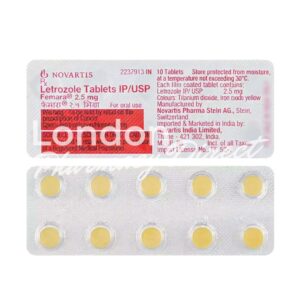
- Oral administration as 2.5 mg film‑coated tablets (blister packs or bottles).
- Letrozole reduces circulating oestrogen levels within about 24 hours; clinical or symptomatic benefits may take several weeks to become apparent.
- Plasma half‑life is approximately 2 days (around 48 hours); once‑daily dosing maintains aromatase inhibition and treatment is continued as clinically indicated.
- Avoid excessive alcohol — alcohol can worsen fatigue, hot flushes and may negatively affect bone health; discuss alcohol use with your physician.
- The most common side effect is hot flushes.
- Would you like to try Femara without a prescription?
Basic Femara information
- INN (international nonproprietary name): Letrozole
- Brand names available in the United Kingdom: Femara (2.5 mg tablets, 14 or 30 per pack)
- ATC code: L02BG04 — aromatase inhibitors
- Forms and dosages: Oral film-coated tablets 2.5 mg in blisters or bottles (7, 10, 14, 28, 30 or 100 tablets)
- Manufacturers in the United Kingdom: Novartis (originator) and licensed generics such as Sandoz
- Registration status in the United Kingdom: Prescription-only medicine (POM), licensed for hormone receptor-positive breast cancer in postmenopausal women
- OTC / Rx classification: Prescription-only medicine (POM). Letrozole/Femara is never available over the counter.
Everyday use and best practices
Morning vs evening dosing
Patients often ask whether to take Femara in the morning or evening.
The standard adult dose is 2.5 mg once daily, taken orally.
Choose a time you can reliably repeat every day to reduce missed doses.
Many UK patients take Femara in the morning as part of a pill‑box routine, alongside other daily medicines.
Some patients prefer an evening dose if hot flushes or sleep disturbance occur at night.
If a dose is missed, take it as soon as you remember unless it is nearly time for the next dose, in which case skip the missed dose.
Never double the dose to make up for a missed tablet.
Taking with or without meals (UK diet habits)
- Letrozole can be taken with or without food, so pair it with a regular UK breakfast habit such as toast and tea or with the evening meal.
- When taking multiple medicines, place Femara with other daily tablets in a labelled dosette box but keep the original blister in a dry place to protect from moisture.
- Store tablets below 30°C and avoid leaving blisters in bathrooms or hot cars during summer trips.
- For holiday plans or late shifts, link the dose to a fixed daily activity (for example, morning tea) to preserve routine.
Missed dose checklist
- If you remember soon after the missed time, take the tablet straight away.
- If it is almost time for the next dose, skip the missed tablet and take the next as scheduled.
- Do not take two tablets on the same day to make up for a missed dose.
Safety priorities
Who should avoid it (MHRA warnings)
Femara is prescription-only and is contraindicated in pre‑menopausal women.
Pregnancy and breastfeeding are absolute contraindications because of teratogenic risk.
Do not use letrozole for ovulation induction without specialist supervision.
Tell your GP or oncology team if your menopausal status is uncertain.
If you have known hypersensitivity to letrozole or any tablet excipients, stop treatment and seek immediate care for severe allergic symptoms.
Activities to limit (driving, work safety)
Letrozole can cause fatigue, dizziness or visual disturbance in some people.
Until you know how Femara affects you, avoid driving heavy machinery or safety‑critical work.
If joint pain or musculoskeletal symptoms affect mobility, contact occupational health or your GP to request workplace adjustments.
Keep a symptom diary noting fatigue, dizziness and pain to discuss at clinic reviews.
Contraindication checklist
- Pre‑menopausal women — do not use.
- Pregnancy and breastfeeding — do not use.
- Known allergy to letrozole or excipients — stop and seek help.
Dosage and adjustments
General regimen (NHS guidance)
The standard regimen for adults is letrozole 2.5 mg once daily by mouth.
This dosing applies for adjuvant therapy, first‑line treatment of advanced or metastatic disease, and extended adjuvant therapy.
Extended adjuvant therapy commonly totals five years and may be longer as advised by an oncologist.
Femara is prescription-only and typically dispensed in 14 or 30 tablet packs in the UK.
Special cases (elderly, comorbidities)
| Indication | Typical dose | Notes |
|---|---|---|
| Adjuvant (early breast cancer) | 2.5 mg once daily | Common course up to 5 years; monitor bone health. |
| Advanced/metastatic disease | 2.5 mg once daily | Continue until progression or unacceptable toxicity. |
| Extended adjuvant | 2.5 mg once daily | May be extended per specialist advice. |
Monitoring checklist
- No routine dose adjustment usually required for the elderly.
- Mild–moderate hepatic or renal impairment: standard dosing generally applies.
- Severe liver disease or creatinine clearance below 10 ml/min requires specialist review.
- Pre‑existing osteoporosis needs baseline DEXA and active bone protection (calcium, vitamin D, and bisphosphonates if indicated).
- Not indicated for children.
Legal status and availability in the UK
Femara is a prescription-only medicine (POM) in the UK.
In our online pharmacy, Femara is available without a prescription, with discreet delivery to the United Kingdom in 9–21 days.
What’s inside and how it works
Ingredients overview
- Active ingredient: letrozole (INN), 2.5 mg per tablet.
- Formulation: oral film‑coated tablets only; no injectable or topical forms are authorised for patients.
- Excipients vary by manufacturer; check the patient leaflet for allergy information.
- Storage: keep in original blister, protect from moisture and store below 30°C.
Mechanism basics explained simply
| ATC code | Drug class |
|---|---|
| L02BG04 | Aromatase inhibitor (non‑steroidal) |
Letrozole blocks the aromatase enzyme that converts androgens to oestrogens in postmenopausal women.
Lowered oestrogen levels reduce stimulation of oestrogen‑dependent (hormone receptor‑positive) breast cancer cells.
The result is reduced tumour growth signal and clinical benefit in the licensed indications.
Main indications
Approved uses (MHRA listing)
Letrozole is licensed for hormone receptor‑positive breast cancer in postmenopausal women.
Approved settings include adjuvant treatment for early breast cancer, first‑line therapy for advanced or metastatic disease, and extended adjuvant therapy commonly up to five years.
Typical adult dose across these indications is 2.5 mg once daily.
Off‑label uses in UK clinics
| Licensed indications | Off‑label use | Notes |
|---|---|---|
| Adjuvant and advanced breast cancer | Not applicable | Standard licensed use in postmenopausal women. |
| — | Fertility / ovulation induction | Occasional specialist off‑label use; must be under strict medical supervision and monitoring. |
Any off‑label prescribing should be discussed in detail with the treating clinician and documented with appropriate consent and monitoring.
Interaction warnings
Food interactions (alcohol, tea/coffee)
Letrozole has no major food interactions and can be taken with or without meals.
Advise moderation of alcohol because it can worsen fatigue and hot flushes.
Caffeine from tea or coffee may aggravate palpitations or sleep disturbance and could indirectly worsen side effects such as anxiety or insomnia.
Drug conflicts
Letrozole is metabolised by hepatic pathways and may be affected by potent CYP450 inducers or inhibitors.
Flag concomitant drugs such as some anticonvulsants, strong CYP inducers or inhibitors, and review statins and anticoagulants with the prescriber as needed.
Report suspected interactions or adverse drug reactions via the MHRA Yellow Card scheme.
| Action | Where to report |
|---|---|
| Suspected side effect or interaction | MHRA Yellow Card Scheme and inform your oncology team or pharmacist. |
Alternative choices
NHS prescribing alternatives
Alternatives available on the NHS include other aromatase inhibitors such as anastrozole and exemestane, and the SERM tamoxifen in appropriate contexts.
- Anastrozole — similar efficacy to letrozole; consider if tolerability differs.
- Exemestane — steroidal aromatase inactivator; may be chosen for individual patient characteristics.
- Tamoxifen — used in pre‑ or perimenopausal women and where bone density preservation is a priority.
Practical switching advice
Switching between aromatase inhibitors is arranged by oncology teams and documented in shared‑care letters.
A washout period is not routinely required unless specified by a specialist.
After a switch, monitor symptoms closely and consider repeat DEXA scanning if bone risk is present.
Ensure clear prescription documentation to avoid gaps in supply at community pharmacies.
Regulation snapshot
MHRA approval and NHS prescribing framework
Letrozole (Femara) is authorised in the UK and used within MHRA and NHS oncology frameworks for postmenopausal hormone receptor‑positive breast cancer.
Specialist units normally initiate therapy with possible shared‑care follow‑up arranged with GPs.
The product is prescription‑only and supplied as 2.5 mg film‑coated tablets.
Generics and patient rights
Generics from manufacturers such as Sandoz are available in the UK; always check product labelling and ensure authorised supply chains.
Patient rights checklist
- Ask for written information and the patient leaflet when the medicine is dispensed.
- Expect explanation of why letrozole is being prescribed and what monitoring will be done.
- Request a shared‑care letter or care plan summarising who manages prescriptions and monitoring.
Frequently asked questions
Common UK patient questions
- Can I drive on Femara? — Usually yes; avoid driving until you know whether fatigue or dizziness occurs.
- Will it affect my bones? — Aromatase inhibitors can reduce bone density; baseline DEXA and calcium/vitamin D and possible bisphosphonate therapy may be advised.
- Can I take it with other medicines? — Check with your pharmacist or GP about potential CYP interactions; report suspected problems via the MHRA Yellow Card.
- Is it prescribed on the NHS? — Yes, when clinically appropriate for its licensed indications.
How to report side effects and where to get support
Report adverse effects to your oncology team and consider submitting a report to the MHRA Yellow Card scheme for national pharmacovigilance.
For emotional or practical support, contact NHS Macmillan services and local cancer support centres.
Your local community pharmacist can provide advice about drug interactions, side‑effect management and where to seek urgent care.
Guidelines for proper use
UK pharmacist counselling style
Pharmacists should confirm the indication and menopausal status and check for contraindications such as pregnancy or pre‑menopausal status.
Review concomitant medicines for interactions and advise on bone health monitoring, including DEXA scans and supplements where appropriate.
Provide the patient leaflet and reinforce missed‑dose and overdose guidance: take a missed dose when remembered unless it is almost time for the next dose, and in the event of overdose provide supportive care and monitoring.
NHS patient support advice
Advise patients on lifestyle measures to protect bone and cardiovascular health: regular weight‑bearing exercise, smoking cessation, a balanced diet and alcohol moderation.
Encourage patients to record new symptoms such as arthralgia, persistent fatigue or mood changes and to contact their oncology team or GP promptly for concerning issues.
Recommend reporting adverse effects to the MHRA Yellow Card scheme and using local support groups for practical and emotional help.
Delivery across the United Kingdom
| City | Region | Delivery Time |
|---|---|---|
| London | Greater London | 9–21 days |
| Birmingham | West Midlands | 9–21 days |
| Manchester | Greater Manchester | 9–21 days |
| Glasgow | Scotland | 9–21 days |
| Leeds | West Yorkshire | 9–21 days |
| Edinburgh | Scotland | 9–21 days |
| Bristol | South West England | 9–21 days |
| Liverpool | Merseyside | 9–21 days |
| Newcastle Upon Tyne | North East England | 9–21 days |
| Sheffield | South Yorkshire | 9–21 days |
| Cardiff | Wales | 9–21 days |
| Belfast | Northern Ireland | 9–21 days |
| Norwich | East of England | 9–21 days |