Tetracycline
In brief
- In our pharmacy, you can buy tetracycline without a prescription, with delivery in 9–21 days throughout the United Kingdom. Discreet and anonymous packaging.
- Tetracycline is a broad‑spectrum antibiotic used for respiratory, urinary, skin (including acne) and certain sexually transmitted infections; it is bacteriostatic and works by inhibiting bacterial protein synthesis via binding the 30S ribosomal subunit.
- The usual adult dose is 250–500 mg orally every 6 hours for many systemic infections; acne is usually treated with 500 mg twice daily.
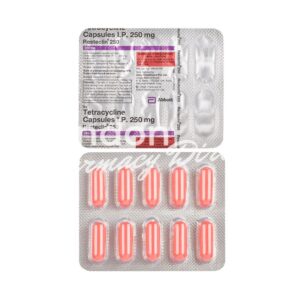
- Administration form: oral tablets (250 mg).
- Antibacterial activity begins after absorption (typically within 1–2 hours); clinical improvement for infections is often seen within 24–72 hours, though acne and chronic conditions may take weeks.
- Duration of action is generally around 6–12 hours per dose, which is why many systemic regimens use dosing every 6–12 hours depending on the indication.
- Avoid or limit alcohol while taking tetracycline, as alcohol can worsen gastrointestinal side effects and increase strain on the liver; also follow guidance on sun exposure due to photosensitivity.
- The most common side effect is gastrointestinal upset (nausea, vomiting, diarrhoea); other frequent effects include photosensitivity and tooth/discolouration in children.
- Would you like to try tetracycline without a prescription?
Basic tetracycline information
- INN (international nonproprietary name): Tetracycline
- Brand names available in the United Kingdom: supplied as generic tetracycline tablets
- ATC code: J01AA07
- Forms and dosages: Tablets 250 mg
- Registration status in the United Kingdom: Prescription-only medicine (POM)
- OTC / Rx classification: Prescription-only medicine (POM)
Instructions, warnings and daily-life integration (UK patients)
Worried about whether tetracycline is safe for you or how it fits into everyday life?
Read the prescription and dispensing label carefully and follow NHS or GP instructions exactly.
Store tetracycline at 15–25°C and keep it away from moisture and light.
Dispose of expired tetracycline, because it has been linked to Fanconi‑like syndrome.
Tetracycline is a prescription-only medicine (POM) in the UK.
Avoid tetracycline during pregnancy and breastfeeding, and do not give it to children under eight years because of permanent tooth discolouration and enamel effects.
Always take tablets or capsules with plenty of water and do not lie down straight after dosing to reduce oesophageal irritation.
Avoid dairy products, iron supplements, calcium, magnesium or antacid preparations within two hours of a dose to preserve absorption.
Check with your pharmacist, or call NHS 111, if you have questions about your medicine.
If you work outdoors, plan sun protection because tetracycline commonly causes photosensitivity.
Everyday use and best practices
Morning vs evening dosing
Many people ask whether to take tetracycline in the morning or evening.
The priority is consistent spacing rather than exact clock times.
Standard systemic regimens commonly use 250–500 mg every six hours or as directed by your prescriber.
Acne regimens are usually 500 mg twice daily and are therefore taken morning and evening.
If your schedule is a typical working day, split doses into morning, midday, early evening and bedtime where required.
If your job involves manual labour or heavy lifting, avoid taking a dose immediately before the start of a shift to reduce the chance of gastrointestinal upset.
Taking with or without meals (UK diet habits)
Absorption of tetracycline is reduced by dairy, antacids and minerals, so avoid taking it with milk, tea containing milk or iron supplements.
Take tablets with a full glass of plain water and wait two hours before eating a breakfast that includes milk or a dairy‑heavy tea.
A light non-dairy snack can help reduce nausea while keeping absorption reasonable.
Set phone alarms and keep a simple checklist or dosing table on the medicine pack to maintain adherence.
- Practical dosing example: 250–500 mg every six hours for many infections; 500 mg twice daily commonly used for acne.
- Tip: keep a dosing table on the fridge if more than one household member is taking medicines.
Safety priorities
Who should avoid it (MHRA warnings)
Absolute contraindications include known hypersensitivity to tetracyclines, pregnancy, breastfeeding and children under eight years.
Use caution with renal or hepatic impairment; dose adjustment or an alternative antibiotic may be needed.
Patients on systemic retinoids should not combine them with tetracyclines because of the risk of intracranial hypertension.
Activities to limit (driving, work safety)
Tetracycline can cause dizziness or vertigo in some people.
If you feel dizzy, do not drive or operate heavy machinery until you know how the medicine affects you.
Photosensitivity is common—avoid prolonged sun exposure, wear protective clothing and use SPF 30+ sunscreen during treatment.
- Red flags — stop and call your GP or pharmacy:
- Severe rash, swelling of the face or throat, or difficulty breathing.
- Severe diarrhoea or persistent abdominal pain.
- Jaundice, dark urine or unexplained bleeding.
- Sudden severe headache with visual disturbance (seek urgent care for possible intracranial hypertension).
Dosage and adjustments
General regimen (NHS guidance)
Follow the prescriber’s instructions; common adult regimens are 250–500 mg every six hours for uncomplicated infections.
For acne, 500 mg twice daily is usually used, often alongside topical treatments.
Severe infections may be treated with 500 mg every 6 to 12 hours as indicated by specialist advice.
Special cases (elderly, comorbidities)
Children under eight are usually excluded due to dental and bone toxicity; if life‑threatening infections require tetracycline, dose by weight at roughly 25–50 mg/kg/day divided every six hours.
Elderly patients commonly use standard dosing, but renal or hepatic impairment may require dose reduction or an alternative agent.
If vomiting occurs soon after a dose, take the next dose at the usual time and do not double up.
| Indication | Typical adult dose | Typical duration |
|---|---|---|
| Uncomplicated respiratory, urinary and chlamydial infections | 250–500 mg every 6 hours | 7–14 days |
| Acne vulgaris | 500 mg twice daily | Weeks to months (reassess at intervals) |
| Trachoma, psittacosis, Q fever | 500 mg every 6–12 hours | Varies with condition; guided by specialist |
Missed dose: take it as soon as remembered unless it is near the time for the next dose; do not double dose.
Legal status and availability in the UK
Tetracycline is a prescription-only medicine (POM) in the UK.
In our online pharmacy, tetracycline is available without a prescription, with discreet delivery to the United Kingdom in 9–21 days.
What’s inside and how it works
Ingredients overview
The active substance is tetracycline (INN), supplied as 250 mg tablets.
Excipients vary between manufacturers; patients with lactose or other excipient sensitivities should check the patient information leaflet or ask the dispensing pharmacist.
Mechanism basics explained simply
Tetracycline binds bacterial ribosomes and blocks protein production, stopping bacterial growth.
Because it prevents bacterial multiplication it is classified as bacteriostatic rather than bactericidal in many situations.
The drug is broad-spectrum with activity against a range of Gram-positive and Gram-negative organisms, and it has been used historically as an alternative in penicillin allergy cases.
- Form and uses: oral tablets for infections and acne.
Main indications
Approved uses (MHRA listing)
Tetracycline is used for uncomplicated respiratory and urinary tract infections, certain sexually transmitted infections such as chlamydia, acne and specific infections like trachoma, psittacosis and Q fever.
Dosing is condition-dependent, commonly 250–500 mg every 6 hours for many infections and 500 mg twice daily for acne.
Off-label uses in UK clinics
In some dermatology settings tetracycline is used when first-line agents are unsuitable or for historical formulations retained in local formularies.
| Indication | Common oral dose | Typical duration | NHS pathway note |
|---|---|---|---|
| Chlamydia | 500 mg every 6 hours (regimens vary) | 7–14 days depending on site | Follow local sexual health clinic guidance |
| Acne | 500 mg twice daily | Weeks to months with regular review | Consider topical combination and dermatology referral if no response |
| Psittacosis/Trachoma | 500 mg every 6–12 hours | As per specialist advice | Hospital or specialist-managed treatment |
Interaction warnings
Food interactions (alcohol, tea/coffee)
Avoid calcium, magnesium, iron, dairy and antacids within two hours of taking tetracycline because these minerals significantly reduce absorption.
Alcohol does not directly reduce antibiotic efficacy but may worsen side effects such as nausea and contributes to liver strain.
Avoid taking tablets with tea or coffee that contains milk; use plain water instead.
Drug conflicts
Notable drug interactions include systemic retinoids, which raise the risk of intracranial hypertension, and some anticoagulants where monitoring may be needed.
Methoxyflurane and certain other drugs have serious interaction potential and should be avoided.
If you experience suspected adverse drug reactions, report them via the MHRA Yellow Card scheme and seek pharmacist advice at dispensing.
| Avoid within 2 hours | Examples |
|---|---|
| Mineral-rich foods and preparations | Milk, calcium supplements, iron tablets, magnesium-containing antacids |
| At-risk drug combinations | Systemic retinoids, certain anticoagulants, methoxyflurane |
Alternative choices
NHS prescribing alternatives
Common NHS alternatives include doxycycline and minocycline among tetracyclines, macrolides such as azithromycin and erythromycin, clindamycin for some skin infections, and fluoroquinolones for specific systemic infections when indicated.
| Alternative | Pros | Cons |
|---|---|---|
| Doxycycline | Once-daily dosing, generally better GI tolerability | Photosensitivity still a risk; not for pregnancy or young children |
| Minocycline | More lipophilic and sometimes better for inflammatory acne | Risk of pigmentation and other rare adverse effects |
| Azithromycin/Erythromycin | Useful for penicillin allergy or some atypical infections | Macrolide resistance and different side-effect profile |
When to ask for a switch (tolerability, resistance)
Consider asking your GP for a switch if you experience severe side effects, have trouble adhering to dosing frequency, or laboratory results show resistance.
Discuss efficacy for your specific condition, pregnancy or breastfeeding status and local susceptibility patterns before changing therapy.
Regulation snapshot
MHRA approval and NHS prescribing framework
Tetracycline is an established antibiotic and a prescription-only medicine (POM) in the UK.
The ATC classification for systemic tetracyclines is J01AA07.
NHS prescribing follows antimicrobial stewardship and local formularies; prescribers must consider indication and resistance patterns when choosing tetracycline.
Prescription rules and pharmacy roles
Pharmacists check interactions and provide counselling.
Report supply issues or adverse events using MHRA channels and seek advice at your local pharmacy if in doubt about interactions or storage.
- Prescriber/pharmacist checklist: legal status, counselling points, interaction check, pregnancy/child checks, storage advice (15–25°C), and expiry warnings.
FAQ
Common UK patient questions
Can I take tetracycline with milk or tea?
No—avoid dairy, calcium, iron or antacid products within two hours of dosing to preserve absorption.
Is tetracycline safe in pregnancy?
No—tetracycline is contraindicated in pregnancy and breastfeeding due to fetal and infant risks including tooth discolouration.
What should I do if I miss a dose?
Take the missed dose as soon as you remember unless it is close to the next scheduled dose; do not double up.
How long until it works for acne?
Oral therapy often takes several weeks to show clear improvement; reassess with a GP or dermatologist if there is no improvement after 6–12 weeks.
Who to call:
- GP for prescription changes or severe side effects.
- Pharmacist for dosing, interactions and minor side-effect advice.
- NHS 111 for out-of-hours triage.
| Situation | Action |
|---|---|
| Missed dose | Take when remembered unless near next dose; do not double-up |
| Suspected overdose | Seek urgent medical attention; symptomatic and supportive care |
Guidelines for proper use
UK pharmacist counselling style
Expect your pharmacist to confirm the indication and check you are not pregnant and are over eight years old before dispensing.
They will review your medicines for interactions such as antacids, retinoids and anticoagulants and will advise on dosing and food interactions.
Pharmacists will warn about photosensitivity, recommend sun protection and explain storage at 15–25°C away from moisture.
NHS patient support advice
Ask for written patient information leaflets and follow local antimicrobial guidance provided by the NHS.
Use NHS 111 for urgent questions and schedule follow-up appointments for long courses like acne treatment.
- Pharmacist counselling checklist: indication, contraception/pregnancy check, child age check, interactions, dosing schedule, storage, and when to seek urgent care.
Patient one-page leaflet template:
- Name of medicine and strength.
- Dosage schedule and missed-dose advice.
- Key interactions and foods to avoid within two hours.
- Photosensitivity and sun-safety advice.
- Storage and expiry warnings (do not use expired tetracycline).
- Contact details for GP, local pharmacy and NHS 111.
Delivery across the United Kingdom
| City | Region | Delivery Time |
|---|---|---|
| London | England | 5 days |
| Birmingham | England | 5 days |
| Manchester | England | 5 days |
| Glasgow | Scotland | 5 days |
| Leeds | England | 6 days |
| Sheffield | England | 6 days |
| Liverpool | England | 6 days |
| Bristol | England | 7 days |
| Newcastle Upon Tyne | England | 7 days |
| Edinburgh | Scotland | 5 days |
| Cardiff | Wales | 7 days |
| Belfast | Northern Ireland | 5 days |
| Nottingham | England | 8 days |